
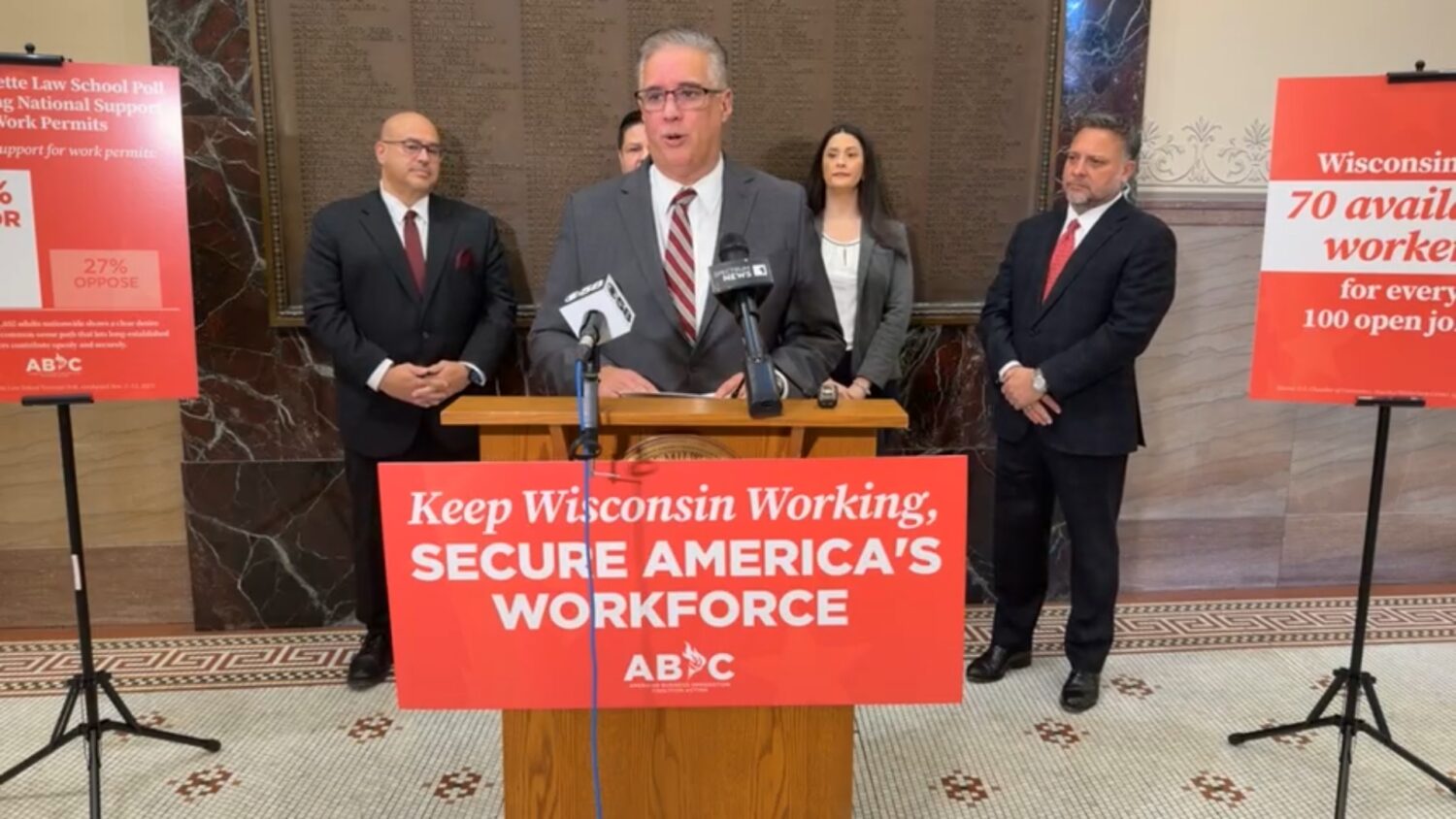
Leaders in Milwaukee urged Congress and the Trump Administration to provide work permits for long-term, law-abiding immigrants and citizenship for Dreamers after a recent poll from Marquette Law School showed the majority of Americans support reforms in issuing permits.
On Dec. 11, the American Business Immigration Coalition (ABIC), Comitté de 100, Latino Chamber of Commerce of Southeast Wisconsin and other business leaders hosted a press conference at Milwaukee City Hall in downtown Milwaukee. The press conference urged reforms in the immigration system and how it impacts Wisconsin’s already shrinking workforce as it struggles to attract and retain talent in multiple sectors of business.
“Let’s begin by looking at the numbers. In 1960, Wisconsin’s fertility rate was 4.1; in 2020, it had fallen to 1.6. To maintain a population not counting on immigration, you need a fertility rate. We’re far below that threshold,” said Darrly Morin, president and CEO of Advanced Wireless Inc., and Comité de 100 state captain.
While fertility rates have fallen, Morin also noted the state’s unemployment rate of 3.1%. The rate contrasts with the number of available jobs with a 7-to-10 ratio for every 10 positions open, seven unemployed individuals are looking for a job. That translates to more than 32,500 jobs short if every unemployed person in Wisconsin gains employment.
The figures coincide with economic constraints in Wisconsin, Morin said. The state has an ample population of workers, but employers are looking elsewhere, as many without proper work authorization are unable to fill job openings.
“It means employers are competing, not only the companies and organizations from other states, but from other countries where they have more labor available,” Morin said. “It’s time for us to… start implementing solutions.”
Morin cited a November study from Marquette Law School looking at broad public opinion to give work permits to immigrants in the United States legally.
Results show that an overwhelming majority of respondents, both Democrat and Republican, support granting work permits to immigrants who have been in the U.S. legally for at least five years, have jobs and no criminal record.
Data shows 72% in favor — 89% of Democrats and 66% of Republicans. Morin and others urge Congress to take action.
“We have to return to a shared set of principles. One of these must be that the idea of hard work should be encouraged and rewarded“, said Milwaukee Alderman José Perez, D-12. “These aren’t handouts and little things. This is not a government subsidy. We are talking about an honest day’s work for an honest day’s pay.”
Perez highlights how many immigrants are paying into U.S. systems without being able to receive any benefits. The most recent study from the Institute on Taxation and Economic Policy showed that in 2022, undocumented immigrants paid $96.7 billion in federal, state and local taxes.
Immigrants, particularly Latinos, as discussed in the press conference, are an economic driver — but not when they cannot obtain work permits, said Nelson Soler, president and CEO of the Latino Chamber of Commerce of Southeast Wisconsin.
Those without work permits cannot fully participate in the economy. The result leads to an increase in prices and gaps in job availability from slowed growth, Soler said.
“Employers in industries such as construction, hospitality, manufacturing and childcare report persistent workforce shortages,” Soler said. “These shortages slow economic growth and limit the ability of businesses, large and small, to be in demand. Those who have lived in our community for years, including Dreamers and long-term workers, are ready and willing to contribute more fully.”
Changes the organizations want to see fall within the spectrum of popular opinion from the Marquette Law School poll.
Chiefly, they want to see a better and clearer pathway for those already here to obtain work permits while still keeping the Southern border secured.