Continued efforts to create a task force for missing and murdered African American women and girls hit the Committee on Mental Health, Substance Abuse Prevention, Children and Families.
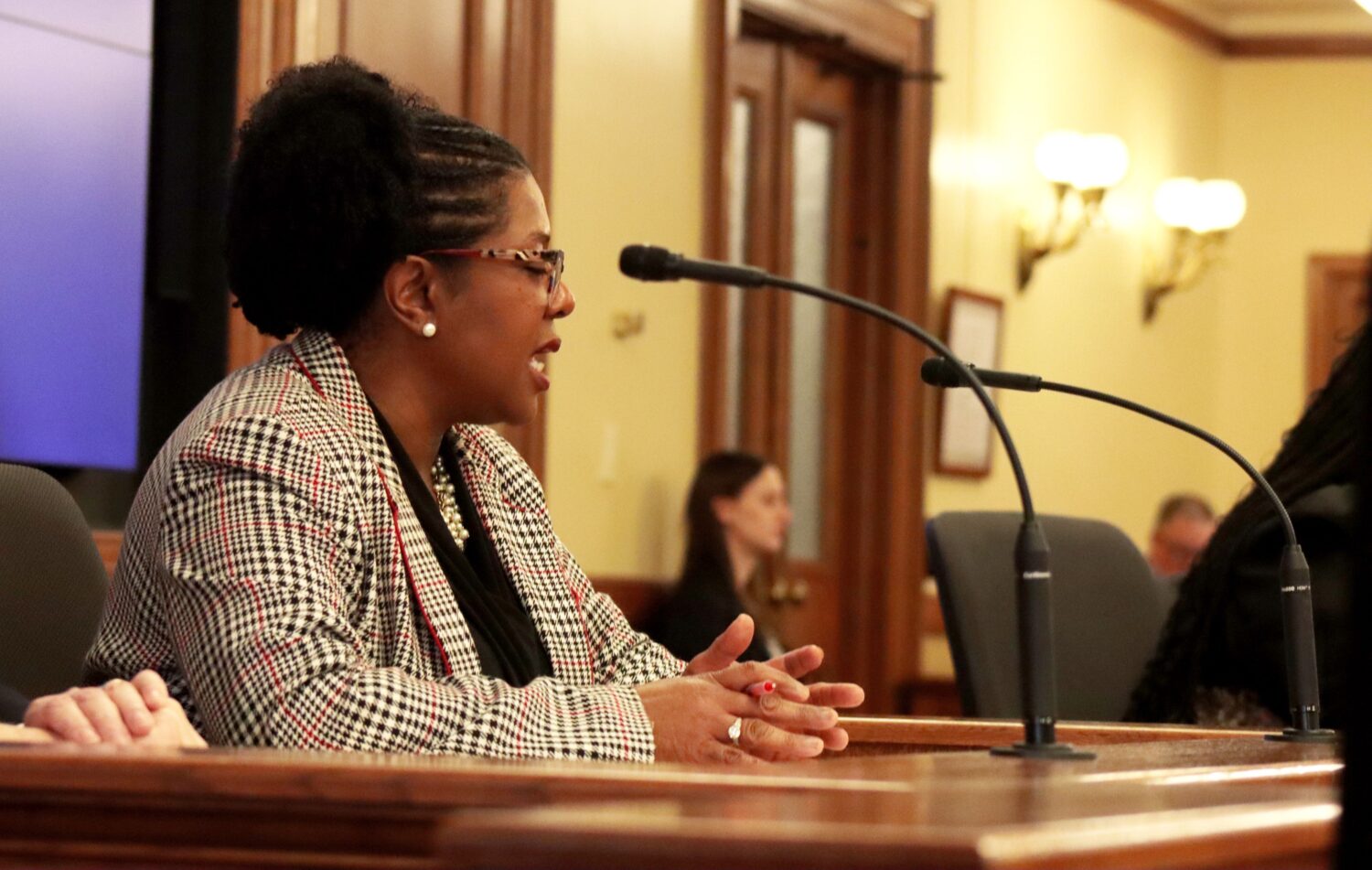
State Rep. Shelia Stubbs, Assembly District 78, other elected officials, community members and families of murdered and missing African American girls and women pleaded to finally create a task force to help combat the issue on Dec. 16 at the Wisconsin State Capitol. The case to create the Task Force on Missing and Murdered African American Women and Girls has been a consistent mission of Stubbs since 2021, where no results have been made. Now, she’s back to push for the task force for the third time with high hopes.
“Wisconsin, the state that I love, the state that I live in, the state where I’m raising my family, had the highest homicide rate for African American women and girls in the entire United States,” Stubbs said.
Wisconsin sits as the state with the highest rate for missing and murdered African American women and girls. The current rate released in 2020 is 20.2 out of 100,000 — double the rate from the previous reported figure of 10.1 out of 100,000, The Guardian reported.
The task force would take measures to support victims and their families, collect data on the issue, identify the key structural causes behind the issue and recommend policy.
Neighboring states like Minnesota and Illinois have already created their own measures to investigate and prevent the disproportionate levels of violence through their own respective task forces. It’s time for Wisconsin to take its own action to do the same, Stubbs said.
“The momentum across this nation for this legislation is growing because the people of Wisconsin have realized the magnitude of this issue,” Stubbs said. “The people of Wisconsin have realized that we cannot wait one more time for another African American woman and girl to go missing or be murdered. The people of Wisconsin have realized that no community is safe, until every community is safe.”
Tanesha Howard, mother of Joniah Walker, came to the hearing where Stubbs read a testimony from her.
Howard’s daughter went missing on June 23, 2022. She called the police, and was told to go to her local station in Milwaukee due to Walker’s age. Ploce told her that Walker — who was 15-years-old — was not a child or teenager so they couldn’t classify her as critically missing.
“They refused to ping her phone. They refused to issue an Amber Alert to allow the community to help search for her,” Stubbs said reading Howard’s statement. “They were telling me that Joniah did not fit the requirement for anything.”
Howard had to take much of efforts into her own hands by speaking to the FBI, organizations and the community. Milwaukee Police did not list Walker as critically missing for over six months after a detective finally spoke with Howard and collected DNA.
“It’s a shame that we Black people in this American society in 2025 have to fight for every right that is given privilege for people in general, especially white Americans. We should not have to fight for a right for our beloved ones to be searched for based on color of their skin,” Howard’s statement read.
The mother of Sade Robinson, Sheena Scarbrough, gave a similar testament as Howard. Her daughter was a 19-year-old college student when she went missing on April 2, 2024. Scarbrough is fighting to make sure what happened to her daughter never happens again.
“Why did it have to get to the point where my daughter’s not here? I don’t get to see her. I don’t get to talk to her,” Scarbrough said. “When things like this happen and your child does go missing, the protocol for, the way things took to search for her, and certain things, they move very slower than what they would have moved for a white girl.”
(Photo by Omar Waheed)
Surgical precision is needed to address the problem, Madison’s Police Chief said
City of Madison Police Chief John Patterson stands behind creating the task force. The violence against African American women and girls is an important truth that needs to be addressed, Patterson said.
He notes how changes in how police work is approached can garner results. Patterson pointed to the 1994 murder of 40-year-old Lula Cunningham in Madison that went unsolved for decades. Advancements in DNA technology and a renewed focus on the investigation made solving the case possible.
“We know firsthand the consequences when violence against African American women goes unresolved,” Patterson said. “Lula Cunningham’s case reminds me of two things. First, justice is too often delayed or never realized for African American women and girls, and profound delays create profound challenges when it goes to trial, if it goes to trial, and second, when systems improve, when data is tracked, when voices are heard and when resources are fully committed, Justice becomes a possibility.”
Senator Van Wanggaard, Senate District 21, who sits on the committee, questioned the need for a task force purely dedicated towards missing and murdered African American women and girls. He pushed for lumping in a task force for all marginalized groups — particularly Indigenous and Hmong — into one instead of a focused group.
There already exists a task force for Indigenous women, and organizations like the Hmong American Women’s Association that tackle the issue. Wanggaard did not know this prior to his question. When informed, wandered still pushed for a larger group instead of focused task forces.
Patterson does not believe a larger task force makes sense. Instead, he urged that “we shouldn’t be afraid to be surgical at times.” If task forces do become some larger group, it should happen organically, Patterson said.
“In my almost three decades, I can tell you work that started off being very focused and surgical in nature to try to address a disparate impact in our community has led to greater communication, greater collaboration across all communities,” Patterson said. “I think that could happen organically over time with this type of work while addressing this set of disparate outcomes that we’re seeing currently in our state.”
Stubbs remains hopeful that the task force will be created. More voices have joined the fight and the hearing was assigned to the correct committee this time.
“They always say the third time’s the charm. Let me see what that feels like,” Stubbs said. “The third time’s the charm. There’s absolutely no reason why this bill is not law.”
Next steps for the bill is to have the bill pop up on the committee and it gets voted on. Stubbs is already talking to Sen. Jesse James, District 23, who heads the committee, and is working towards getting it on the Senate calendar. She plans to keep the public updated on how the bill proceeds.