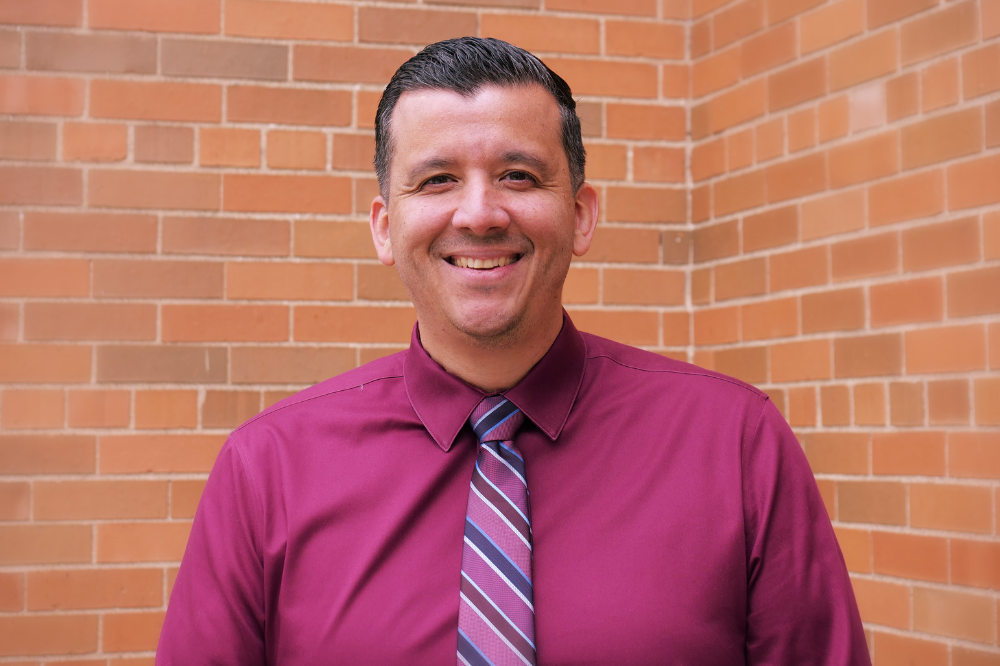
“K-12, to me, is where the magic is,” said Dr. Louis Macias, who is returning to secondary education as the assistant principal at Vel Phillips Memorial High School after spending more than a decade in higher education.
A longtime educator originally from Florida, Macias began his career as a social studies teacher before moving into positions in higher education, where much of his work centered on diversity, equity and inclusion. Although the idea of returning to his roots in K-12 education had remained in the back of his mind, he wasn’t sure whether the opportunity would ever come.
Now, Macias is back in the space he says he has always been drawn to, beginning the upcoming academic year as assistant principal at Vel Phillips Memorial High School.
“It was always one of those things where, if I wasn’t in higher education, it [K-12] was a top consideration. If I ever left higher ed, at that point I had gotten into senior-level roles, at some point you begin to wonder, ‘Has this ship sailed? Is it practical at this point?’” Macias said. “But the universe has a funny way of working.”
Part of his hang-up was his time away from K-12 education and having last done it in Florida. His last time teaching in K-12 was 2010 in Tallahassee, Florida as a social studies teacher.
Macias moved into higher education in 2011 at Florida State University as an academic success coach and adjunct instructor. He later went on to Florida International University as an associate instructor and assistant director of multicultural programs and services. His last time as an instructor was in 2015.
Macias moved to the Midwest in 2013 in the Urbana-Champaign Area. He remained there for less than two years before moving to Madison to head UW’s School of Business’s pre-college program. He popped around multiple areas at UW, largely in student success and DEI, until Oct. 2025 — around when the university started to scale back DEI initiatives and programs.
He took the chance to jump back into K-12 as the Interim Dean of Students at Middleton High School in early 2026.
“When the opportunity presented itself, I was more than happy to go that route again,” Macias said. “It was so formative for me as a professional being in this space and being a teacher and being in a classroom and understanding the impact we have as educators.”
Education has been a long passion for Macias, but it wasn’t what he initially set out to do. His “origin story,” Macias describes it, started at 10-years-old when the school started tracking student potential outcomes. Macias was picked as unlikely to graduate high school.
“I’ve shared in other stops along my career that I’ve experienced the best and worst that education has to offer,” Macias said. “I’ve experienced what it’s been like to be labeled as someone who was not expected to graduate high school. I’ve also experienced the opposite. I’ve experienced what a transformative teacher is, what type of impact a person like that can make on your life.”
Still, Macias pursued psychology in college. He planned to go into clinical psychology but “lost the flavor for it,” he said. He was involved with research in his undergrad on children with ADHD.
“I think that work is really important, and the people that do it, I think, are doing really consequential work. But it just felt impractical to me,” Macias said.
Studying problems instead of being involved with fixing them and being closer to solutions for children didn’t feel like where Macias wanted to be. During that same time, he did a lot of volunteering at schools in mentorship programs.
One day, someone asked Macias if he ever thought about teaching — which he never had at that point. Six months later, he found himself as a social studies teacher in Miami.
“I fell in love with it, so I ended up teaching for about eight years at the middle and high school levels in Florida,” Macias said.
Macias’s educational philosophy has evolved over the years. He believes that good intentions alone do not necessarily lead to positive outcomes for students. Instead, meaningful change requires the hard work of aligning values with purpose and ensuring that decisions and actions have the greatest possible positive impact on students and their families.
Macias often reflects on a quote from Nelson Mandela that he has displayed in his offices for years: “A good head and a good heart are always a formidable combination.”
For Macias, the quote speaks directly to his educational philosophy. He believes educators cannot rely solely on intellect or compassion; both are essential. “If you’re all head and no heart, or vice versa, you will miss something vital to the work being done,” he said.
Now that he is back in K-12 education, Macias has noticed significant changes. He has been encouraged to see students unapologetically being themselves while engaging in conversations about equity, disparate outcomes, access, and the difference between impact and intent—concepts that he says he personally struggled to understand for years.
“What if every one of our students just came and were allowed to become the best of who they are,” Macias said. “Dr. Gothard actually spoke to it the other day, talking about students having the opportunity to be the best versions of themselves. That’s something that was very alluring to me.”
Hearing Dr. Gothard and seeing how kids are in schools now compared to when he was last in the space helped Macias to know that this is where he is supposed to be.
Macias is excited for the start of his first full academic year back in K-12. He was around for the summer, but that doesn’t allow him to see as many students, families and faculty.
“I think when we talk about the difference between higher ed at K-12, the volume on that, the proximity to the purpose, proximity to mission, is the volume is so much louder at this level,” Macias said. “For me, [it’s] incredibly exciting and something that I think has and will certainly feed me professionally in a way that I’m excited about.”