I was supposed to be writing about where Black people go in Madison at night.
Then Madison police shot and killed Corey Ruiz in broad daylight.
Since then, this city has been forced to look at itself.
We have seen press conferences overwhelmed by people carrying political ambitions into a family’s grief. We have seen protests that were somehow organized and unorganized at the same time. We have seen community members compete for microphones, recognition and positions of visibility.
We have also watched an encampment become one of the clearest examples of community care this city has seen in years. People have fed one another. They have redirected traffic. They have de-escalated tense encounters. They have created a safe space for unhoused people. They have made room for grief, anger and frustration over a system that seems content to continue producing these outcomes.
Madison has been thrust onto a national stage. At times, we have been an embarrassment. At others, we have shown the country what becomes possible when ordinary people collectively decide to keep one another safe.
People keep asking the same questions.
Where are the leaders? What are the demands? Why do so many of the demands stop at the final moments of Corey’s life? Why has this become so political? Why has the conflict surrounding the Office of the Independent Police Monitor (OIPM) and members of the Common Council consumed so much attention while poverty, housing instability and the criminalization of poverty remain largely unaddressed?
Why has the officer who killed Corey Ruiz not been arrested?
Those questions deserve serious answers.
They also reveal our larger problem.
We are grieving without a map.
A leaderless movement still needs structure
Leaderless movements can fill streets. They can gather people quickly. They create space for new voices and make it harder for one politician, organization or personality to claim ownership of the cause.
They can also become a car with 20 people grabbing for the steering wheel.
Everybody thinks they know where we are going. Nobody agrees on the route. Then anyone who asks for a map is accused of trying to take over the car.
When no one is responsible for establishing the facts, everyone becomes their own expert. When no one is responsible for strategy, every idea becomes a demand. When no one is responsible for communication, the loudest person becomes the temporary spokesperson.
When no one is responsible for accountability, people can use the movement to build their profiles, advance their organizations or feed their political ambitions. They never have to answer to the people whose grief placed them in front of the camera.
You cannot tell people who think they know everything anything at all.
A correction becomes disrespect. A question becomes opposition. Experience becomes elitism. Knowledge of government becomes evidence that someone has stopped dreaming big enough.
That is dangerous.
Leadership does not require one person standing above everybody else. Leadership requires structure. It requires roles. It requires shared facts. It requires people who can organize, people who understand government and people with enough humility to admit when they do not know something.
The community has leaders. They are serving food at the encampment. They are protecting protesters. They are redirecting traffic. They are speaking to the media. They are comforting Corey’s family. They are researching the law. They are trying to move grief toward action.
Corey Ruiz’s name cannot become a ladder for anyone’s campaign, organization, career or social-media following.
No person owns this moment.
No organization owns this grief.
Political ambition cannot be allowed to swallow the reason people gathered in the first place.
Madison does not need another person grabbing a microphone and announcing that they are in charge.
We need a table.
Corey’s family should have a place at it. So should representatives from the encampment, protest marshals, civil-rights attorneys, housing and harm-reduction workers, youth representatives, faith leaders, civilian-oversight advocates and organizers from the groups currently mobilizing.
The assignment should be clear.
Consolidate the demands. Identify the person and government responsible for each one. Separate what can happen now from what requires a new budget or state law. Set deadlines. Publish updates. Correct misinformation.
Give the public one reliable place to understand what has happened, what remains unknown and what must happen next.
Every demand needs an address
Yesterday, I told the organizer of a protest that she could demand that I give her the moon.
She could repeat the demand. She could put it on a sign. She could gather hundreds of people outside my home and shout it through a bullhorn.
I still could not give her the moon.
It is not within my power.
She told me that people had called things impossible before, and those things eventually happened. I understand the sentiment. Black people would still be sitting at segregated lunch counters if our ancestors had accepted every limitation placed before them. Women would not have the vote. Workers would not have basic protections. Gay people would still be denied the right to marry.
Every movement for justice has been told that its demands were impossible.
Those movements succeeded because people did more than make demands. They studied the systems they intended to change. They learned who controlled the buses, who wrote the ordinances, who appropriated the money, who interpreted the Constitution and who possessed the authority to act.
Then they organized enough power to force those people to act.
Government is a building with many locked doors. The mayor has keys to some of them. The Common Council has keys to others. The county executive has a different set. The district attorney has his own hallway. The Wisconsin Department of Justice is in another building entirely.
Screaming at the wrong door will not make it open.
That does not mean we accept injustice. It means we find the right door and apply pressure until it opens.
The mayor cannot order the Wisconsin Department of Justice to open its investigative files. The Common Council cannot order the district attorney to prosecute. The Office of the Independent Police Monitor cannot discipline an officer or command a state agency. Dane County cannot expand a municipal program across the county without building and funding a structure capable of operating it.
Madison also cannot substantially reduce police services without confronting a state law designed to protect those services.
These limitations do not excuse inaction. They tell us where the next fight belongs.
Dream as large as the moon.
Then figure out who controls the rocket.
Why hasn’t the officer been arrested?
The mayor cannot order an arrest.
The Common Council cannot order an arrest.
The Police Civilian Oversight Board cannot order an arrest.
The Office of the Independent Police Monitor (OIPM) cannot order an arrest.
Wisconsin law requires an officer-involved death to be investigated by at least two investigators who do not work for the agency employing the involved officer. Those investigators must provide a complete report to the district attorney for the county where the death occurred. If the district attorney decides there is no basis to prosecute, the investigative report must be released after legally protected information is removed.
The Wisconsin Department of Justice is conducting that investigation. When its work is completed, the report goes to the Dane County district attorney. The district attorney then decides whether the evidence supports criminal charges.
That process may feel painfully slow. It may deepen public suspicion. It is still the process created by state law.
Our demands should follow the path the case must actually travel.
The Wisconsin Department of Justice’s Division of Criminal Investigation must complete an expeditious investigation. Every recording must be preserved, along with every dispatch communication, witness statement, and piece of physical evidence. The public should receive regular procedural updates without compromising the investigation itself.
Once the district attorney receives the file, he must review it promptly and independently. Any conflict capable of undermining public confidence should be disclosed. Outside assistance should be requested when necessary.
The charging decision must be explained publicly and in detail.
“Trust the process” is not an explanation.
Show us what the process produced.
The police cannot control the evidence
The Office of the Independent Police Monitor has opened its own investigation.
That investigation serves a different purpose.
The Wisconsin Department of Justice is responsible for the criminal investigation into Corey’s death. The OIPM can examine Madison Police Department (MPD) policy, tactics, training, supervision, internal communications, previous complaints, and whether officers followed department rules.
Those investigations may overlap. They are not the same.
Madison cannot order the Wisconsin Department of Justice to give the OIPM real-time access to DCI’s investigative file. The city does not control a state agency. That gap requires action at the State Capitol.
The city does control access to records held by the Madison Police Department.
MPD should not decide which of its records an investigation into its own officers is allowed to see.
The police cannot be both the subject of the audit and the keeper of the ledger.
OIPM should have secure, direct and auditable access to relevant MPD records, databases, dispatch information, reports, communications, training materials, personnel files and use-of-force documentation to the fullest extent permitted by law.
MPD should not decide which documents are relevant. MPD should not control the timing. MPD should not be allowed to filter information through supervisors, attorneys or public-relations staff before the monitor can see it.
Language already proposed within city government would prohibit MPD from requiring prior approval or delaying access based on the department’s own assessment of a record’s status, sensitivity or security classification. That is the direction Madison should take.
Any legitimate legal restriction should be evaluated by conflict-free counsel responsible to the monitor.
When a record is withheld, someone outside MPD should have to put the reason in writing. What law prevents access? Who made the decision? What information is being withheld? When will that restriction be reviewed?
The monitor should not have to knock on MPD’s door and beg for evidence.
That is oversight on a leash.
Wisconsin law should also create a defined role for legitimate local oversight offices during state investigations involving local police. That could include confidential access after certain investigative stages, formal liaison status or access to the completed file when it reaches the district attorney.
That fight belongs with the Legislature.
A city cannot give its monitor authority over a state agency.
The state can.
Facts still matter when we are angry
One of the demands circulating around Madison tells residents to invoke Recommendation 109 as though it established or directly supports the independent police monitor.
The city’s own historical materials identify OIR Recommendation 146 as the recommendation calling for an independent police auditor reporting to a civilian police review body.
Someone may have another document.
Bring it forward.
But before we send hundreds of people to City Hall demanding that a recommendation be implemented, we should open the document and confirm what it says.
That may sound like a small mistake.
It is not.
A demand that collapses the moment an alder opens the actual report is not a strong demand. It weakens the movement.
Government is complicated. Officials often use that complexity to discourage public participation. We should never allow bureaucracy to become a hiding place.
We should also understand what we are asking for.
Facts matter. Precision matters. Credibility matters.
Anger does not excuse us from doing our homework.
Wisconsin has placed a fence around police spending
People are demanding that Madison defund the police and move the money into housing, youth employment, mental-health care, violence prevention and community response.
I understand the demand.
Wisconsin law has placed a fence around police spending.
Under the maintenance-of-effort requirements created by 2023 Wisconsin Act 12, municipalities must annually certify that they maintained law-enforcement services at a level at least equivalent to the previous year. Failure to satisfy the requirement can reduce the municipality’s county and municipal aid and supplemental aid payments by 15 percent the following year.
We can hate the fence.
We can challenge the fence.
We cannot pretend it is not there.
A major reduction in police spending could cause Madison to lose substantial state revenue needed for roads, libraries, housing, youth programs, crisis response and the same services the community wants expanded.
That is the trap.
Wisconsin protects police services through state law. There is no similar protection for affordable housing, youth employment, mental-health treatment, violence prevention, addiction services or alternative crisis response.
Police spending is treated like a load-bearing wall.
Everything else is treated like furniture.
The Wisconsin Legislature must amend the law. Qualified investments in CARES, violence prevention, housing stabilization, treatment, youth employment and community-based crisis response should count toward a municipality’s public-safety obligation.
A dollar spent preventing a crisis protects the public. A dollar spent housing someone before desperation becomes criminalized protects the public. A dollar spent employing a young person protects the public. A dollar spent sending a clinician instead of an armed officer protects the public.
Public safety is bigger than policing.
State law should recognize that.
Until the law changes, Madison must find sustainable funding for prevention without triggering the loss of state revenue. That may require new revenue, grants, partnerships, and deliberate investments through the city budget.
Ignoring the law will not make it disappear.
It may leave the city poorer and the community no safer.
CARES is a county problem trapped inside a municipal box
CARES has shown that some nonviolent behavioral-health emergencies can be handled by a community paramedic and crisis worker without sending police. The service currently operates within Madison, with limited hours, and expanded into Sun Prairie through a pilot arrangement.
That expansion required government agreements and a local contribution from Sun Prairie for calls inside its boundaries.
That structure makes countywide expansion difficult.
Crisis does not stop at Madison’s border. Homelessness does not stop at Madison’s border. Mental illness does not stop at Madison’s border.
A person’s access to a clinician should not depend on the tax base of the municipality where the crisis happens.
Dane County needs a countywide alternative crisis-response system with a sustainable regional funding model. Municipalities should contribute through an equitable formula. Madison should pay its fair share. The county should provide enough central funding to make participation possible. The state should provide permanent support.
A clinician should be available whenever a clinician is the appropriate response.
At 3:00 in the afternoon.
At 3:00 in the morning.
In Madison. Sun Prairie. Middleton. Fitchburg.
Everywhere in Dane County.
Put the demands where the power is
The movement needs one consolidated set of demands organized according to authority.
The Wisconsin Legislature must change the maintenance-of-effort law. Community safety investments should count as public-safety spending. The Legislature must also create a role for civilian oversight during state-led investigations and provide permanent funding for regional alternative-response systems.
The Wisconsin Department of Justice and DCI must complete a thorough and expeditious investigation. Preserve the evidence. Update the public. Deliver the completed file to the district attorney without unnecessary delay.
The Dane County district attorney must review that file promptly and independently. Disclose meaningful conflicts. Seek outside assistance when necessary. Explain the charging decision in detail.
The City of Madison must fully fund the OIPM. Give the monitor secure and direct access to MPD-held records. Provide conflict-free legal counsel, investigative staff, case-management capacity, and public outreach. The city must also account for whether MPD’s training and practices actually reflect its written policies on de-escalation and deadly force.
Dane County must build and fund countywide alternative crisis response. Expand housing stabilization, treatment, diversion and case management. Stop allowing people to disappear into the cracks between hospitals, jails, shelters and the street.
Those are demands with addresses.
Now we need people assigned to deliver them.
Corey’s death did not begin with the first gunshot
The criminal investigation will focus on the final moments of Corey Ruiz’s life.
It will examine the knife police allege he possessed. It will investigate the reported injury to the officer and the attempted use of the Taser. It will scrutinize the officer’s decision to fire each and every shot, then determine whether the use of deadly force was legally justified. Police say one officer fired during a struggle after a Taser was unsuccessful, while available bystander footage captures only portions of the encounter.
Those questions matter.
Madison police officers were not wearing body cameras. There is no official recording showing the entire encounter from their perspective. The four involved officers were placed on administrative leave while the Wisconsin Department of Justice’s Division of Criminal Investigation conducts the outside investigation.
We should not invent facts that have not been established.
We should also refuse to limit this entire conversation to the few seconds captured on a cellphone.
That is where the camera entered the story.
It is not where the story began.
Police reportedly encountered Corey after calls involving bicycles and people checking vehicle doors. He was unhoused. Whatever the investigation eventually establishes about his conduct, poverty and housing instability had already become matters for armed police to manage.
People whose property is violated deserve safety.
Corey deserved to survive that encounter.
Both things are true.
Poverty does not erase personal responsibility. It does help explain how checking car doors can become the final link in a chain built from homelessness, desperation and a complete lack of opportunity.
Madison waits until poverty becomes a crime before it responds. We wait until someone is checking car doors, sleeping outside, experiencing a crisis or sitting in jail before we decide their circumstances deserve public resources.
Sometimes we wait until they are lying dead in the street.
Then we act surprised by the outcome.
Madison spends nearly $100 million a year on its police department. The 2026 budget placed police spending at approximately $100 million, nearly 22 percent of the city’s general and library operating budget.
For that investment, we are feeding a criminal legal system in which the Black jail incarceration rate in Dane County has been reported at 1,400 people per 100,000. That is approximately 65 percent higher than the frequently cited estimate of 851 per 100,000 for Black South Africans near the end of apartheid. The measurements are not perfectly identical, but the scale of the disparity should still shame this community.
Nearly $100 million a year.
Twenty-two percent of the city budget.
An incarceration rate for Black people that exceeds the reported rate under apartheid South Africa by 65 percent.
That is the return on our investment.
Police are not the dependable public service waiting at the end of every institutional failure. They are an armed institution sent to manage the wreckage after housing, treatment, education, employment and mental-health systems have already failed.
Police departments have lied. They have closed ranks. They have protected their own. Then they ask the public to trust their account of what happened.
Madison created independent police oversight because trust alone is not accountability.
The criminal investigation will decide whether the officer’s use of force was legally justified. Madison must answer a much larger indictment.
Why was Corey unhoused? What opportunities had already failed to reach him? Why do we guarantee the money used to arrest people while forcing housing, treatment and prevention to compete for leftovers?
Why does the state require us to preserve the machinery that responds to poverty while placing no similar obligation on the systems capable of preventing it?
An arrest may provide individual accountability if the evidence supports criminal charges. It will not house anyone. It will not create employment. It will not provide treatment. It will not prevent another person’s desperation from becoming a police encounter.
Justice for Corey must reach the officer who fired each shot.
It must also reach the city, the county, the state, and the nation that built the road leading to that intersection.
The city we owe him
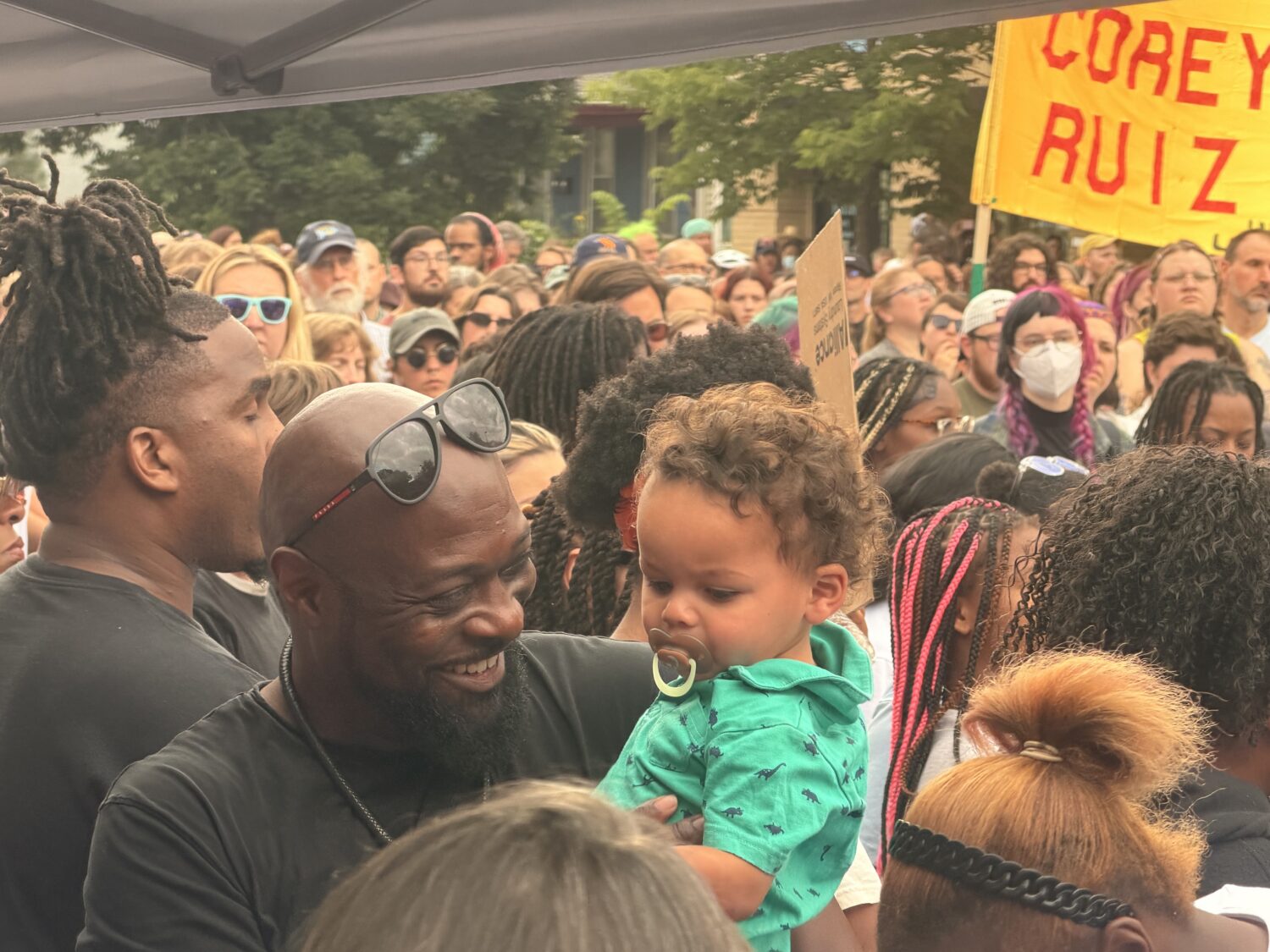
In the middle of all this grief, anger and confusion, one photograph has stayed with me.
I am standing in the crowd holding a little boy. Hundreds of people are behind us. Around us are signs, chants, anger and grief. Corey Ruiz’s name hangs over the gathering.
The little boy is too young to understand why we are there. He does not know which agency controls the investigation. He does not know about maintenance-of-effort laws, municipal budgets or state jurisdiction.
He does not know that adults are arguing over leadership, competing for microphones and struggling to agree on what should happen next.
He only knows that I am holding him.
In that moment, he is safe.
That is the promise this movement must make real.
As I held him, I thought about the Madison he will inherit from us.
Our work cannot be limited to teaching him how to survive the same conditions that brought us here. We have to build something better.
He should grow up with secure housing and real opportunity. When he is in crisis, care should reach him before the criminal legal system does. He should inherit a city where poverty does not make police contact inevitable and where independent oversight does not need permission from the police to investigate them.
Public safety should be measured by whether children like him grow up whole, healthy and free.
One day, he will be old enough to understand what happened here.
He may learn that Corey Ruiz died in the street. He may learn that people marched. That a community gathered, fed one another, protected one another and demanded change.
He may also learn about the competing microphones, the misinformation, the personal conflicts and the people who saw tragedy as an opportunity to become more visible.
What happens next will decide which part of the story matters most.
When I look at that photograph, I do not see myself as the leader everyone keeps asking for.
I see a responsibility.
I see a child trusting me to hold him.
I see the future looking back at us while we decide what to do with all this grief.
Corey Ruiz deserves a complete investigation. He deserves accountability wherever the evidence leads. He deserves a public explanation.
People living under the same conditions that placed him in that intersection deserve housing, treatment, opportunity and a government that intervenes before desperation becomes a police encounter.
The little boy in my arms deserves a city that learned something.
Every demand needs an address.
Every institution needs accountability.
Every decision should be measured against the future we are creating for him.
One day, he may ask me what Madison did after Corey Ruiz was killed.
I want to give him an answer worthy of the trust he placed in my arms.