Wisconsin Democrats have waited 16 years for this moment.
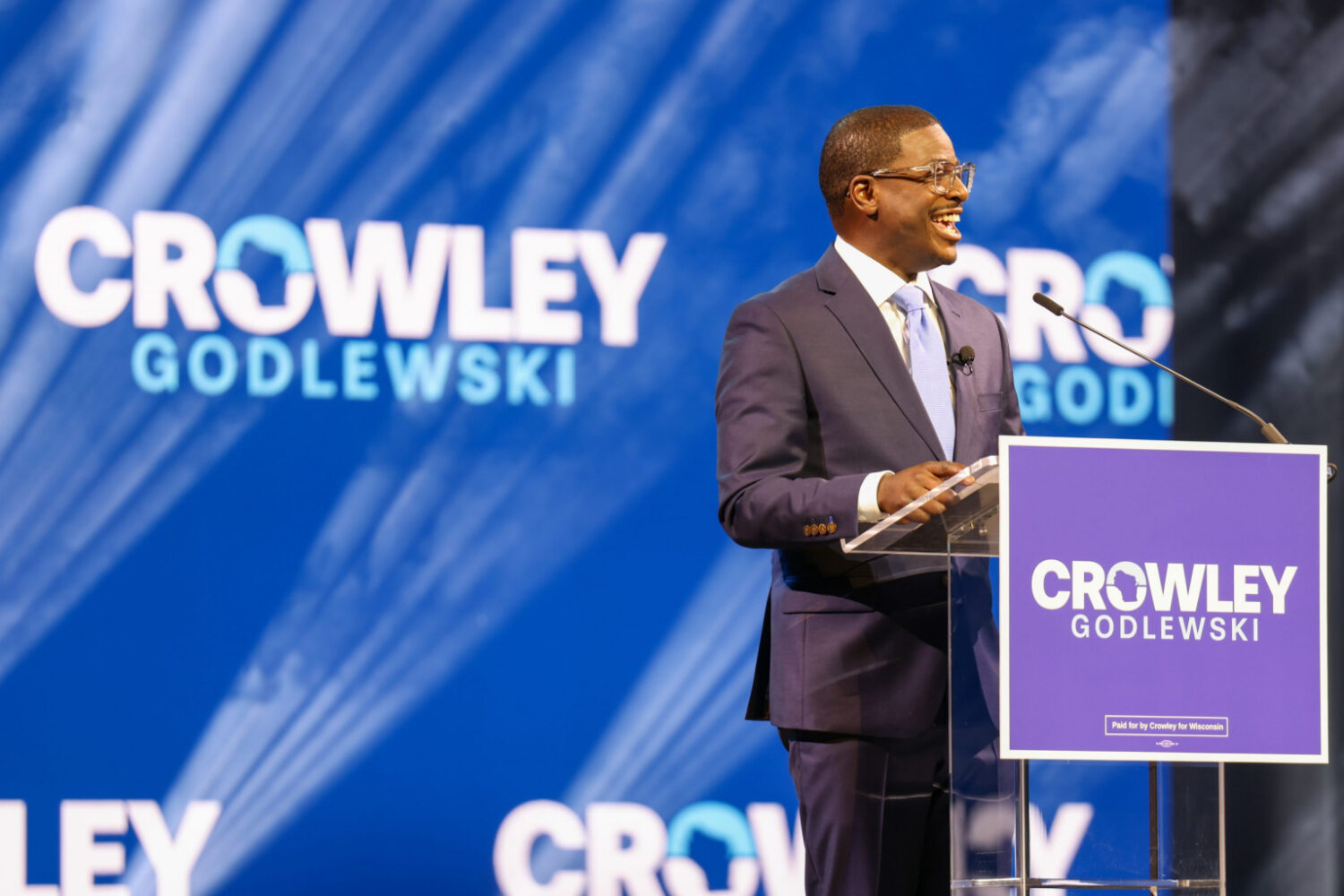
With David Crowley’s victory over Tom Tiffany in the governor’s race and the flip of the Senate and the Assembly from Republican to Democratic majorities, the state Capitol in Madison come January will be completely controlled by Democrats.
“For the first time since 2010, Wisconsin voters will trust us to lead,” Crowley told the crowd gathered at his victory party Tuesday night in Milwaukee. “Close margins will mean we earn that trust every day. But we do it by governing the whole state.”
Crowley was leading Tiffany 54-46 with nearly all the votes counted.
Senate Democrats declared victories in all four of the key Senate races the party needed to win a majority Tuesday night: the 5th and the 21st in southeastern Wisconsin, the 17th in southwestern Wisconsin and the 31st in Eau Claire. Those numbers mean the party will have an 18-15 majority when the new session begins in January.
Assembly Democrats secured a 53-46 majority. Democrats also won three other statewide races: attorney general, secretary of state and state treasurer, which they flipped from Republican control.
Assembly Democratic Leader Greta Neubauer, who is likely in line to become speaker next year, in a statement called the victories “historic” and said a trifecta will “end decades of Republican obstruction.”
“We know that people will be counting on us to deliver, and we will deliver,” Neubauer said. “Alongside Governor David Crowley and our Democratic colleagues in the Senate, we will show that government can be a force for good and that things can be different with Democrats in charge.”

The Democratic victories were boosted by President Donald Trump’s plummeting approval ratings, which also helped Democrats win majorities in the U.S. House and Senate. Complete control of state government means Democrats for the next two years have an opportunity to easily pass the party’s priorities — expanding Medicaid eligibility under BadgerCare, reinstating protections for public sector unions, enshrining clear abortion rights in the state constitution, legalizing marijuana, raising the minimum wage, and using the budget surplus to boost child care, local government aid, public schools, and the higher education system.
“Democrats’ policy plans have been stymied since 2010 when they lost control of state government,” said Barry Burden, director of the Elections Research Center and political science professor at the University of Wisconsin-Madison. “As a result, Democrats are in general agreement about a wide variety of backlogged initiatives they would like to tackle right out of the gate in 2027.”
Tuesday’s results also symbolize the end of an era of Republican politics that started in 2010, another midterm year when economic frustrations led to Republicans taking over the Legislature and the governor’s office with the election of former Gov. Scott Walker. Republicans had hoped to forge a permanent majority in 2011 with gerrymandered legislative maps that survived a Democratic wave election in 2018 that saw Democratic Gov. Tony Evers defeat Walker.
But after years of slowly turning a conservative Supreme Court majority into a liberal one, which in turn overturned the gerrymandered political maps, Democrats made significant gains in 2024, setting up Tuesday’s return to full power in the Capitol.
Democratic victories on Election Day happened in spite of the millions of dollars from three Republican megadonors that flowed into the governor’s race through the Republican Party of Wisconsin. Those numbers allowed Tiffany to outspend Crowley by double so far this year, more than $46 million for Tiffany to $23.2 million for Crowley, according to most recent campaign finance reports.

In the coming months, Democrats will have to prepare to govern after years of limited power. Among current Democratic lawmakers, just four senators and one representative served in the Capitol the last time Democrats held power in the Legislature.
Longtime Republican Assembly Speaker Robin Vos, who did not seek reelection, in a social media post Tuesday night congratulated new Democratic leadership but pointed to a lack of “any real private-sector experience” among Crowley, Neubauer and Senate Democratic Leader Dianne Hesselbein, D-Middleton.
“Crowley built his career in campaign organizing and political staff work. Neubauer and Hesselbein have the same resume,” Vos said. “They know politics. Being good at politics will mean paying back their powerful political allies.”
In the Senate, Hesselbein said the party met regularly prior to Election Day to plan what bills members want to prioritize under a Democratic majority in her chamber.
“We’re trying to make sure we know on day one what we’re going to be doing,” Hesselbein said in an interview ahead of Election Day. “And like I said, every day we wake up in the morning, we try to think how we can make people’s lives better, whether that’s funding for K-12 education or higher education or lowering health costs.”
Pat Raes, president of the SEIU Wisconsin union, in an interview at the Crowley watch party called on Democrats in state government to serve lower-income people.
“We have to find a way to make things livable,” she said. “We are seeing more homeless people across the state and across the country. That is not acceptable. Pure and simple.”
What happened in 2010
The Republican victories in Wisconsin in 2010 highlight the transformative potential for state government in the years ahead. Sixteen years ago, a bold print headline above a photo of Walker on the front page of the Wisconsin State Journal declared the state was “Turning Right.”
Over the course of Walker’s two terms in office, Republican majorities in the Senate and the Assembly had a fast track to pass conservative priorities into law, such as a strict voter ID law, concealed carry of firearms, a 20-week abortion ban and Act 10, which stripped collective bargaining rights for most public sector unions. They also cut taxes for farmers and manufacturers, expanded private school vouchers and rewrote state regulations in a way that benefited private businesses and weakened state agencies. They could move those proposals from bill to law without any input from Democrats.
Senate Democrats have said they don’t want the Legislature to operate like it has under Republican control where the minority party has little say in the legislative process. The Senate should hold more public hearings to let people share their views with lawmakers, Sen. Brad Pfaff, D-Onalaska, said in an interview in September.
“They will have a more open process,” Pfaff said of a Democratic majority. “They will at least be able to try and hear out our colleagues from both sides of the aisle and have hearings on issues that are important to the people of this state. Now, will everything be all in harmony? Of course not. It’s politics. But the thing is I firmly do believe that it is important that we allow both sides to be heard and for a variety of issues to be considered, and that just hasn’t happened over the last few years.”
Republican Sen. Mary Felzkowski, R-Tomahawk, in Wausau said her party will have to “wait and see” if such promises from Democrats hold true.
“The Democrats haven’t been in control for 16 years,” Felzkowski said. “And we have a lot of the Democrats that are elected are socialists. So how far are they going to push David Crowley to the left? And I think that’s very scary. And David’s going to have to try to stand against them to keep the independents.”
Sen. Rob Stafsholt, R-New Richmond, said the results are an “eye opener” for Senate Republicans and the Republican Party.
“It’s a good time for us to regroup and re-strategize and figure out what’s important to Wisconsinites and see if we can meet those needs,” he said.
Why the outcome swayed blue
Many Wisconsin voters on Election Day said they were motivated to cast their ballot to bring change to the state amid turbulent national politics and rising costs.
Richard Singapori, 70, who owns a 24-unit hotel in Kenosha, said his monthly electrical bills this winter averaged more than $3,500.
“That didn’t used to happen,” he said.
The lifelong Republican voted for Democrats at the state and local level for the first time in at least 20 years on Tuesday.
Amanda Wills, a 45-year-old Madison retail worker, had never voted before casting her ballot for Crowley. She turned out this time because of “all the chaos in the world.”
“It’s got to change,” Wills said.
Wisconsin Watch reporters Tom Kertscher, Paul Kiefer and Natalie Yahr contributed to this report.
This article first appeared on Wisconsin Watch and is republished here under a Creative Commons Attribution-NoDerivatives 4.0 International License. 
 //cdn.parsely.com/keys/wisconsinwatch.org/p.js