
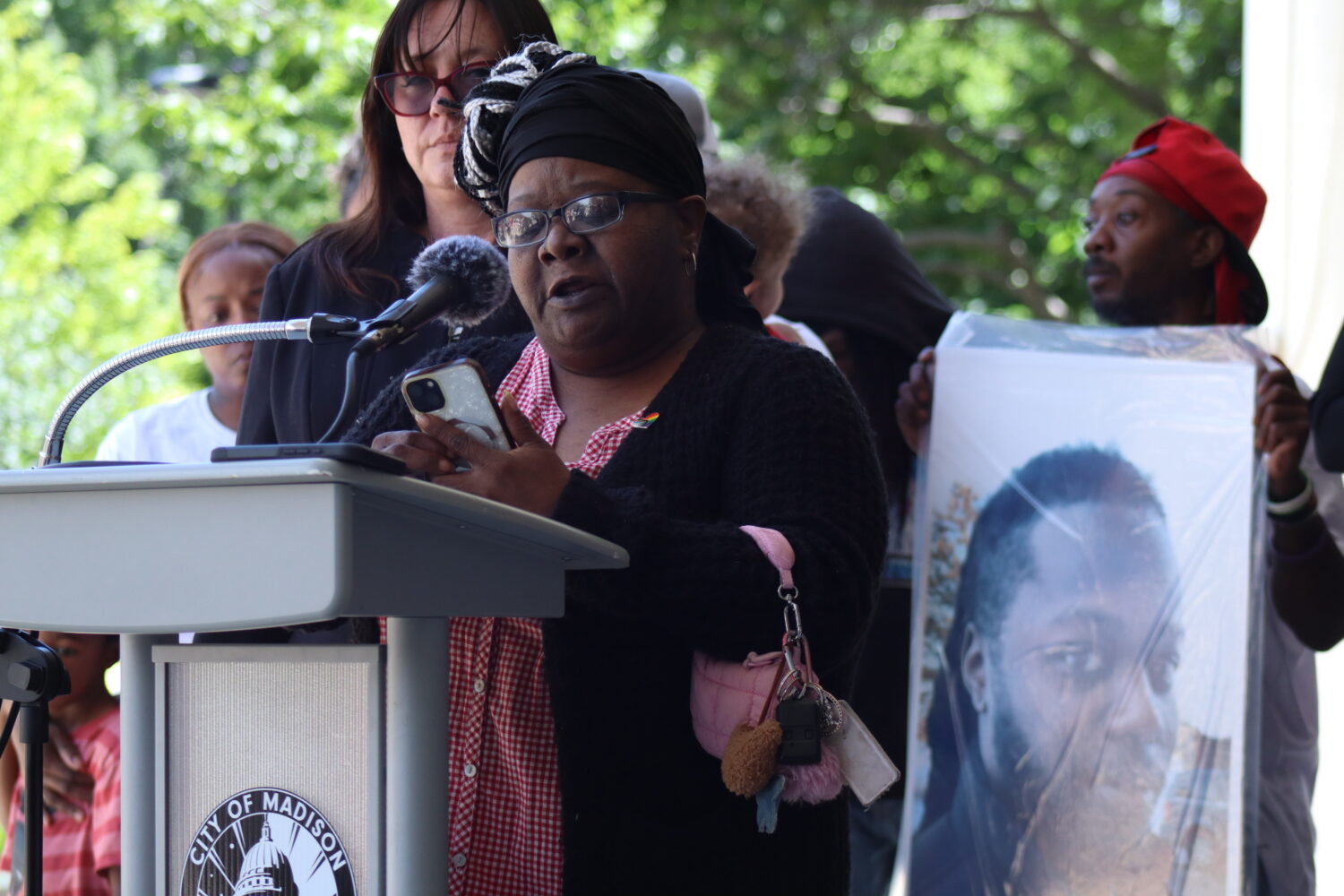
A press conference was held at City Hall hours after the Office of the Independent Police Monitor (OIPM) released its report on the death of Richard Lee Johnson June 15.
The report was released Monday morning, disputing the claim that Johnson died of complications from cocaine toxicity and blaming Madison police for not conveying adequate information to EMS and ignoring Johnson’s rapidly declining condition.
His family, elected officials and OIPM took the City Hall to briefly discuss findings, but also call on the Dane County Medical Examiner to review Johnson’s cause of death in light of the report’s findings, change Madison police policy on prone restraint and what officers are required to tell EMS, reconsider the district attorney’s previous decision to not prosecute officers involved and issue a public apology to the family.
“There is no pain greater than a mother having to bury her child,” said Gloria Johnson, mother of Richard Lee Johnson. “I am not here asking for special treatment. I am acting for families. I am asking for accountability. I’m asking for the truth. My son’s life had value. His life mattered before December [2024] and matters today.”
Lack of transparency about the circumstances around Johnson’s death in 2024 led his family to seek answers. The Johnson family received a report on his death in September 2025 — nearly nine months after.
While it shed some light on the circumstances that led to his death, it brought about more questions. The Johnson family sought an independent review of what ultimately led to his death.
The recently released report now brings into question what led up to Johnson’s death. Certain points have not been disputed — such as what initiated the arrest — but officer conduct and the Dane County Medical Examiner have been scrutinized
The OIMP independent autopsy review conducted by Dr. Victor Weedn, a forensic pathologist retained by the office, stated that Johnson died from “prone restraint cardiac arrest” and metabolic acidosis brought on by the prone position with weight across his shoulders for multiple minutes. The position and force used on Johnson had the potential to reduce his airflow by 25%, Weedn said.

(Photo by Omar Waheed)
Weedn also noted that Johnson was brought to a standing position without being placed in a lateral “recovery position.” Johnson was ultimately cleared by EMS, but Weedn noted that emergency medical providers are not apt to address a prone restraint cardiac arrest.
Officers did not check on Johnson when he lost consciousness on the way to jail. Johnson was later taken to a hospital where he ultimately died.
Greg Gelembiuk, OIPM’s data and forensic analyst, who spoke on Weedn’s report at the press conference, relayed refutations of the Dane County Medical Examiner’s stated cause of death.
“The initial Dane County Medical Examiner’s report incorrectly described his death as cocaine toxicity. However, with cocaine toxicity as a cause of death, one would expect ventricular arrhythmias, hypertension, and significant cocaine levels in the blood. None of that was the case here,” Gelembiuk said.
A new question arose from Weedn’s findings: Why was Johnson’s death ruled as a complication of cocaine toxicity?
Gelembiuk said that the Dane County Medical Examiner should not be criticized for its conclusions due to a lack of familiarity that medical examiners typically have in these circumstances.
“It doesn’t leave obvious markers apparent in the autopsy. In addition, medical examiners need to come up with some cause of death, so they’re forced to guess,” Gelembink said. “They’ll tend to seize on something. Attributing such deaths to cardiac pathology of drugs is a common error.”
That error is fairly commonplace, Galembiuk said. While he did not want to provide a firm number on how many cases end up with an erroneous cause of death, he stated “easily half” are.
There is no agreed-upon figure on how many rulings on cause of death are erroneous, but a study has shown that more than 30-40% of medical examiners and medical toxicologists disagree on cause of death.
When a hospital conducts an autopsy, pathologists consistently detect diagnoses that medical examiners missed, another study found.
However, racial bias may come into play in medical examiner diagnoses. While Aeramique Glass, the independent police monitor, refused to say that there is an explicit racial bias in the reason for Johnson’s death, she is sure it would have been handled differently if it were “one of their brothers.”
In an independent audit of Maryland’s Office of the Chief Medical Examiner, independent examiners disagreed with 44 out of 87 rulings. Many of those cases involved people of color described as “excited” or “agitated,” the Innocence Project reported.
For now, the OIPM looks to have policies reviewed and changed under its recommendations and to have Johnson’s cause of death reviewed again.
Glass said that MPD’s Chief John Patterson has shown he has a willingness to engage with OIPM, but does not have much faith in the system right now.
“But this is a new day, and this is an opportunity for them to do something different,” Glass said.