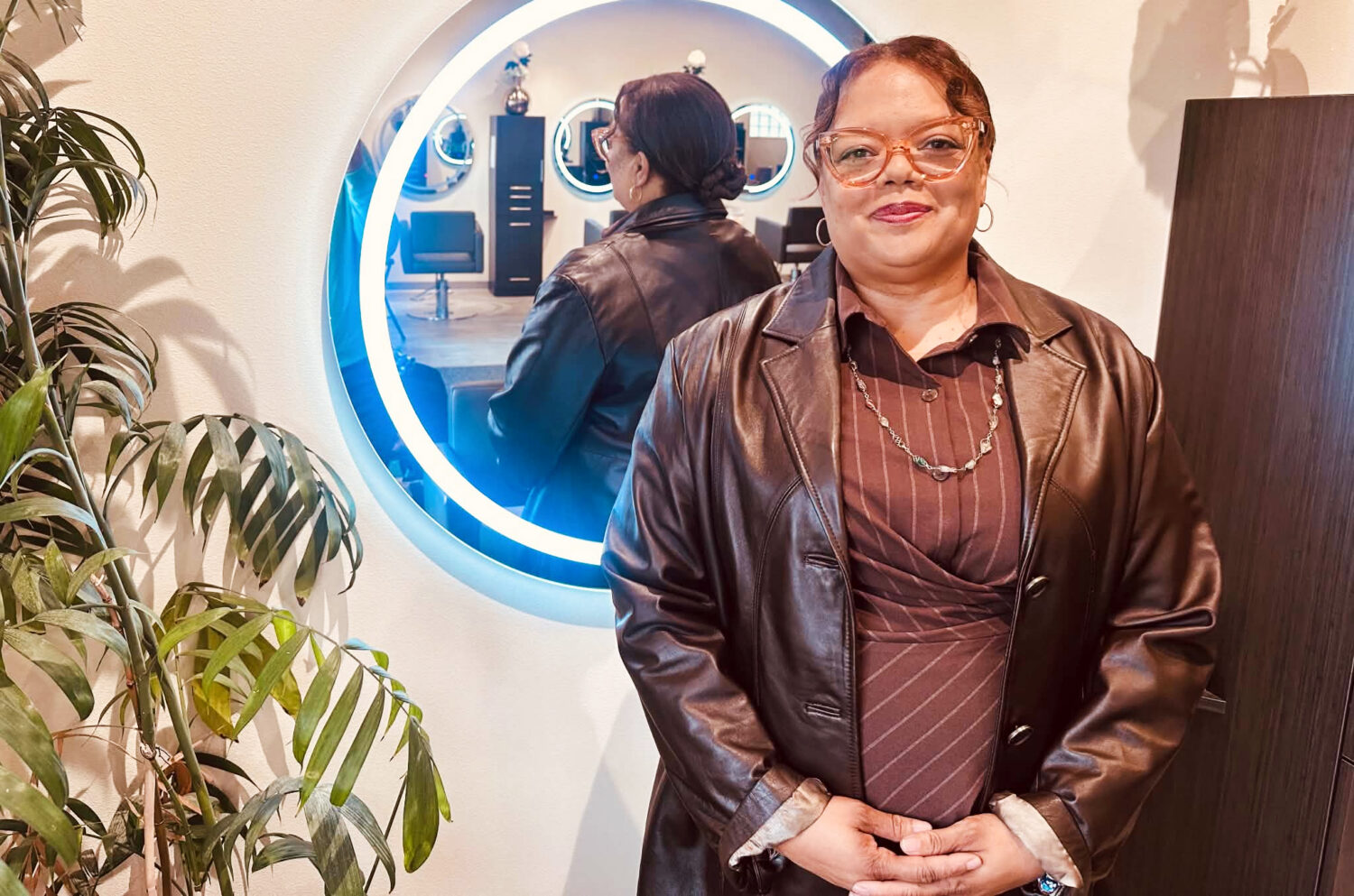
For Tamara Brown, a salon has always been about more than hair.
It’s a place where people gather, share stories, exchange information and build relationships. It’s also a place where people should feel welcome, regardless of their hair texture or background.
That philosophy has guided Brown, owner of Fringe Salon Spa, located in the heart of South Park St. across the street from the Labor Temple, throughout her career in the beauty industry and her years as a business owner in Madison.
“We love being connected to our community here at Fringe. The core of our salon is being Black-owned and being focused on having a space for all hair textures, because we are the most diverse area of Madison, and it is amazing to serve the most diverse clientele,” says Brown, whose clientele lovingly knows her as “Miss T.” “We’re able to service all those textures well, but to really be intentional to have a space where highly textured hair can come in and get service … that’s not common even still in 2026.”
Fringe Salon Spa, located at 1423 Park St., offers haircuts, coloring, styling, relaxers, perms, manicures, pedicures, waxing, hair removal, and select skincare services. The salon also has a spa room and retail products.
Brown, who has lived in Madison for 35 years with her husband, Curtis Brown III, and their three children, has spent more than two decades in the beauty industry. She has owned and operated Fringe since 2010, she says.
Brown stresses that her salon is for everybody and you will find men getting haircuts in places traditionally thought of as women’s spaces, such as a woman-owned salon. “I have male clients that I have been cutting their hair for over 20-plus years,” Brown says. “I have men who have been coming to us since they were younger and are in college now or are professionals and they have been very committed to us. So that’s awesome.
“And I love when guys come into the salon for the first time, young or old, and they are like, ‘Ohhhhhhhhh. I didn’t even know this was here!’
Where did the name “Fringe” come from?
“Honestly, I wanted to name the salon ‘Mahogany,’ and it was already taken when I looked in the database. So ‘Fringe’ was a name I had heard from a class I had taken and I just thought it was the coolest name,” she says.
Brown’s mission is to enrich the community through a healthy motivation toward beauty and self-wellness.
But the business is also an extension of something Brown says has been part of her life for as long as she can remember: entrepreneurship and community service.
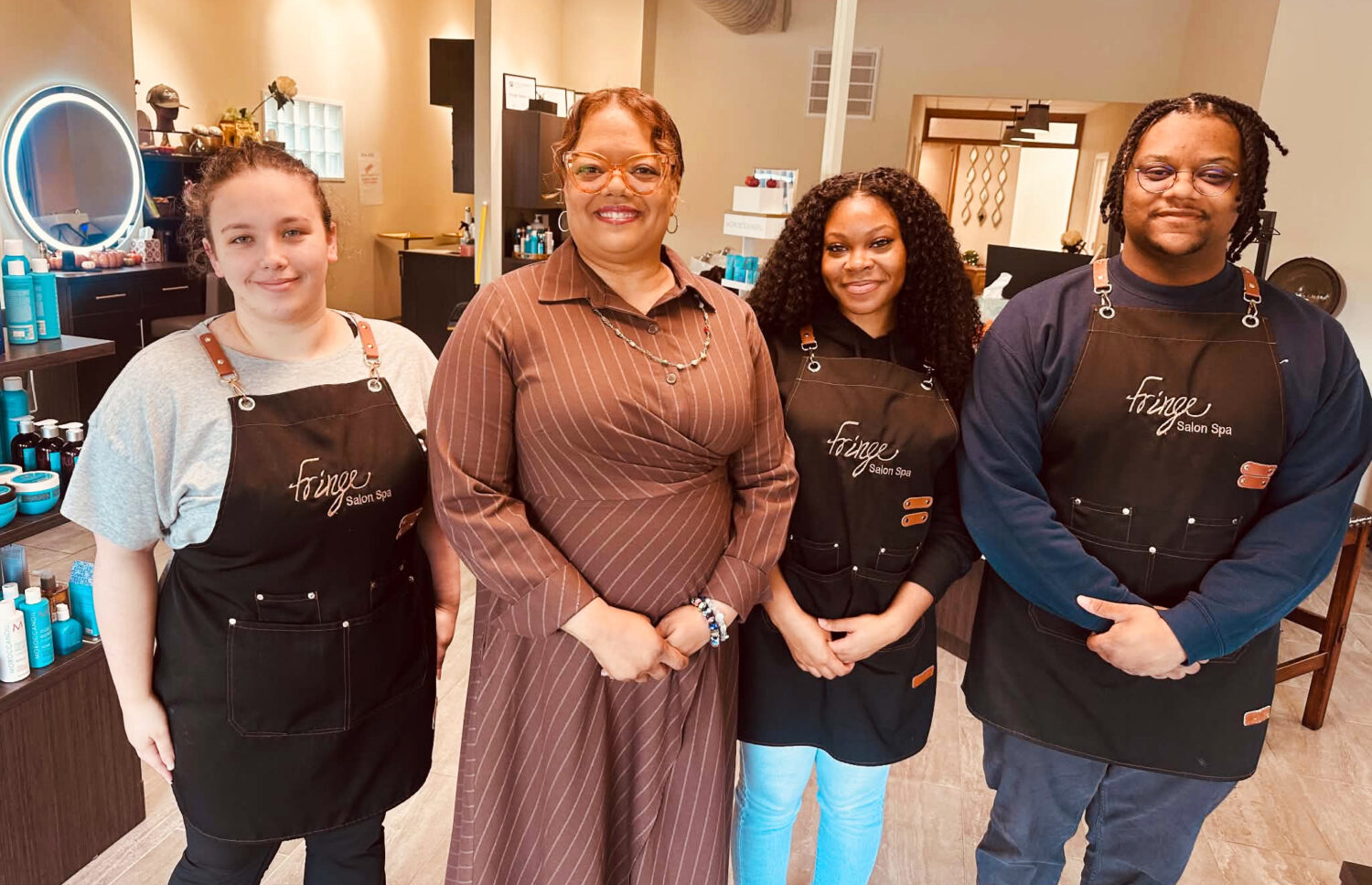
Davidetta Boakai, and Curtis Brown IV
A family legacy of entrepreneurship
Brown grew up watching her grandmother build businesses and establish connections with people in her community.
Her grandmother owned multiple houses on her block, operated a cab stand and convenience store, and eventually became a pastor and built a church, Brown says. She also worked as a hairstylist, following a trade practiced by Brown’s great-grandmother. “I’ve always been around that type of entrepreneurship mindset. And it was never, ‘Can I do this? It was always, ‘How do I do this?'”
Beyond the entrepreneurship, her grandmother’s spirit for community left a lasting impression on her.
“I’ve always had an understanding of community because I saw the importance of how she connected with people,” Brown says. “People were drawn to her because of solutions that she would try to give. Not that she solved everything, obviously, but she definitely had a heart to hear and then try to supply what needs she could.”
Brown says she didn’t necessarily recognize the connection between her grandmother’s entrepreneurial spirit and her own ambitions until after opening the salon.
Her own path included working at a successful salon with more than 50 employees. She was the only Black woman working there, she says, an experience that helped her recognize an opportunity to create a different kind of space.
She wanted to provide high-quality service while ensuring clients with diverse hair textures could receive the care they needed.
“The connections I make every day are what I really like most,” Brown says of her favorite parts of the profession. “Listening to clients, being connected to the community, has been really important to me. I love the trends and I love the styles that change over time. This is a fun industry to be in.”
A return to Park Street
Fringe has had a few different locations in Madison, but Brown has long viewed Park Street as an important location for the business.
The salon originally opened on Park Street in 2010, near what was then a Pick ‘n Save grocery store. Brown later relocated to the west side not far from Woodman’s Grocery Store, where the business operated for more than 12 years.
The opportunity to return to Park Street came when she found a space that had previously housed another salon. Brown says she was excited to return to an area she had identified through research as one of Madison’s most diverse communities.
Before opening her business, she took classes through the University of Wisconsin-Madison’s Small Business Development Center and conducted research as part of her business plan.
“I did research when I worked on my business plan and all the things to understand that this is the most diverse area in Madison,” Brown says. “I was really intentional to find a space in this area to serve that market.”
Fringe moved into its current Park Street location in March 2025.
“The relocation required a substantial renovation. The space needed new flooring, ceilings, painting and several other improvements. We opened up a couple of walls. It was a huge undertaking,” Brown remembers. “We worked to get everything completed quickly to avoid disrupting appointments for clients. It was a pretty quick move.”
The response from longtime customers was encouraging.
“99% of them were super excited we were coming back to Park Street,” she says. “It’s such a central location, and it’s worked really well, and Park Street has grown so much since we left that it’s been amazing coming back because now we have a lot of new clients.”
Brown says the salon is still rebuilding toward the vision she has for its future, but returning to Park Street has been an important step.
More than a place to get your hair done
Community connections extend beyond the services Fringe provides.
Brown has intentionally incorporated local businesses into the salon through its retail offerings and vendor relationships.
Among them are Tapestry Design, a business founded by a UW-Madison art graduate; Still on My Mind Coffee, a local coffee roasting company; and Mogul Empire, owned by Michael, the husband of her daughter, Helene. The salon also carries products from Simply Beautiful One, a vendor from the St. Louis metropolitan area.
The partnerships give local entrepreneurs another place to showcase their products while introducing salon clients to businesses they might not otherwise encounter.
For Brown, the salon also serves as a place where people can learn about opportunities and resources throughout Madison. “You get the scoop at salons,” she laughs.
Clients sometimes arrive having recently moved to the area and looking for information about where to go, what services are available, how to meet people, and how to get connected. “We do get a nice number of new people in the community that have moved here from other states and want to know what’s going on,” she says.
Brown sees those connections as part of the salon’s larger purpose.
A conversation during an appointment can turn into a referral, an introduction or a connection to a community resource. It’s one reason Brown believes salons can play an important role beyond their traditional services.
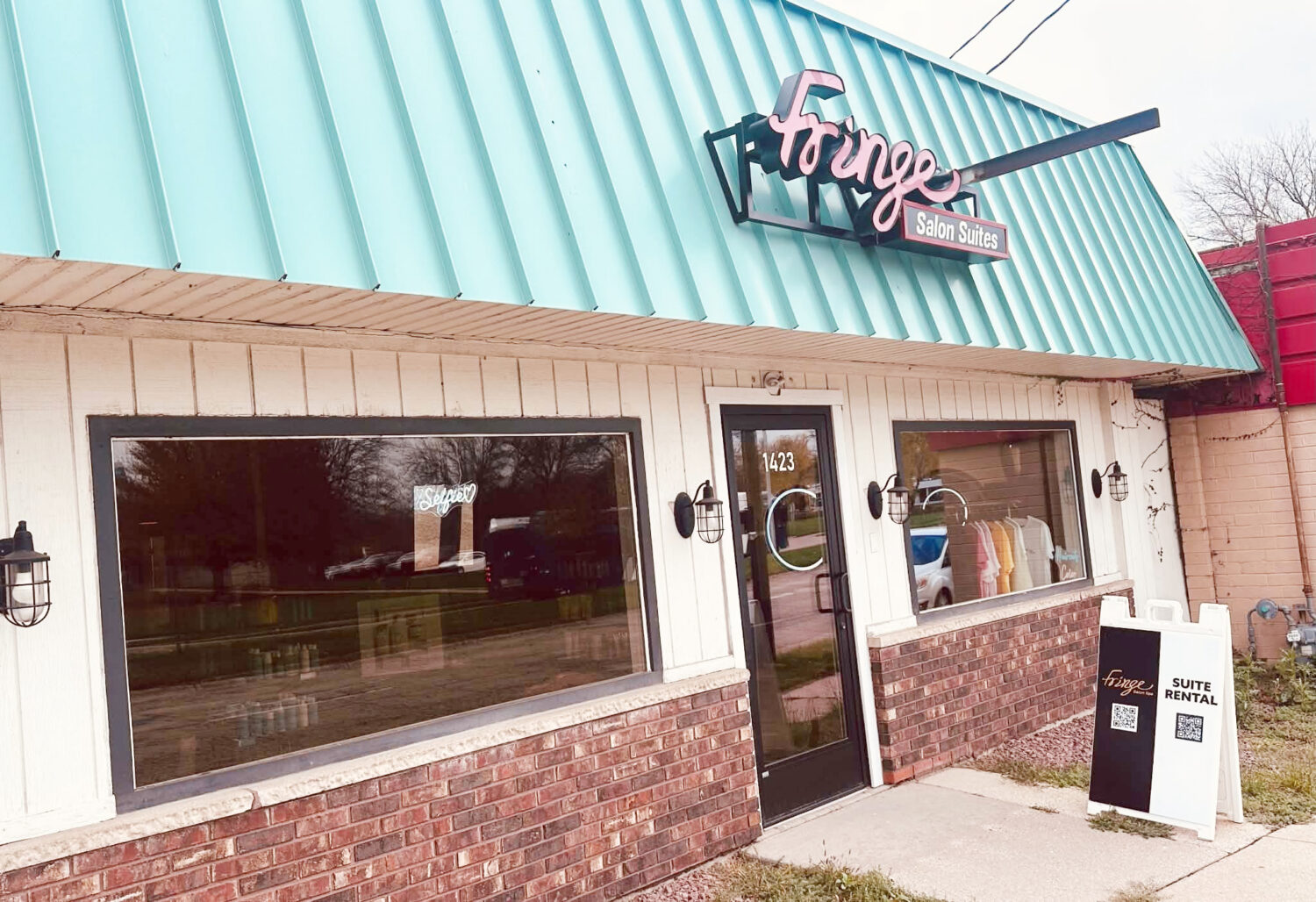
(Photo by A. David Dahmer)
Navigating the challenges of business ownership
Brown’s journey as a business owner hasn’t been without obstacles.
She describes the challenges facing Black women-owned businesses as something that requires constant awareness and intentional navigation.
“I remember getting my license and planning my business’ initial opening in 2009 during the Great Recession. That was a challenge,” she says. “Later, the COVID-19 pandemic brought particular uncertainty. Like other salons, I was worried about closing down and concerned about how I would maintain the business while expenses continued. Bills were still coming in.”
She credits her staff and their willingness to adapt with helping the salon stay connected to customers.
“We activated our online booking system, we created videos for YouTube, we increased our social media activity and offered curbside product pickups,” she remembers. “We just really learned how to navigate and pivot to stay relevant. Reaching out to clients, letting them know we’re still here and reassuring them that the salon remained committed to serving them when they could return.”
She applied for a Paycheck Protection Program (PPP) loan but says the assistance available to her was not what she had hoped for. “The problem was, as national news reported, a lot of Black-owned businesses were not getting what they needed, and we were definitely one of those,” she says.
“It has been a fight. It has been hard, but I am blessed, and I’ve had some success and some help,” Brown adds. “My clients are amazing, and people just really continue to show up.”
That support reinforced her belief that the salon fills an important need in Madison.
Looking toward the future
Today, Fringe Salon has six styling chairs, with four currently occupied.
Brown employs three stylists and hopes to bring in additional professionals, potentially including a barber, to fill the remaining chairs.
The location also includes five private suites, four of which are available. The suites operate as a separate business under the name 1423, providing independent beauty professionals with opportunities to establish their own businesses.
“The goal is to continue to build staff, to train staff, to give myself room to decrease a little bit more from behind the chair to be able to train more, go into the schools and teach more, and to fill the suites,” Brown says. “That is where I’m focused right now.”
Ultimately, she wants Fringe to continue growing while remaining responsive to the needs of the community it serves.
Brown says one of the biggest lessons she has learned as a business owner is the importance of patience.
“I get excited, and I have this sort of grandiose excitement of having the vision and wanting to see it done,” she says. “But it is important to give myself some patience and time to get there.”
For Brown, that vision has always extended beyond creating a successful salon. It’s about building a welcoming space where people feel good about themselves, connect with others and find a sense of community.