For 8 years, Dr. Martha Stacker has served as the division administrator of the Children, Youth, and Families department at the Dane County Human Services Department. It has been a tough job at times, she says, but one that she enjoys.
“Every day, when I finish this job, I always say, ‘I hope I did something to help a family to make them a bit better,'” Stacker tells Madison365 in an interview at her office at Dane County Department of Human Services overlooking Lake Mendota on Northport Drive. “I say that every single day. I’m always thankful and I’m very grateful. I feel like this job is full circle of everything I’ve ever done. I’ve always worked with the underserved in some capacity my whole career.
“I’m very grateful to the staff. They are amazing. Also, I really appreciate my peers,” she adds. “We really triage things in the background a lot more than people ever see.”
The Children, Youth, and Families (CYF) Division oversees services to youth who are at risk of or are currently in the youth justice system. This includes court services, supervision, prevention programming, gang intervention services, and restorative justice. CYF has significant child protective services and youth justice responsibilities with 180 dedicated FTE staff, according to the department’s website.
“Currently, in youth justice and prevention, we have our lowest rate of youth of color not being in the youth justice system since 2012. So we have a 10.7% reduction of youth not being in the youth justice system. That’s a historical low, and that’s really unheard of, to be quite honest,” Stacker says. “It’s a compliment to our preventative work.
“When I came into this position, there were well over 500 children in foster care. We were close to 550. My goal has been to get below 200 youth in out-of-home care. So yesterday I found out that we were at 200,” she adds. “Per capita now, Dane County has the lowest out-of-home care placements in the state of Wisconsin, and for us to be the second-largest county [in Wisconsin], that’s pretty phenomenal.”
A critical responsibility of the CYF Division is child protective services of children and youth from abuse and neglect. Stacker’s position is an integral part of the department’s management team that assists the director in overseeing the department’s entire human services system. Her focus, she says, is to be strong on the preventative side.
“One of the things that’s really important is our stakeholders and our partnerships in the community and listening to what people say, the families doing preventative work, voluntary services, holistically working with the family, and really meeting people where they are at,” Stacker says. ”My thought process is really preventative services … what do we do to disrupt and dismantle so that people don’t come into the system in the first place? And also, how do we address racial disparities? There’s a direct correlation of poverty to racial disparities.
“We just did some research with the Institute for Child & Family Well-Being, and it showed a direct correlation of how reports of neglect and abuse are directly related to poverty,” she continues. “Most of those reports, 72% of them, for example, are people in need of mental services, mental therapy, housing, and resources … people who are in food deserts. There’s a need for more preventative services on the front end.”
Stacker says she is proud of some of the things that her staff at the Children, Youth and Families Division has implemented that have been successful. “We’ve implemented voluntary restorative justice programs with youth justice and prevention that eliminates felonies for youth if they participate in working with our stakeholders like the DA [district attorney]’s office and the public defender and community partners like Briarpatch [Youth Services],” she says.
“It’s all voluntary. It’s been hugely successful. It disrupts the pipeline so that we don’t have youth going into the prison system being charged with felonies,” she adds. “We have another voluntary program with child welfare and Child Protective Services [Division], for example, called our family and community engagement (FACE). It started out as one person, and now it’s a complete unit. That works specifically with all chronic neglect. It’s a holistic approach. It’s working with children and families that have had multiple referrals to CPS.”
The Dane County CYF Division is the largest county-run CYF division in the state of Wisconsin. The division budget is a complex mix of revenue, including county, state and federal funds, grant funds, Medicaid reimbursement, and collections.
“What’s unique to our county, as a larger county, is that we have youth justice and prevention and child protective services under our umbrella. So, for example, Milwaukee has that separated out, so they have child welfare under one entity and then youth justice under another,” Stacker says. “So that makes us unique in a sense. It really helps us work very collaboratively with the family from the trajectory of pre-birth through after death, and I think that that gives us an opportunity to do a lot of preventative work as well as fast intervention work. That’s been a huge success for our division.”
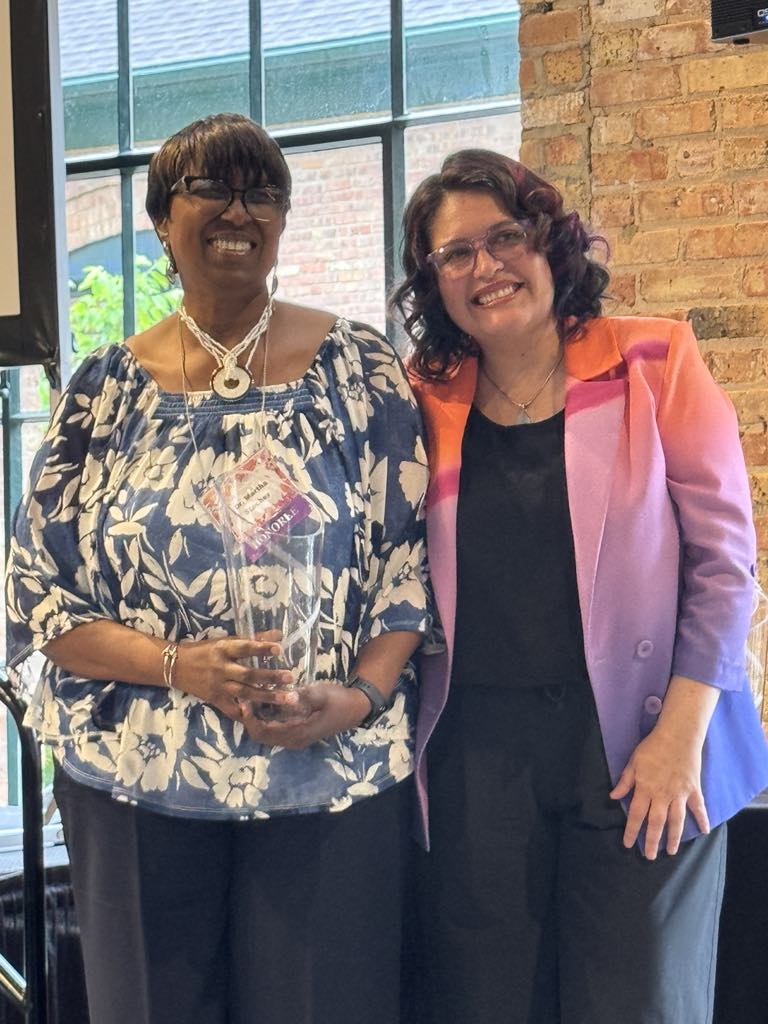
For her work over the years, Stacker was honored in May with the Women United Philanthropy Award, which recognizes her achievements in educating, empowering and inspiring young women and girls to be leaders in Dane County. A month later, on June 18, she was honored with the prestigious YWCA Madison Women of Distinction Award.
“I’m really grateful this year of the acknowledgement from the community [with the awards], which I didn’t expect,” she says. “It’s good to be seen and it elevates the work.”
Dr. Stacker is also active in the Madison community outside of her job, volunteering with the United Way Dane Co. Financial CST (chairing Women’s Wealth), the Wisconsin Women of Color Network, and serving on the board of Wisconsin Women in Government. She is a member of several national honor societies, including Sigma Alpha Pi, Tau Upsilon Alpha, and Phi Eta Sigma.
Stacker is originally from inner-city Milwaukee, growing up on the North Side. “I’m the oldest of six kids. My mom was a single mom,” she says, adding that her childhood experience helps her to understand social service systems firsthand. “I’ve been through the system. I’ve lived the system. I’ve had family members in prison. I’ve been on welfare. I’ve been in low-income housing. I’ve almost been homeless. I worked three jobs to get off of welfare. I’m a non-traditional student. I was the first family member to get a doctorate.
“Now is my chance to pay that forward,” she adds. “You gotta remember the core values of who you are in order to be successful in what you do on behalf of others. I’m a servant of other people … always have been.”

Stacker sees herself as a fighter for vulnerable populations in the community. One of the things she frequently emphasizes is that poverty should not be penalized.
“My fear right now is that poverty is being penalized at some of the highest levels of government right now,” Stacker says. “So we’re charged with the responsibility at this level now to ensure that we still provide the resources needed within our local communities to not have increases of reports of child welfare on the back end of it, or kids coming into the youth justice system because there is a reduction of the very basic needs and resources that have been available.”
Under Stacker’s leadership, Children, Youth, and Families has shifted from a focus on the child to a focus on the whole family and intergenerational change to strengthen the family.
“We figure out what we can do to meet the people where they are at. Do you need some food? Do you need a refrigerator? What do you need that we might engage you? It’s all voluntary. We’ve had an overwhelming response to this as well,” Stacker says. “This is all evidence-based practice, by the way, and so we engage these people with whatever they need: mental health services, getting their kids in programs. Who else in the family needs service? This is a holistic approach. There’s no end date to these services. We don’t stop working with the family. The family can stop working with us whenever they want to.”
Back in 2017, Stacker became the first person of color to become division administrator for Dane County’s Division of Children, Youth & Families. Having been there for 8 years now, she says the challenges of her position have changed, but she is also proud of her staff and their accomplishments. “We are engaging our stakeholders and the organizations and we were having a lot of discussions about how we do this work differently, working with less, when there’s going to be a need for more,” Stacker says. “I think the diminishing of funding at the federal level is critical, and I think people may need to pay more attention to things that they’re not right now. There has been such a loss of basic needs and resources that are going to directly impact underserved people and that’s going to impact the services we provide, and how we offset and accommodate that is going to be very, very challenging these next few years.”
Stacker says her department has been working diligently on the things that they can control. “We are managing things as best as we can with limited resources. We are trying to empower our staff and keep them motivated so they can empower people,” she says. “I think we have really good working relationships with a lot of organizations of color and ones that are led by people of color, building those relationships, helping people better navigate resources and opportunities to apply for different things. This has been really important and unique.
“Our staff are just excellent in the community and in the schools and things like that, trying to triage other things,” She continues. “So the partnerships have been pretty phenomenal. We’ve all been kind of reaching out to each other, talking about how we can do things differently to support each other.”