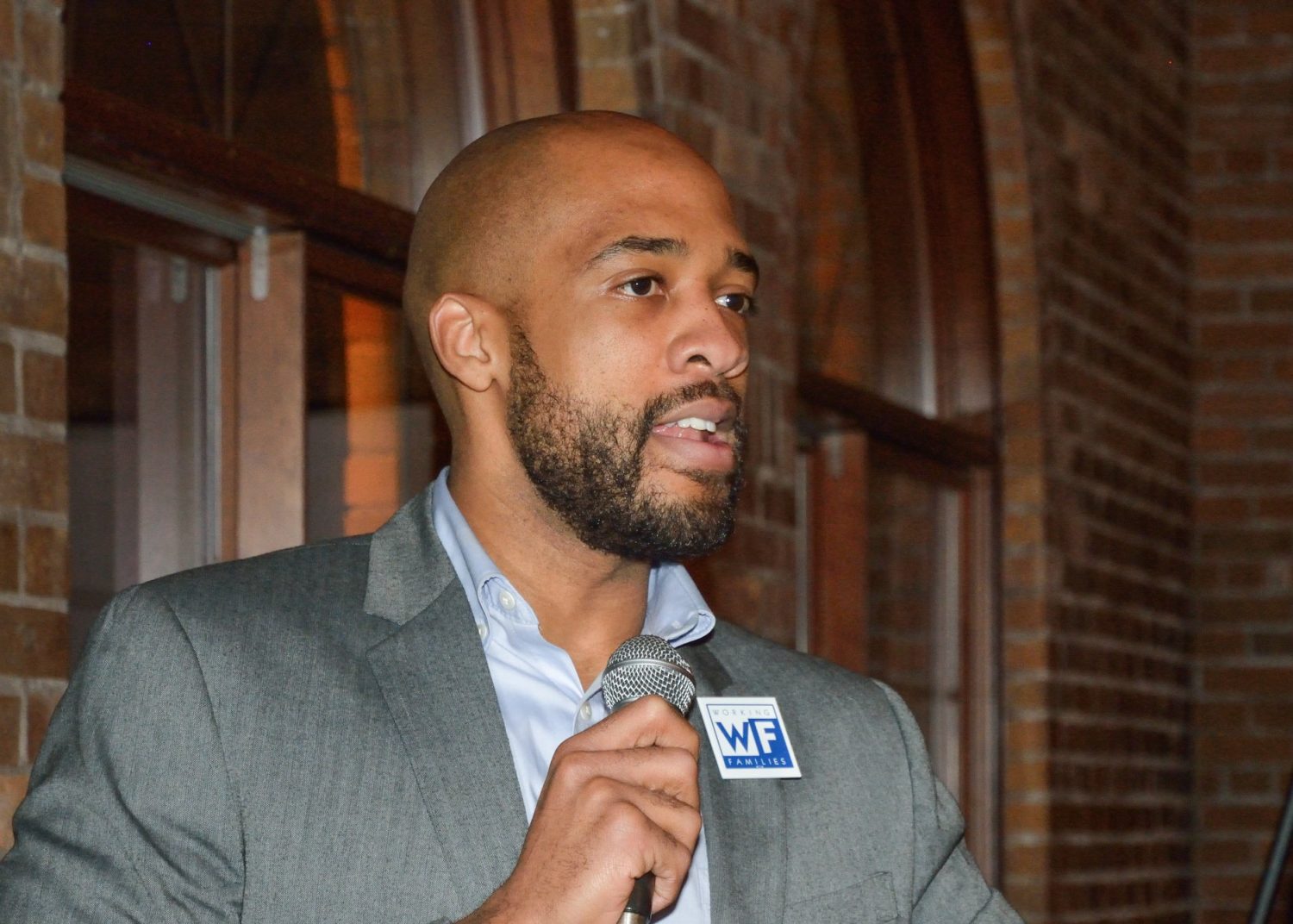
Former lieutenant governor and U.S. Senate candidate Mandela Barnes says his 2026 run for governor is rooted in affordability, health care access and what he calls a need for “real leadership” in Wisconsin, drawing on both his statewide campaign experience and his term in the executive branch.
Barnes, who previously served as Wisconsin’s lieutenant governor and was the Democratic nominee for U.S. Senate in 2022, said his recent competition in the Ironman Wisconsin triathlon helped sharpen his campaign mindset.
“It takes so much out of you, right? (Training) is almost like a campaign in many ways. It’s a long process,” Barnes said in a recent interview for the 365 Amplified podcast. “You get to certain points during the training where you question yourself. Is this the right thing to do? Am I doing it right? Am I crazy? How’s it going to end up? And you know, at the end of the day, once you start the race, you’ve got to be able to trust your training.”
Listen to the interview:
On the campaign trail, Barnes said voters are consistently focused on economic strain and rising costs.
“It feels like it hasn’t been this rough for people since the 2008 crash,” Barnes said. “This is a time, unlike many others, where people are struggling to pay the bills. People are struggling for healthcare, housing, you name it.”
He argues that affordability and health care costs dominate nearly every conversation he has with voters.
“Wisconsin is one of 10 states that has not expanded our Medicaid program under the Affordable Care Act, leaving so many people out to dry,” he said. “These are the stories we hear all too often.”
Barnes says his opening priorities would include Medicaid expansion, tax fairness and school funding.
“Expansion of Badger Care is a day one priority,” he said. “Another priority is fully funding our public schools … the state has to meet its commitment so that the burden is not falling on working-class households through property taxes.”
He describes affordability as the umbrella issue connecting jobs, wages and basic expenses.
“It’s overarching, because it’s hard to do anything else if you are having to spend every dime on rent, on utilities, you know, on groceries, on health care,” Barnes said. “People are legitimately struggling right now. So affordability is top of mind.”
Barnes is also tying his campaign to legislative control, saying a Democratic majority would be essential to implementing his agenda.
“This race is about more than just running for governor, winning that race. This is about getting a majority in the Assembly and a majority in the Senate so we can actually do the will of the people,” he said, noting that new legislative district maps make flipping both houses from Republican to Democratic control possible. “You can easily show up, get to work, and lower health care costs with one legislative session by expanding Badger Care.”
He points to Wisconsin’s minimum wage as another gap.
“Wisconsin is one of just a few states who still has a $7.25 cent minimum wage. We have to lift the wage floor for folks,” Barnes said.
Comparing the current political moment to his first statewide win, Barnes said the mood feels familiar.
“Honestly, 2026 feels more like 2018,” he said. “People wanted a fighter for sure who was going to stand up for our values. So I talk about doing things the Wisconsin way we have to reject the Washington way. We have to reject the status quo. We have to be bold in the way that we approach the challenges ahead of us.”
Barnes says his work since 2022 has centered on organizing and turnout.
“I have been very focused on organizing in communities all across Wisconsin. Have not let up,” he said. “In Milwaukee, we had the highest voter turnout of the 50 largest cities in the entire country in 2024 that was due to the work we did.”
Barnes served two terms in the State Assembly before running unsuccessfully for State Senate in 2016. He won the Democratic nomination for lieutenant governor in 2018 and elected to the position with Governor Tony Evers in 2018.
“I learned so much. I’m grateful to Tony Evers for entrusting me with so much,” he said. “My time in that office, I wanted to maximize every single moment, and as I look at potentially becoming governor, we will maximize every single moment to do everything we can to improve quality of life for people across the state.”
“I’m proud to be the most experienced candidate in this race, the one who is ready to go on day one, because I know how the state functions. I’ve traveled all across Wisconsin. I’ve met with folks from all different backgrounds,” Barnes added.
Barnes left the LG’s office after his first term to run against incumbent US Senator Ron Johnson, losing by just over 20,000 votes.
On ideological divisions within the Democratic coalition, Barnes stresses unity over labels.
“When I ran in 2018 I said, we’re united, all shades of blue,” he said. “It is more important for us to unite, to come together. If you believe in decency, if you believe in democracy, if you believe in doing things better than they have been done.”
“This is about progress. This is about moving us forward,” Barnes said. “It’s far too important to let any intra-party dividing lines keep us from becoming the best state in the entire country to live, work and raise a family.”
Barnes will face Milwaukee County Executive David Crowley, Assembly Rep. Francesca Hong, former WEDC CEO Missy Hughes, current Lieutenant Governor Sarah Rodriguez, Greater Milwaukee Committee President Joel Brennan, and State Senator Kelda Roys in the Democratic Party Primary on August 11. The general election will take place on November 3.