As the organizations that helped establish Madison’s civilian police oversight structure and nominate the majority of the Police Civilian Oversight Board (PCOB), we are outraged by the police killing of Corey Durell Ruiz, the aftermath and the subsequent treatment of Interim Independent Police Monitor Aeiramique Glass, PCOB member Devon Snyder, and Common Council Vice President Carmella Glenn.
We helped create this oversight structure because police investigating and regulating themselves does not lead to accountability. The PCOB and Office of the Independent Police Monitor (OIM) grew from years of community advocacy, Black leadership, research and public pressure in demand for something different.
This structure belongs to that history.
We understood then, as we do now, that meaningful civilian oversight requires independence, access, authority, and the ability to challenge police power without fear of retaliation. What we have witnessed over the past several weeks calls into question whether city leadership is prepared to honor that commitment when independent oversight becomes uncomfortable.
We stand with Interim Independent Police Monitor Aeiramique Glass, the PCOB, Common Council Vice President Carmella Glenn, Corey Ruiz’s family and loved ones, and Black residents who continue to demand that their government value Black life through the actual exercise of power.
We call on the Common Council and city leadership to:
- Fully enforce MGO 5.19 and protect the independence and authority of the OIM and PCOB.
- Ensure the OIM receives the records and information necessary to fulfill its legal mandate.
- Hold officials accountable for the police violence experienced by Monitor Glass, Devon Snyder and Carmella Glenn.
- Provide explicit protection against retaliation toward Monitor Glass, PCOB members, nominating organizations or others for exercising oversight authority, speaking publicly, protesting, challenging police conduct and exercising First Amendment rights.
- Stop using language, tone, anger, or emotional responses of Black people as a distraction from the institutional conduct that produced that anger.
- Provide a public accounting of the status of the 177 recommendations and what remains undone.
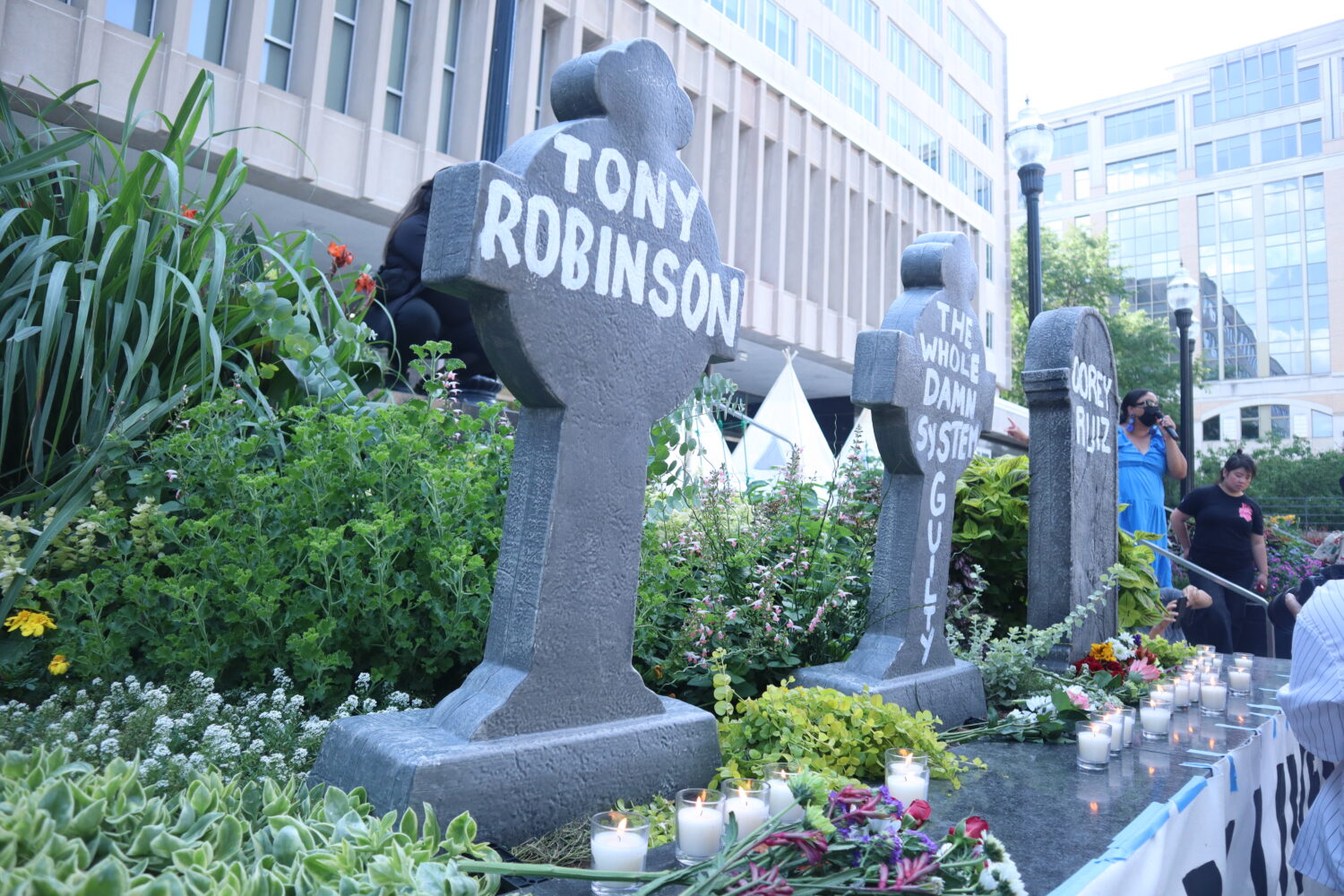
Corey Ruiz, a 38-year-old Black Latino man, was killed by Madison police on July 22, 2026, at the intersection of Williamson and South Baldwin Streets. His killing was witnessed by community members and captured on video from multiple angles. In the hours and days that followed, people gathered to grieve, protest, demand answers, and create a memorial in the place where his life was taken.
As per their mandate outlined in Madison General Ordinance 5.19, the OIM opened an investigation and requested records from MPD. By July 2, the OIM issued a subpoena for the records with a July 31 deadline. On August 4th, Monitor Glass reported that MPD had not complied.
Also on August 4th, while observing the clearing of the memorial and protest area, Monitor Glass, Common Council Vice President Carmella Glenn and members of the Police Civilian Oversight Board engaged with community members and attempted to reduce harm during an already volatile and painful moment.
Monitor Glass witnessed a Madison police officer detaining a woman in a manner that caused her to see the officer’s badge number. While doing so, an officer in a blue helmet pushed their forearm into Monitor Glass. As Monitor Glass removed the officer’s arm and retreated, the officer grabbed her. Other officers converged on her and she emerged from the encounter with an injured arm and bleeding hand.
This was not an interaction between police and someone whose identity or role was unknown. Monitor Glass was wearing clothing prominently identifying her with the City of Madison Office of the Independent Monitor. She was in the Willy Street neighborhood where MPD has gunned down six different people with impunity… and MPD knows what Monitor Glass represents: accountability.
Impunity is at war with accountability.
The Monitor’s job is not to make the police department comfortable. Her job is to ask difficult questions, examine conduct, demand information, identify patterns, challenge failures, and help ensure that the tremendous authority we give law enforcement is not exercised without meaningful civilian scrutiny.
When the Black woman entrusted with that responsibility is denied information, forced to issue a subpoena to obtain evidence related to the killing of a Black man, and then physically confronted by officers from the department she is charged with overseeing, we have moved far beyond a disagreement between city agencies. We are looking at power protecting power, and race and gender.
Misogynoir is not limited to the use of racial slurs against Black women. Anti-Blackness is not limited to racist policies. Patriarchy does not disappear because women hold positions of leadership. These systems show themselves by who is respected, who is expected to submit, whose questions are taken seriously, whose anger is labeled dangerous and who gets punished for challenging institutional power.
A Black woman is welcomed into leadership until she exercises positional authority. She is celebrated when her presence demonstrates diversity but challenged when her leadership disrupts established power. She is expected to endure disrespect and violence with extraordinary composure, while the institutions causing the harm are afforded endless explanations for their conduct.
That contradiction is at the center of what happened to Monitor Glass.
Immediately following the assault by officers she oversees, Glass used an idiomatic phrase about burning the city down, i.e., dismantling harmful elements to rebuild. Instead of beginning with serious questions about why police had assaulted Monitor Glass, whether she was injured, or how such an encounter had occurred, Mayor Satya Rhodes-Conway and Chief John Patterson focused public attention on her words.
The Black woman assaulted by MPD became the public threat.
That framing is neither harmless nor racially neutral. It draws from a long history of portraying Black women as angry, aggressive, irrational, hostile, and dangerous when they resist mistreatment or challenge authority. When government leaders reinforce those narratives from a public podium, they activate racial and gendered stereotypes that carry real consequences for that person’s safety, credibility, and ability to do their job.
The public hostility that followed should concern every organization that fought to create independent civilian oversight in Madison.
We are equally concerned about what happened to PCOB member Devon Snyder and Common Council Vice President Carmella Glenn. PCOB members must be able to witness police activity, participate in public protest, and stand with community members without fearing physical retaliation, criminalization, or institutional consequences for exercising rights that belong to everyone in this city.
When our organizations nominate people to the Police Civilian Oversight Board, we are entrusting them with a serious public responsibility. We expect the City to protect their ability to perform that responsibility safely and independently.
The treatment of Council Vice President Carmella Glenn raises its own serious concerns. Glenn was attempting to deescalate the situation while serving both as an elected official and a Black woman in one of the highest leadership positions on Madison’s Common Council. She too was placed in harm’s way while trying to prevent further violence.
This moment cannot be separated from the killing of Corey Ruiz, as without it, there would have been no gathering, memorial, protest, OIM investigation, obstruction of that investigation and reason for why the strength and limits of civilian oversight are being tested right now.
There is also history of the Williamson Street neighborhood that Madison cannot ignore. The police have killed six people in that neighborhood in a little over twenty years. Four of those men were Black and three of the four were Latino. In 2015, 19-year-old Tony Robinson was killed by Madison police on Williamson Street. His killing became part of a much larger community reckoning with policing, racial disparities, use of force, and the absence of meaningful independent accountability.
Years of advocacy, public testimony, research and community pressure followed. Madison created committees, studied its police department, and adopted 177 recommendations that created the Police Civilian Oversight Board and the Office of the Independent Police Monitor.
Now, the independent oversight structure that emerged from years of community demands for change is being tested by another police killing of a Black man.
MGO 5.19 gives the Office of the Independent Police Monitor unfettered access to MPD records, policies, Standard Operating Procedures, data, computer databases, and other information necessary to perform its duties. It also gives the Monitor subpoena authority. Those powers were written into the ordinance for a reason.
The OIM is not simply another member of the public requesting records.
No matter what MPD has done in the past or how City Attorney Michael Haas feels, no law prohibits the OIM from conducting an investigation concurrent to the criminal investigation. Wisconsin Statute 175.47 prohibits MPD from conducting the criminal investigation into its own officer-involved death. It does not prohibit concurrent investigations by the OIM or even MPD, for that matter. It does not prohibit MPD from sharing records with the OIM. The criminal and OIM investigations are two different investigatory tracks that answer different questions and serve different purposes. Whether a prosecutor ultimately believes criminal charges are warranted is not the same question as whether police followed policy, training, de-escalation, whether patterns exist, or whether institutional practices need to change.
Civilian oversight cannot be forced to wait until every other institution has finished deciding what the public is permitted to know.
The Common Council enacted MGO 5.19 and the powers contained in that ordinance are being obstructed, ignored, narrowed, or rendered meaningless in practice.
The Common Council must ensure that the authority it granted to civilian oversight exists in practice, not simply in municipal code. This is obstruction, not a disagreement between the Monitor, the police department, the City Attorney, or the Mayor.
For years, Madison has engaged in arduous public processes to support public commitments to reform. None of that, by itself, is transformation.
The measure of an institution’s commitment to racial justice is not what it says when racial justice is safe or popular but what that institution does when Black people challenge its power, demand evidence, refuse silence and exercise real authority over systems that are accustomed to answering primarily to themselves.
That is what Madison is being asked to demonstrate now.
We reject the idea that independent oversight is legitimate only when it is quiet, agreeable, deferential, or convenient. Real oversight will create tension because accountability creates tension. It will uncover things institutions would rather remain unseen. It will ask questions people in power would prefer not to answer. It will challenge explanations, demand documents, examine patterns, and insist that government power be answerable to the people subjected to it.
That is the work.
We also reject the continued fixation on alleged shortcomings, personalities, tone, or past disagreements involving the OIM and PCOB as substitutes for answering the central questions before this city. Criticism cannot become a weapon used to weaken civilian oversight whenever it begins to challenge police power in ways that make city leadership uncomfortable.
Nor should Monitor Glass, members of the PCOB, or those associated with civilian oversight face retaliation for doing the work this community entrusted them to do. There must be no retaliation through removal, discipline, budget reductions, restrictions on authority or access, political pressure, public vilification, or other adverse action because the Monitor or Board members challenged police conduct, exercised their legal authority, participated in protected activity, or stood with community members demanding accountability.
Protecting civilian oversight means protecting its independence when that independence is inconvenient.
The killing of Corey Ruiz, the obstruction of the OIM, and the police violence against Monitor Glass are not separate conversations. Together they force this city to answer the following:
- When MPD kills, will those incidents be meaningfully investigated by an institution that does not answer to police?
- Will a Black woman be allowed to hold real institutional authority over MPD without retaliation?
- Can civilian oversight remain independent when that independence conflicts with MPD’s sense of impunity and city risk management?
- Do community voices mean anything after the meetings are over, the reports have been written, and the ordinances have been passed?
Civilian oversight is not a gift from government to the community. The community spent years demanding civilian oversight because the existing systems of accountability were not enough.
Corey Ruiz does not get another opportunity for Madison to get this right. Neither does Tony Robinson. Neither do the other Black people and families who have carried the consequences of systems that repeatedly promise reform after harm has already been done.
What city leadership and the Common Council do now will tell this community whether civilian oversight was created to hold police power accountable or merely to create the illusion that someone could.
We helped build this oversight structure because Black lives demanded something more than promises.
We expect the City of Madison to honor it.
Respectfully submitted by,
The Coalition for Community Oversight of the Police (CCOP)
Member organizations:
Community Response Team
Freedom Inc
Just Dane
Nehemiah
OutReach LGBTQ+ Community Center
Urban Triage
YWCA