
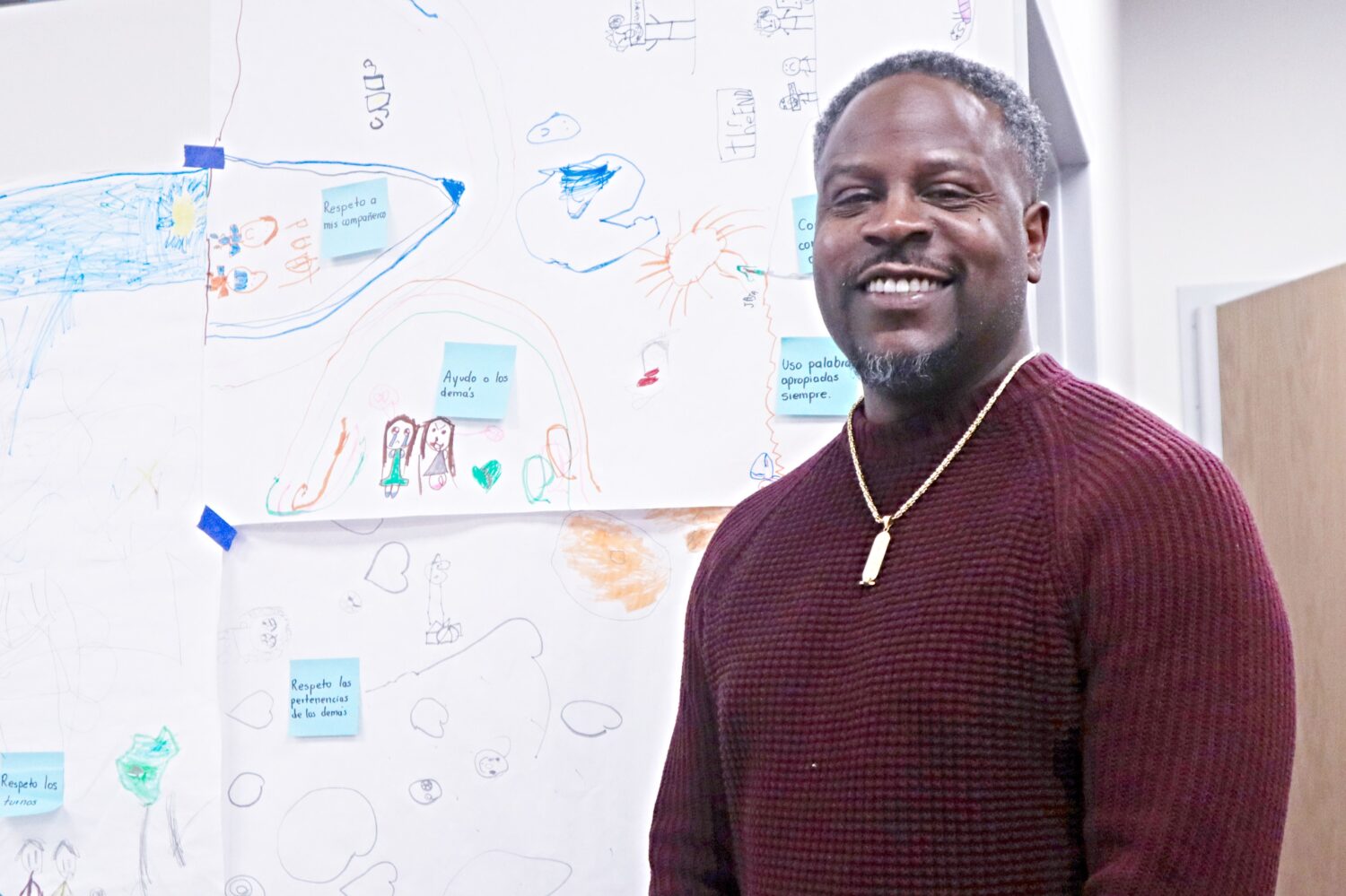
“My first goal was to be the next Michael Jordan,” laughed Percy Brown Jr. as he reflected on the full-circle moment from his very first job in education, working at former Southside Elementary School, to now leading as the principal of the school, which was recently renamed Lorey Mann Carey Elementary.
Brown is a lifelong Madisonian, originally from South Madison. While teaching wasn’t his first path in life, something called to him as he felt a connection to the youth and his neighborhood — but the journey took many turns to find where he needed to be.
His roots are deeply entrenched in Madison, with his parents having been homeowners on the South Side for over 40 years and having lived in the area for about 55 years. Brown still remembers his time as a Southside Raider, residing in Brighton Square Apartments, going to Mt. Zion Baptist Church …staples in his neighborhood that helped shape who he is today.
“I’m a hardcore South Side man, ride or die to the end,” Brown said. “To be able to come back in and lead a school that’s right here in the heart of South Madison, in a lot of ways, is a dream come true.”
He credits a lot of his pride to his father, Percy Brown Sr., who worked for the City of Madison Urban and Planning Development. They had chances to relocate, he said, but Brown’s father had a deep belief and pride in the South Side.
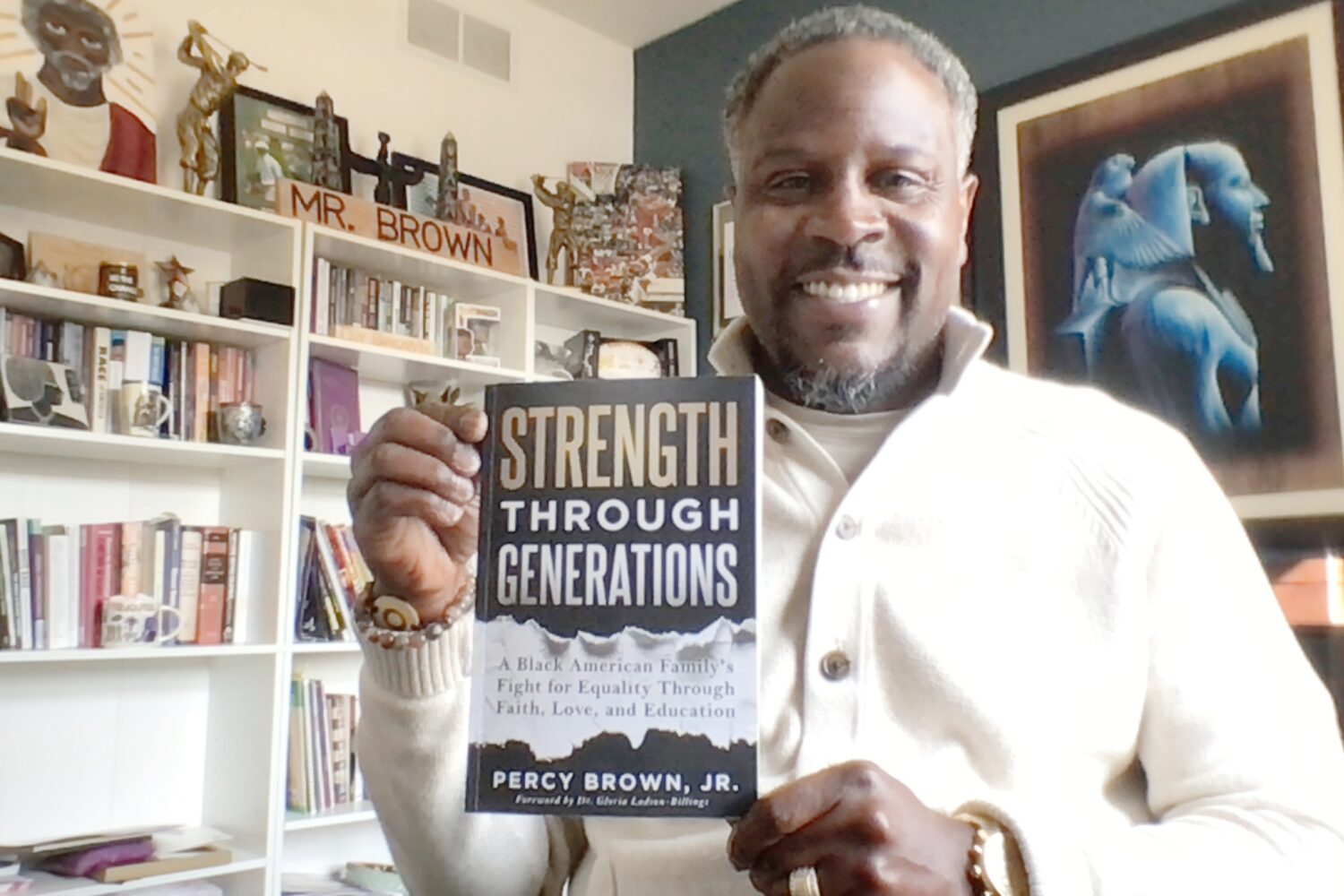
Earlier this year, Brown debuted his first book, “Strength Through Generations: A Black American Family’s Fight for Equality Through Faith, Love, and Education,” which talked about his family’s legacy of civil rights activism in Madison. The book explores the history of race and its evolution in shaping the current cultural climate in the United States.
His passion for Madison and the South Side of the city has always been strong, but Brown did ultimately leave the city and the state for a brief period of time.
Home away from home
Brown briefly attended the University of Wisconsin-Whitewater in the ’90s. He, admittedly, was not doing what was best for himself then.
“It was during the heart of the crack-cocaine epidemic. A lot of my friends on the South Side got caught up on that,” Brown said. “There was a stretch where I wasn’t making the best decisions, and it could have easily made me be found guilty by association.”
He wasn’t getting into anything too hard, but Brown wouldn’t have called his actions “clean,” he described. In hopes of changing his life path and in the wake of flunking out of UW-Whitewater, he decided to head south to Mississippi to attend Delta State University.
“I faced some hard choices, and it was in the best interest for me to leave the city entirely, and it really allowed an opportunity to reinvent myself,” he said.
Mississippi wasn’t unfamiliar to Brown. He spent many summers there growing up. Delta State University was also just 17 miles away from where his father grew up. It was like a second home for him.
At Delta State, he studied history and political science, was a walk-on to the basketball team and joined Omega Psi Phi Fraternity, which both his uncle and father belonged to.
There was a noticeable change he experienced when he attended Delta State. At the time he attended, Delta State had a campus that was about 25% Black. It was the first time his classes and education had people who looked like him outside of elementary school in Madison.
“At Lincoln, I had it, but at Cherokee, because of high test scores, I was in advanced classes; I didn’t have a lot of my friend group from the South Side in my academic classes. It was pretty much the same thing at Madison West,” Brown said. “Staff didn’t reflect me and the South Side community.”
In Mississippi, Brown enjoyed the small communal feeling. Being around other Black students and with Black friends in the community with “ambitions” and “goals” in an intellectual space he couldn’t find in Madison at the time helped him reshape his life when he needed it most, he said.
He calls himself a “country boy at heart,” but he wanted to return to Madison sometime after he graduated. He wasn’t sure if he was going to stay long.
Upon his return, he found employment with the Dane County Neighborhood Intervention Program, which turned out to be Brown’s first experience working with youth.
“I just fell in love with, and from that moment on, I just knew that I wanted to be able to do something to uplift young people that looked like me,” Brown said. “Funny thing about it, my first job was literally right here at 501 E. Badger Rd.”
His time back in Madison was limited. Brown ended up leaving to support his friend and fellow Madison native, Reece Gaines, the first-round draft pick by the Orlando Magic in the 2003 NBA Draft. Brown stayed alongside his friend in Orlando until Gaines was back home with the Milwaukee Bucks two years later.
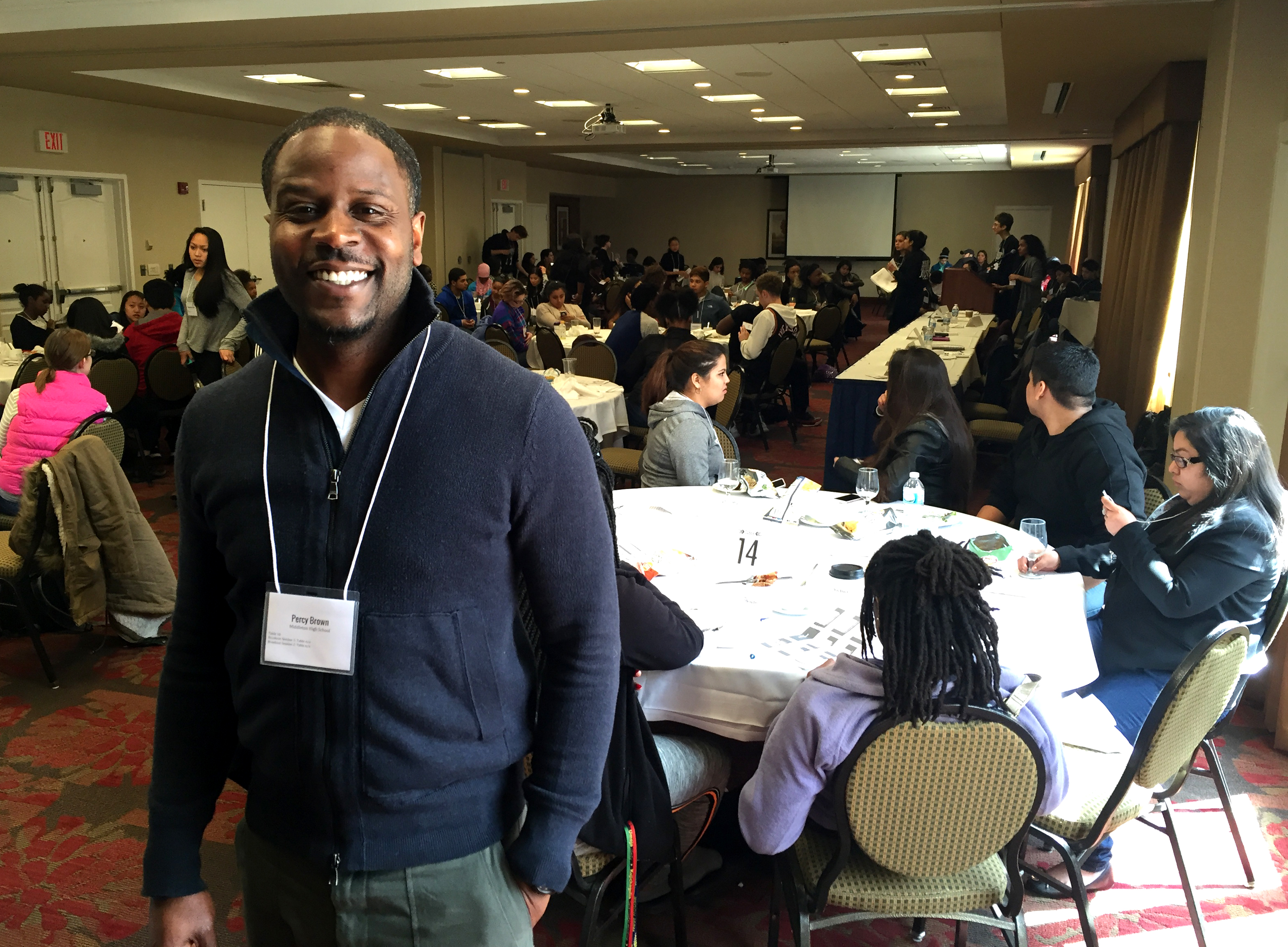
(Photo by A. David Dahmer)
A career serving the youth
Brown came back to Madison, for good this time, in 2005. He strived to reenter serving youth and found himself in his first full job in education as a minority services coordinator at Madison Memorial High School.
During that time, Brown was encouraged by Bruce Dahmen, former principal of Memorial High School, to go back to school to get his teaching license and pursue his master’s degree for certification for principalship. Dahmen saw something in Percy after he told him to stop by the school one day.
“When I went before I interviewed for the job… he told me to stop by the school whenever I could, and I just happened to come during lunch,” Brown said. “We were just talking, but there were so many kids from the neighborhood that knew me. ‘Oh Percy, Percy, Percy,” and he was just like — maybe that’s what it was. My connection with kids. He saw that I have a love for young people.”
Brown isn’t entirely sure what exactly Dahmen saw in him, but he ventures that it was his ability to connect with kids and his passion. He never got the chance to ask him what it was before Dahmen’s death in 2014, but Brown wanted to model himself after him.
Dahmen reminded Brown a lot of his own family and how they rooted themselves to serve the community. Dahmen, who got his start at Middleton, wanted to go back to be principal one day, but never got the chance. Brown managed to get into an administrative position in Middleton’s school district after Dahmen’s death.
“I shared with his wife. Peggy, ‘I’m here for him. I know how bad he wanted to come back.’ That didn’t happen for him, so to be able to have that opportunity, I felt that was my way of being able to give back all that he had done for me.”
Brown’s job at Middleton was initially dean of students. However, they added days for him to start working around diversity to improve the achievement gap for Black and Latino students in the district.
The bouncing around between the two roles was unsustainable, he said. Middleton decided to create a special position for him in 2014 as the director of equity and student achievement.
“I would say, in a lot of ways, Middleton was out front before everybody, and their mom started creating DEI roles.”
The position opened up more opportunities for Brown. Soon he would speak at national conferences and school districts on diversity, equity and students. He would go on to start North Star Consulting to continue that work for some years. He likens himself as the “Michael Jordan of DEI,” staying in line with his original goal in life before finding himself in education.
In 2021, his consulting business took a slight hit as less interest in DEI work started to crop up. The most recent election saw his business start to flatline, so Percy wanted to find something else to do.
After going through all he had done and all he hoped to do, everything pointed towards serving kids.
“I said,‘ You know what? Let me see if I can take myself back to the beginning.’”
Brown scored high in the screening process for MMSD, but there were no elementary principal positions open at the time. Later, in June, and just weeks away from being fully unemployed, MMSD reached out to ask if he would be interested in interviewing for a principal position at Lorey Mann Carey Elementary School (formerly Southside Elementary).
Brown’s education career had come full circle. His start in education was at the same building nearly two decades ago at the school he now leads.
“I was ready to walk the streets and knock on doors. I really just wanted to connect with the community, but that didn’t go as planned, because there was just so much that needed to be done,” Brown said.
His hiring as principal comes after the school’s previous principal was removed. There was a lot of work to be done, but it was also Brown’s first time serving as a principal. He knew there was a mountain to climb and a learning curve for him to overcome.
Being a principal is different from his previous career, which was largely in school administration. Brown was scared and overwhelmed at times, but he turned back to a mantra he would often tell himself when his work was more centered on DEI.
“Move slow to move fast. I wanted to accomplish everything all at once, but that’s impossible,” Brown said.
He found himself leaning a lot of the expertise of teachers at the school and really buckling down to hear what they needed.
“It’s building the plane as you’re flying it,” Brown said. “I’m making sure I’m taking notes, learning about certain deadlines for things so I know all of the things that I’m going through for the first time this year won’t be a problem next year.”
Year two will look different for him at Lorey Mann Carey Elementary with more confidence and certainty about how he can best support the school and its needs. He’s so confident in the school that he plans to transfer his daughter there for the third through fifth grades.
“That’s how much I believe in the school. That’s how much I believe in the staff, the families and the students that come here every single day,” he said.