
This opinion piece reflects the views of its author and not necessarily those of Madison365, 365 Media Foundation, its staff, board of directors or funders.
I’d already started thinking about this column before my phone rang shortly after five in the morning.
I was going to call it, “Where Is She?”
For nearly two weeks, Mayor Satya Rhodes-Conway had issued statements about the Corey Ruiz memorial site. She described the people gathered there. She judged their tactics. She repeated accusations about them. She told Madison what was happening at Williamson and Baldwin and what needed to happen next.
But she never came.
I wanted to ask why the mayor hadn’t stood at the place where one of her police officers killed Corey Ruiz. Why she hadn’t looked into the faces of the people grieving there. Why she hadn’t spoken directly with the unhoused residents sleeping at the site, the organizers trying to hold it together, the business owners struggling around it or the community members working toward a peaceful transition.
Before I could finish asking where she was, my phone rang.
On the other end was Spawn, one of the people staying at the memorial. I’d heard anger in their voice before. I’d heard frustration.
I’d never heard terror like this.
“Alan, they’re here. They are raiding the encampment.”
Even writing those words fills me with grief.
I jumped out of bed, threw on some clothes and ran to my car. We’d received no meaningful warning. No final call saying negotiations had ended. No real opportunity to wake the unhoused people sleeping there, gather their belongings or prepare the memorial for what was coming.
By the time I reached Williamson and Baldwin, the city had arrived in force.
I saw what looked like nearly 150 Madison police officers and Wisconsin State Troopers. Many were wearing riot gear. Two city buses that weren’t in service blocked nearby streets. Garbage trucks, Bobcats and a massive bucket loader filled the area. The outer barricades had already been crushed.
I heard wood breaking.
I saw city employees throwing tents, tables and memorial items into trucks.
I was told that heavy machinery had started moving through the encampment while people were still asleep and that two unhoused residents were nearly run over inside their tents.
They could’ve been killed.
The mayor had spent days describing the memorial as a threat to public safety. Then the city under her leadership sent heavy machinery into a sleeping encampment before sunrise.
“I love you”
At the center of the intersection stood the solidarity fist brought to Madison by people from George Floyd Square.
The security team had linked arms around it. They formed a human shield because none of us knew whether the city planned to move it, destroy it, or throw it away with everything else.
People were already watching their tents and belongings disappear into trucks. Flowers, signs and pieces of the memorial were being swept into piles. Nobody had given us a reason to believe the fist or the Pan-African flag above it would be treated with dignity.
I spoke with a police captain. He explained that the fist needed to be loaded onto a forklift and flatbed. I told him I’d speak with the people protecting it.
There was still time to slow down. There was still room for communication.
The police didn’t give us that time.
They moved closer.
Then closer.
Then they pounced.
Spawn was among the people protecting the fist.
Spawn is a gentle giant. I’d watched them stand between people and danger, calm tense situations and protect others without needing to prove how strong they were.
That morning, about six officers pulled Spawn from the memorial. They pepper-sprayed them, dragged them away and threw them onto the pavement.
I followed with my camera rolling because I was afraid they were going to hurt Spawn.
I don’t remember exactly what I said. Maybe I told them I was there. Maybe I promised I’d bail them out. Maybe I said they weren’t alone and that everything would be all right.
I can’t bring myself to watch the livestream yet.
I’m not ready to hear my own voice or watch that morning happen again.
But Spawn heard me.
On their knees, surrounded by police officers, pepper spray burning their face, Spawn shouted at the top of their lungs:
“I love you.”
I love you.
They said it the way we say goodbye to family. The way we say it to a friend we’ve known longer than we haven’t. The way we say those words when we don’t know what’s about to happen, but need the other person to understand that they mattered.
A few days before the raid, I’d noticed that people at the memorial were saying “I love you” to one another.
The people providing mutual aid said it. The people doing security said it. People who hadn’t known one another before Corey’s death said it naturally.
Nobody told us to say it.
It wasn’t contrived.
We’d bonded.
There was genuine love at that intersection.
The memorial wasn’t perfect. We argued. We made mistakes. People became exhausted. Some people acted out of ego. Some people caused harm.
But something real had taken root.
Unhoused people, organizers, grieving residents and volunteers had begun treating one another like family.
The mayor never came to witness that.
She didn’t hear the laughter. She didn’t watch people share meals. She didn’t see people staying awake through the night so others could sleep. She didn’t see unhoused residents addressed by their names instead of treated like problems waiting to be removed.
She never heard us say, “I love you.”
She sent police instead.
People talk about the site as though it was only tents, barricades and an occupied intersection.
It was food.
It was safety.
It was protection.
It was dignity.
It was people who are normally chased from one corner of Madison to another finding somewhere they were known and cared for.
When the city destroyed it, those people didn’t lose an abstract political symbol.
They lost one another.
The flag
The fist had already been loaded onto a flatbed when a city employee approached me.
He told me his children were Black and so was their mother. He said he hated what was happening.
He wasn’t my enemy.
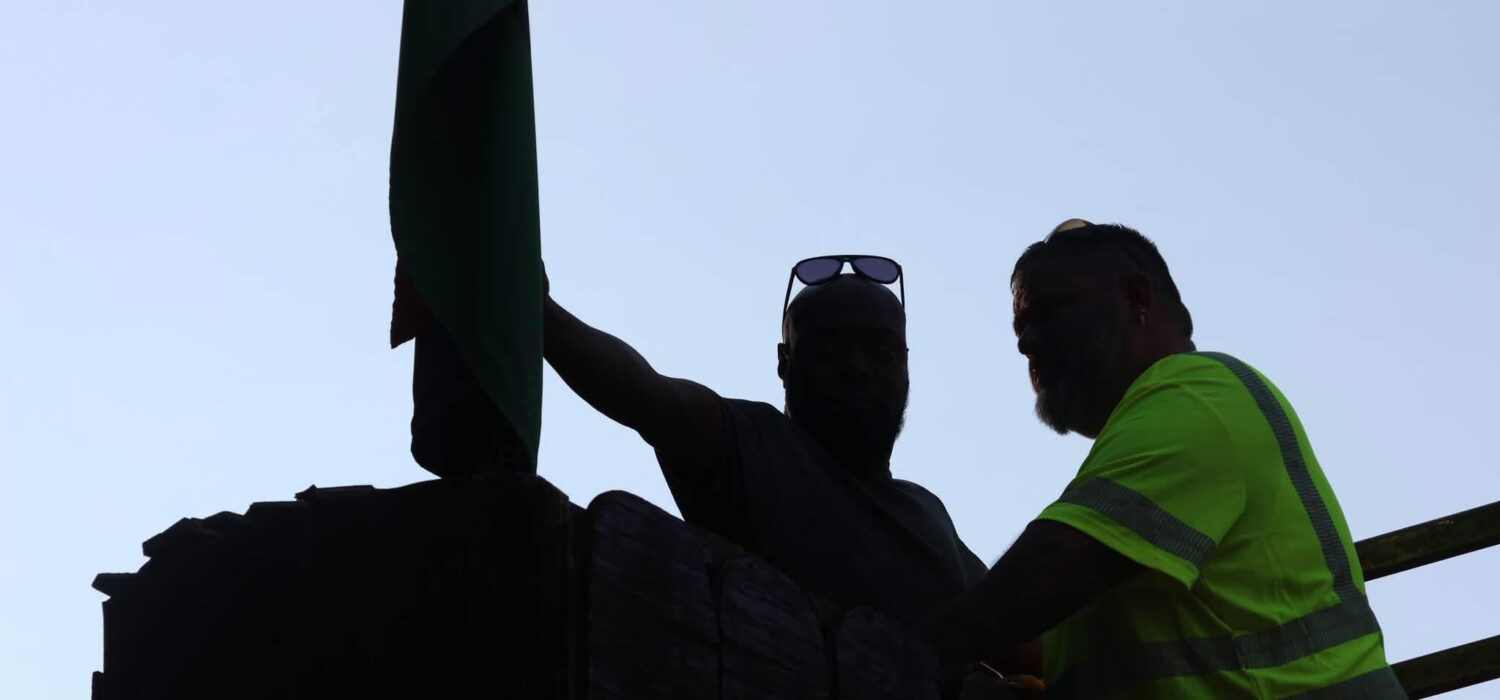
He explained that the fist was too tall to travel safely beneath the power lines with the flag still attached. He asked whether I’d ride up in the bucket loader with him and remove it.
I knew what could happen if a city employee or police officer climbed onto that fist and pulled down the Pan-African flag.
People were terrified. Their homes had been torn apart while they slept. Their friends were being arrested. Armed officers surrounded them. Heavy equipment was moving through the place where Corey had been killed.
This was the same police department whose officer shot Corey in the street.
If the city hadn’t respected the sanctity of Corey’s life, how could I trust it to respect the sanctity of the memorial built in his name?
So I cried.
I cried for Corey. I cried for Spawn. I cried for the people being dragged away. I cried for the community we’d built and everything I could feel slipping through my hands.
The unhoused people living there had been fed. They’d been protected. They’d been offered clothing, naloxone, safer-use supplies and the dignity of being treated like human beings.
For a brief moment, people Madison normally treats as disposable had somewhere they belonged.
The city ripped it away before sunrise.
I felt like I’d failed them.
I know I didn’t order the raid. I didn’t send the police. I didn’t drive machinery through their homes. But grief doesn’t always obey reason.
I’d accepted responsibility for helping protect those people because Madison had already failed Corey. Now I was watching the city force another failure upon us, and I couldn’t stop it.
I quit smoking years ago.
Before I climbed into that bucket loader, I smoked a cigarette.
Then I went up and removed the flag myself.
It was never in the city’s possession.
I made sure of that.
I carried it in my car and followed the fist to Demetral Park. When I arrived, it was still on the flatbed. The city would only place it near the edge of a sidewalk.
So I climbed into the bucket loader again.
I put the flag back where it belonged.
While I was doing that, Dr. Danyelle Wright was trying to protect what remained of the encampment residents’ belongings.
City workers were sorting through tents, bags and personal possessions. We were told that things they considered trash, including items worth less than fifty dollars, could be discarded.
But a tent isn’t trash when it’s someone’s home.
Clothing isn’t trash because its owner is poor.
Medicine, papers, blankets and photographs don’t lose their value because the person who owns them doesn’t have an address.
Dr. Wright made them stop. She demanded a supervisor. When that wasn’t enough, she demanded the supervisor’s supervisor.
Eventually, a city official arrived and worked with us to keep the remaining property safe.
Then he told me there had been chatter about the fist. Right-wing extremists wanted it destroyed.
Its location will remain undisclosed.
The city tore down the memorial.
It didn’t get to destroy everything.
We saved what we could.
The riot gear came first
The raid didn’t end when the barricades came down.
It stretched across the entire day.
Jazzman eventually arrived and took charge of what remained of the mutual-aid operation. Once she’d stabilized things enough to delegate, she went to the Dane County Jail to start helping people get released.
Free the 350 was there. Freedom, Inc. was there. People spent hours locating those who’d been arrested, arranging bail and making sure nobody disappeared into the system without support.
Everything was chaos.
At some point, I appeared on Jesse Jackson Jr.’s podcast. I barely remember doing it. I moved from one emergency to another without enough time to understand what had just happened before something else demanded my attention.
Later that morning, Madison’s independent police monitor followed officers who were moving to arrest someone else.
She was doing exactly what Madison hired her to do.
She was observing the police.
She asked officers for their badge numbers. When she extended her hand, they pushed her and physically went after her.
These were armed officers in riot gear.
She was the civilian Madison employed to monitor them.
A council member and someone from the Police Civilian Oversight Board shouted that she was the independent monitor. Only then did the officers back away.
They left a gash in her hand.
Whatever she said in the moments afterward has to be understood in the context of what had just happened. She wasn’t delivering prepared testimony from behind a podium. She was reacting after armed officers pushed and attacked her.
I immediately went looking for her.
When I found her, she was clearly not all right. Neither was I. By then I was exhausted, overwhelmed and running on whatever remained after terror and adrenaline had burned through me.
I didn’t have much care left to give.
But I stayed.
The mayor never came.
The independent monitor did.
Eventually, police withdrew, and people reclaimed the intersection.
Earlier that morning, while officers stood in armor around a community that hadn’t attacked them, I led a chant through the bullhorn:
“Why are you in riot gear? I don’t see a riot here.”
There hadn’t been a riot.
There were sleeping people. There were tents. There were frightened community members linking arms around a memorial.
The riot gear came first.
The pepper spray came first.
The arrests came first.
The garbage trucks and heavy machinery came first.
Near midnight, police returned in force. More people were arrested. Dumpsters were set on fire. The night descended into something uglier.
I didn’t set those fires. I don’t celebrate them. That wasn’t the form of protest I would’ve chosen.
But I won’t allow the mayor to begin the story at midnight.
The city didn’t deploy riot police because there was a riot. The city deployed riot police to dismantle a memorial and remove unhoused people before most of Madison had poured its first cup of coffee.
After people had been pepper-sprayed, dragged across pavement, arrested, separated from their possessions and forced to watch the place they’d built be torn apart, there was a riot.
By the end of that night, I wrote on Facebook:
“You brought cops and riot gear. Now there is a riot here.”
The mayor will point to the fires.
I’ll point to the clock.
This was a failure of leadership
The mayor’s defenders will say the situation was complicated.
It was.
That’s why we elect a mayor.
Leadership isn’t measured by how well someone manages a ribbon cutting or delivers prepared remarks when everyone already agrees. It’s measured when a city is wounded, people are frightened and every available choice carries risk.
Satya Rhodes-Conway failed that test.
On the night Corey was killed, the mayor promised transparency and accountability. Those were the right words. Then her administration oversaw a disastrous press conference that showed a grieving city its leaders had no control over the conversation and no plan to rebuild trust.
While the mayor repeated the language of accountability, Madison’s independent police monitor struggled to obtain the information she needed to conduct independent oversight.
Then came the mayor’s absence.
Council Vice President Carmella Glenn came. District 6 Alder Davy Mayer came. The county supervisor representing the area came. Pastor Everett Mitchell came. Alders from districts halfway across the city came. Clergy, organizers, neighbors and business owners came.
They didn’t all agree.
They came anyway.
Carmella Glenn was at the site day after day. Davy Mayer was there nearly every day. They entered a difficult space filled with grief, anger, exhaustion and distrust.
The mayor never did.
She didn’t have to endorse everything happening at the intersection. She didn’t have to agree with every demand, bless every tactic or defend every person.
She had to show up.
Instead, the explanation conveyed through her office was that no discernible leadership had emerged with whom she could negotiate.
I understand why the situation appeared confusing.
Many people were contacting City Hall. Some claimed authority they didn’t have. The memorial was decentralized. Different people were handling mutual aid, security, political advocacy and communication.
But confusion didn’t leave the mayor helpless.
It made leadership more necessary.
Her office knew about Jazzman. It knew about Lolo. It knew about me.
I sent the mayor’s office a structured proposal for a peaceful transition. It included emergency housing for the people living at the site, voluntary mental-health and substance-use services rooted in harm reduction, a permanent memorial honoring Corey and a defined period in which the occupation could responsibly transition.
We all knew the intersection couldn’t remain occupied forever.
We were trying to build a path out.
The mayor could’ve come to the site and asked who was sleeping there, who was responsible for mutual aid, who was handling security, who was communicating with Corey’s family and who needed to be at the table.
She could’ve asked the community to designate a negotiating group.
She could’ve convened the table herself.
A movement without a single leader didn’t give the mayor permission to abandon leadership.
Instead, she sent staff, intermediaries and other elected officials into the place she refused to enter herself.
That wasn’t leadership.
It was leadership by remote control.
Then she began dividing Madison into categories.
There were supposedly reasonable people who wanted “real change,” and protesters whose tactics stood in the way. There were established organizations doing legitimate work, and grassroots volunteers allegedly undermining them. There were people acting in “good faith,” and everyone else.
Conservative agitators were already portraying everyone at the memorial as dangerous, irrational and indifferent to the surrounding neighborhood.
The mayor’s rhetoric validated the premise of their attacks.
Then she accused the rest of us of dividing the city.
When a white man entered the memorial, shouted racial slurs, kicked candles and decorations, assaulted multiple people and threatened to kill them, the people at the site restrained him and turned him over to police alive.
He was later charged with felony substantial battery as a hate crime, along with four misdemeanors.
The mayor reduced that attack to a person confronting protesters, cursing at a crowd and pushing people.
When she described the supposed danger presented by the memorial, her language was expansive.
When racist violence entered the memorial, her language became small.
Even then, she didn’t come.
She didn’t stand beside the people who’d been assaulted. She didn’t condemn that violence with the force she later used to condemn the occupation.
She issued another statement.
As more unhoused people found food and safety at the memorial, the mayor treated their presence as evidence that the occupation had become a problem. She told the community to redirect its energy toward established organizations and suggested that grassroots support could undermine existing services.
I work with unhoused people.
I work with people who use drugs.
I know the difference between saying services exist and making sure a person can actually access them.
At Williamson and Baldwin, people who are normally chased, ignored or treated as disposable were fed. They were protected. They were known by name. They had access to naloxone, safer-use supplies and people willing to remain beside them.
The city didn’t arrive with permanent housing to replace what it destroyed.
It arrived with garbage trucks.
Then the mayor said the occupation had to end so the “real work” of healing and change could begin.
Real work?
People fed one another. They protected one another. They comforted Corey’s family. They stayed awake so vulnerable people could sleep. They restrained a violent racist without killing him. They tried to negotiate a peaceful transition. They built a community out of grief.
Some of it was messy. Some of it failed.
That doesn’t make the work unreal.
The mayor doesn’t get to remain absent for nearly two weeks and then declare that the real work begins when everyone else leaves.
She claimed there was no discernible leadership with whom to negotiate.
But when she decided to clear the intersection, the city suddenly demonstrated extraordinary organizational clarity.
It found officers and State Troopers. It found riot gear. It found buses to block the streets. It found garbage trucks, forklifts, Bobcats and a bucket loader. It found workers willing to arrive before sunrise.
It found every resource necessary to dismantle the community.
It never found the political courage to enter it.
Now she has to go
This isn’t about a personal disagreement between the mayor and me.
I agreed that the intersection needed to transition. I worked toward that transition. I proposed housing, services, a permanent memorial and a process that could reopen the street without erasing Corey or abandoning the people living there.
The difference between the mayor and me was never that she wanted the street reopened and I didn’t.
The difference is that I went there.
I listened before I spoke.
I saw the people before I judged them.
And when everything fell apart, I stayed.
Satya Rhodes-Conway failed this moment.
She failed the unhoused people whose homes were destroyed before sunrise. She failed the surrounding neighborhood by refusing to lead a genuine negotiation before the situation reached a breaking point. She failed the independent oversight system she claimed to support. She failed everyone who believed electing a progressive mayor meant Madison would respond differently when police killed another marginalized person in the street.
We shouldn’t wait until the weeks before the next election to decide what comes next.
We need to organize now.
We need neighborhood leaders, labor, clergy, civil-rights advocates, business owners, unhoused residents, harm-reduction workers and people from every part of Madison to identify and support someone capable of leading through conflict instead of governing through prepared statements.
I’m not calling for vengeance.
I’m calling for an election.
Don’t threaten her. Don’t harass her family. Don’t confuse fury with strategy.
Build a coalition.
Raise money.
Register voters.
Knock on doors.
Find someone with the courage to enter the room when the room is burning.
Madison needs a mayor who’ll listen before issuing orders. A mayor who understands that the most marginalized people in this city are still part of this city. A mayor who understands that public safety must include protection from the government itself.
We needed a mayor who would enter the wound and help us stitch it closed.
Satya Rhodes-Conway never came.
Now she has to go.