
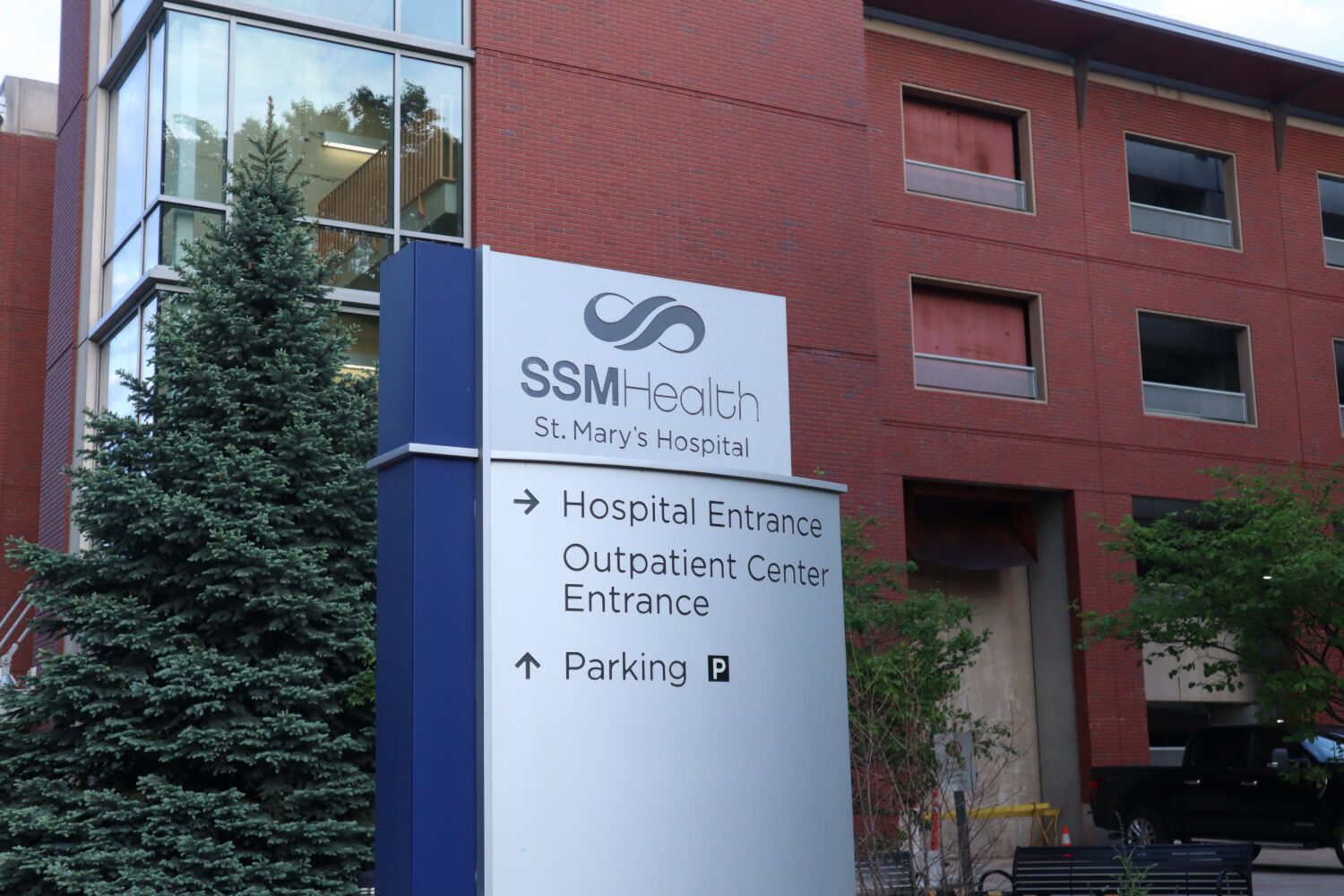
“We’re putting out fires just constantly, and we all go home feeling like we didn’t take care of our patients today. We kept them alive, but we didn’t take care of them. That doesn’t feel good,” nurses at St. Mary’s Hospital said as they look to form a union to help address issues it faces.
Nurses at St. Mary’s Hospital, 700 S Brooks St., are currently working to form a union under the Service Employees International Union (SEIU) Wisconsin. There have been other attempts in the past, with the most recent during COVID-19, which was ultimately stopped due to the pandemic, but is now set to vote to officially be represented under SEIU. The hospital is owned by St. Louis-based SSM Health.
The most recent effort comes as issues in the past have continued to worsen with problems like poor staff retention, lack of seniority in staff, poor compensation, increased pressure to do more with less, lack of ability to fully care for patients, a “productivity grid” that pushes for billing over care, cut to incentive pay, and mandatory overtime.
Organizing efforts began a little over a year ago, but this time has the most traction nurses have seen, said Patrick Masters, a nurse at St. Mary’s.
“The need is more intense. The urgency and the feeling that we’re not meeting our patients’ needs, that we’re hemorrhaging good experienced nurses who are leaving the hospital and burning out young nurses faster, is more apparent than it was,” Masters said.
Hemorrhaging talent
A common issue seen now is the lack of experience among nurses. As working conditions continue to deteriorate, more and more nurses are leaving for other opportunities. The hospital now struggles to keep its more veteran staff, and retain newer nurses to fill that gap.
Sable Dobbie, a registered nurse who works in St. Mary’s step-down intensive care unit as a charge nurse, said that she is usually the most experienced person on the floor.
“A lot of our staff has left at this point, so most of the time it’s usually me and a couple float pool nurses who don’t know the unit very well,” Dobbie said.
Dobbie has been with St. Mary’s for around two and a half years — with this as her first job out of nursing school. She is often left working with little instruction for situations she has not handled before, with almost no resources to figure it out.
“I’m not educated enough, I’m not experienced enough for not giving me the resources I need to take care of our patients,” Dobbie said. “We are the lowest-paid hospital in the area, too, where there are no retention incentives for our nurses. There’s no reason for our nurses to stick around.”
Dobbie is a charge nurse on her floor. That position is often a very senior role in charge of the nursing unit that balances care and administrative duties. However, she’s been thrusted into the position in a short period of time in her career.
“Sable is really a phenomenal example of what’s happening in our hospital with staff,” Masters said. “When I started in the ER, it was understood that it takes two years for you to get your legs under you.”
The common belief is that it will take at least two years to feel like you can do the job. You won’t be great yet, Masters said, but you’re able to come to work confident that you can get through the day.
“This is the norm now that we have very new nurses having to step into charge positions, take heavy patient loads, and Sable is doing amazing,” Masters said. “But it’s not fair to her, and there’s a lot of nurses that it’s not going well for.”
Dobbie is an example of one of the few who powered through, but many cannot make it the full two years under current conditions and ultimately leave.
“I’ve brought it up to management too, because I was like, ‘I don’t think I have enough experience to do this job, but I also don’t see what other options you have,’” Dobbie said. “I’m now the most experienced on the floor. I’ll do it because you need me to do it, but I don’t think it’s a good idea. It’s not safe.”

Less time to care for patients
St. Mary’s uses a “productivity grid” to push for profitability at the hospital. The system compares billing to the number of hours of work that go into a patient. Nurses are forced to treat the hospital as a revolving door by management to get more patients in and out as quickly as possible to bill as much as possible.
That, coupled with poor staffing, causes a shortfall in the spectrum of care provided.
“The problem with productivity grids is that when you are the most productive, the system isn’t good for the patient or the nurse,” Masters said. “We don’t bill for having a nice conversation with a patient who’s having a hard day. We don’t bill for fluffing someone’s pillow, or even just paying attention. We’re only billing for procedures and meds.”
The system “keeps the dial turned to 10 constantly,” Masters said.
“You’re always just running around. You’re always choosing what you’re skipping, who you’re neglecting, versus who you’re going to deliver primary care to. It’s exhausting,” Masters said.
A constant run prevents nurses from educating patients, which causes a high readmission rate.
“Nursing used to start on the foundation of education,” said Savannah Nesvik, a nurse at St. Mary’s for seven years. “I find myself not even having time to educate my patients on the reasons of what brought them to the hospital. Like this is the third time you’ve been in the hospital for diabetes … but they don’t have the means to be educated because we don’t have the time.”
Nesvik gave a hypothetical on how many patients she would see in a 12-hour day. She, on a typical day, would see five or six patients a day, which would only leave two hours per patient for care. She can, hopefully, manage to take a 30-minute break sometime in her shift, but there are still other duties like charting that are separate from immediate care.
“If you have a rapid response or blowout, there’s so many things that could happen that pulls your time, and all of a sudden you’ve spent four hours of your day with one patient, which means other patients are getting neglected,” Nesvik said.
The feeling of not being able to provide adequate care “makes you feel like a horrible person” and “not the nurse you want to be,” Nesvik said. There is no time to stay in a room to teach.
“[Management doesn’t] care about that when it comes to productivity, because they estimated you should have five patients for your floor, even though three of our patients are acute, but the ICUs are so full that we can’t go to the ICU,” Nesvik said.
A hope with the union is to be able to have better staff ratios to provide some level of cushioning for nurses. That would translate to better nursing care, outcomes and lower readmission rates, said Lynette Willsey-Schmidt, another nurse at St. Mary’s.
“That should matter to all of us, including the administrators,” Willsey-Schmidt said. They’re not just patients. These are people. This is their lives. This is their loved ones. Everyone is affected in their life.”
SSM union busting
St. Mary’s parent company, SSM, has expressed strong opposition to the union’s formation. It has stated that it does not believe that a third party, SEIU, is needed.
Madison365 requested comment on alleged union-busting activity. In a statement to Madison365, SSM stated:
“SSM is committed to high-quality, patient-centered care and maintaining our facilities as places of healing. To support this care, staffing is based on patient needs, ensuring appropriate levels of care based on the severity of each patient’s condition. We also maintain policies that support a safe, respectful healing environment for our patients and their visitors, including guidelines on dress and restriction on non-patient-focused, non-work-related activities in patient care areas. As health care systems face rising costs, regulatory changes, and workforce challenges, we are focused on balancing patient care, employee well-being, and financial sustainability — an effort we believe is best achieved without the addition of a third party.”
Nurses allege multiple different union-busting efforts by SSM.
Management has been seen walking down halls and pouring water on anything union-related, then setting out their own anti-union literature.
Nurses report that some have been taken aside and threatened with indefinite suspension, which is considered interfering with employees’ right to unionize.
Other instances include cancelling t-shirt day with the theory that it was aimed to prevent nurses from working in SEIU shirts.
Management has also called wearing SEIU pins the same as “supporting the KKK,” according to multiple nurses.
Screen savers have been changed on hospital computers telling nurses to vote no on unionizing, a Reddit post shows.
SSM did not comment on any allegations in its statement to Madison365.
Still, nurses have moved to be creative in their support for the union. Many have turned to small accessories like painting their nails, changing their shoe laces and wearing scrubs that match SEIU’s purple, gold and white color scheme.
Vote scheduled soon
In the midst of SSM’s union-busting efforts, it failed to submit its Statement of Position to the National Labor Relations Board (NLRB) on time.
Its failure to submit by the deadline has forfeited SSM’s right to litigate key issues — such as voter eligibility and consideration of an appropriate bargaining unit — at St. Mary’s pre-election hearing, according to the NLRB.
SSM is required to waive its right to raise objections regarding voter eligibility, the scope of the bargaining unit and supervisor classifications for its failure to comply on time. It is working to appeal to the NLRB to consider its late Statement of Position.
St. Mary’s nurses expect the union to form, with a current estimate at 73% in favor of unionizing.
A formal vote is anticipated for the end of May or early June. Bargaining sessions will take place soon after.