Democratic gubernatorial candidates gathered at the Center for Black Excellence and Culture for another forum to discuss issues of affordability on July 20.
The most recent forum was hosted by Kaleidoscope Wisconsin, a statewide coalition of organizations and individuals from marginalized communities that looks to change prenatal-to-age-three systems to change outcomes for babies and families. The forum saw only three Democratic candidates from the lot: Rep. Francesca Hong, Senator Kelda Roys and former Lt. Gov. Mandela Barnes. Joel Brennan and Milwaukee County Executive David Crowley, who recently rejoined the gubernatorial race, were not in attendance.
Angela Russell, host of the Black Oxygen podcast, moderated the panel, where she deviated from how other forums have flowed. She kicked it off with a typical, “why are you running for governor?” question before switching to a lightning round.
The lightning round asked more personality and humor-based questions for the three to make attendees more familiar with candidates outside of the political spectrum. Questions included go-to dance move, karaoke song, famous person living or dead they would like to have a meal and speak with, favorite 90s song, fun facts about Wisconsin and hidden gems in the state.
Hong’s go-to move was clapping, 90s song Brittney Spear’s “… Baby One More Time,” Gloria Gaynor’s “I Will Survive” for karaoke, Robin Vos as her famous person to have a meal with to ask him about why he pushed all the policies he made and eat kimchi fried rice. Sewer socialism was invented in Milwaukee was her fun fact and the Cranberry Marsh in northern Wisconsin as a hidden gem in the state.
For Barnes, the two step; “Crossroads” as his favorite 90s song, but he did not say if it was the dance hit by Terry Man or song by Bone Thugs-N-Harmony; “My Song” by Elton John; Nelson Mandela, who he has is named after, and make something quick in the air fryer; the shipwreck called “Home” which was used to transport enslaved Africans through the underground railroad from Wisconsin to Canada; and Milton House in Milton, Wisconsin, that was a stop on the underground railroad.
For Roys, it’s dependent on the music, any Boyz II Men song, no preference in karaoke song as she is prone to break out into song anytime, Loretta Ross as her person, Wisconsin is the home to the first kindergarten, as a fun fact and Parfrey’s Glen as a beautiful place to hike and take in nature.
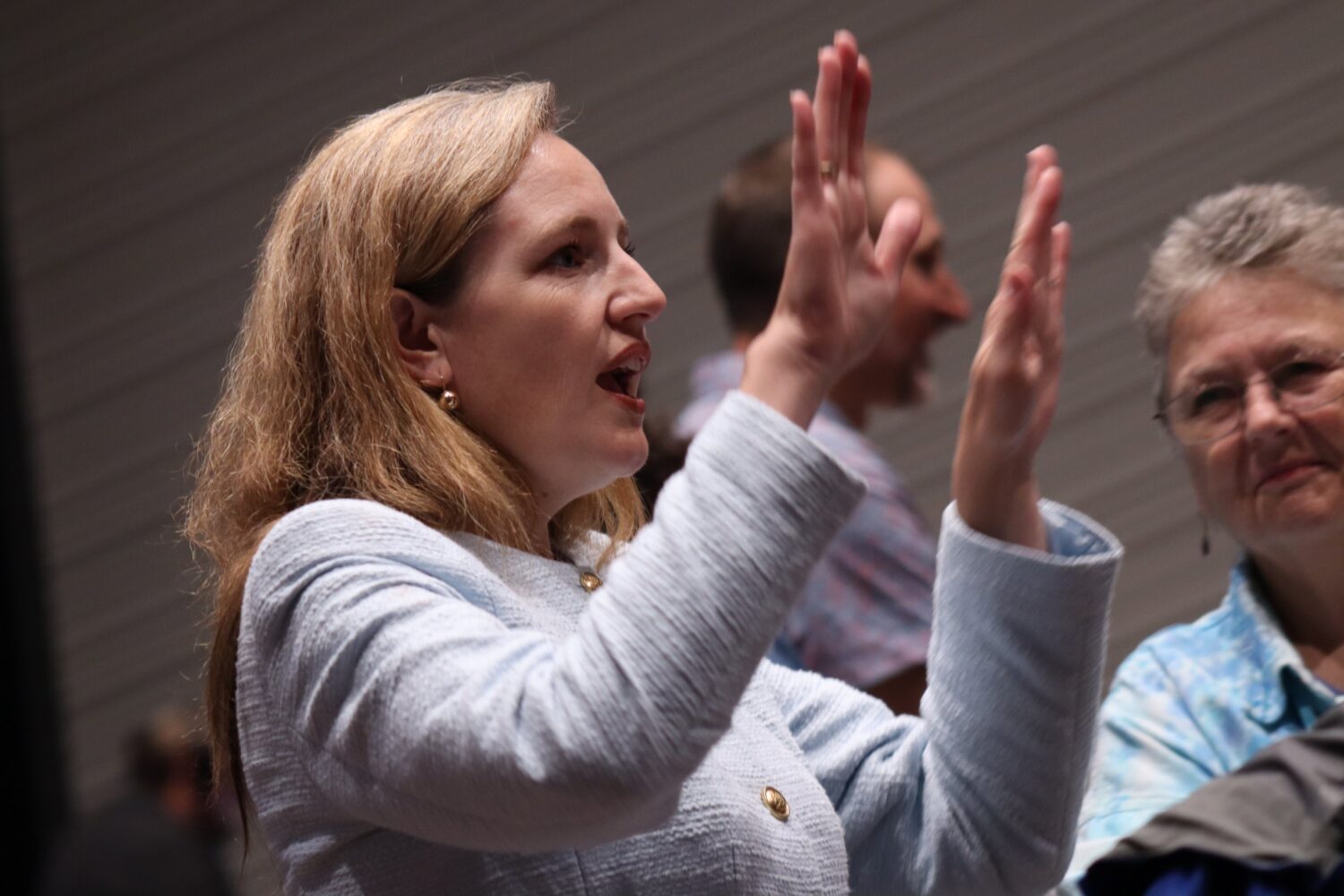
(Photo by Omar Waheed)
Approaching a divided legislature
The first full question of the forum asked how candidates can make meaningful changes if faced with a divided legislature compared to one controlled by their own party and break down silos to ensure the people can access services.
Barnes answered with, “Nothing works anymore.” The friction in the system is the barrier and that system doesn’t work and hasn’t worked for a long time, party lines are not the main concern, Barnes said.
“Everything is really, really broken. Childcare, healthcare, housing, education, all of our systems are either not working or on the brink, and that’s the problem corporate greed has brought upon us,” Barnes said. “We are still dealing with the impact of the decisions that the wealthiest among us in our society have made. They have made their virtually unlimited sums of wealth, and they’ve run away with it.”
He noted that there has been no accountability for their actions. Tax increases have been the answer to keep some services alive, but that puts the onus on residents and not those who have “left devastation… in their wake once they left.”
Barnes believes corporations should be taxed, and that money should go directly into schools to trickle into a better society that will yield better jobs.
Roys recounted her long history within the government and being able to pass laws despite what the legislature looks like. She noted that restoring bargaining power to state employees stripped away by Act 10 is the stepping stone for better action.
“When you politicize agencies, and you always have to be looking over your shoulder to see if you’re going to be punished for talking to a legislator or coming up with a new idea, you end up in a very risk-averse place,” Roys said. “Mandela is right. Nothing works. Everything is terrible, and the government can’t solve problems. And a lot of that has to do with political dysfunction and money in politics.”
Roys believes a lot of that dysfunction has to do with how the state has deprived employees, the “front-line people closest to knowing… what people are looking for,” she said. That has led to a decades-long bottleneck in how the state can progress in wages, improvements of infrastructure, tax codes, technology implementation and more.
Hong said that it depends on who you surround yourself with and fostering a commitment to leaders that serve the interests of the community. She agreed with Roy’s point on restoring bargaining power to state employees.
“It’s a non-starter. We are working under crisis response mode, and that requires efficiency, organization and ensuring that resources are being allocated effectively across agencies,” Hong said.
Hong noted her campaign and how it has worked towards getting everyday people involved from all walks of life to combat party division.
“It’s why we invested so heavily in organizing a ground game and have people knocking on tens of thousands of doors talking about the importance of electing Democrats to make sure that when we elect Democrats, we can legalize weed and put those tax dollars into investments that we need. That when we elect Democrats, that’s how we’re going to be able to make sure that we’re taxing the ultra-rich and putting that revenue back into our communities,” she said.

(Photo by Omar Waheed)
Fair taxation
Hong, Barnes and Roys have all voiced their desire for more updated taxation to better fund schools, public infrastructure and community investments. The three believe that the ultra-wealthy and corporations need to pay a fair share, and that the burden should not have to continuously increase on the lower and middle classes who — often — are effectively taxed at a higher rate.
Candidates were asked what one specific policy they would implement in their first proposed budget is.
Roys wants Wisconsin to return to its progressive roots with progressive taxation and end breaks that allow large corporations to pay less than people and small businesses.
“I think we have given millionaires and billionaires who have benefited the most from what society has to offer … a free ride, and it comes at everybody else’s expense. And we’ve done the same thing with businesses,” Roys said. “We’ve never had workers taking home a smaller share of the wealth that we create, and those very top taking home a greater share. We are more gilded than the Gilded Age. Tax policy is part of a solution for that.”
Hong agreed with Roy’s points, but also pointed towards ending the Manufacturing Agricultural Tax Credit. The tax credit used by manufacturers allows for some businesses to have an effective tax rate as low as 0.4%. There is no maximum dollar limit to the credit, but it cannot exceed gross tax calculated for a business.
The credit costs Wisconsin around $400 million a year, Hong said.
“This is a credit we have to repeal and make sure we actually help some of our smaller farmers, as opposed to giving some of the large corporations a tax credit that is close to zero,” Hong said.
Measures to change taxation will help towards reaching goals Hong will push for as governor if elected. She aims to use the increase in tax revenue to fund programs like childcare and fully funding schools.
Barnes spoke on how communities have voted time and time again to raise their own taxes to compensate for what is lost by offering extensive tax breaks to the wealthy and corporations.
“It feels like a historic number every single year, or every election cycle, going to referendum to just fund the school system, just to keep the lights on, just to keep teachers in the classroom,” Barnes said. “Many of our schools need significant upgrades to equipment and technology, but our state has not fully funded our public schools as we should, and it’s creating a problem.”
The answer for how schools can be fully funded was clear to Barnes. He pointed to the surplus and said there is money, but it needs to be allocated correctly, and progressive taxation needs to be implemented.
“We need to have long-term sustainable funding. We can’t just count on a one-time surplus to get us out of this hole and ultimately leave people with the rug pulled from underneath them the following year, or the following budget cycle,” Barnes said.
He also agreed on ending the Manufacturing Agricultural Tax Credit. Another point Barnes makes is that tax breaks should not go to companies that do not pay a living wage. That priority should be on Wisconsin businesses versus large out-of-state corporations.
Equal voice for underrepresented communities and trust in government
Candidates were asked how they would work towards getting underrepresented communities — racial, ethnic and rural — equal voices in decisions outside of Wisconsin’s population centers like Madison and Milwaukee.
For Hong, actually hitting the streets across Wisconsin is key to getting communities to feel like they have a place in our democracy.
“I was elected in 2020 to one of the most progressive districts in the state, and one of the first things I did when I was elected was get the hell out of Dane County,” Hong said. “What I realized was it’s not just about having a seat at a table.”
Hong said that a gratuitous seat is a meaningless gesture, or a “seat warmer.” Building a coalition with community members who actually represent the people is the key to securing a meaningful seat at the table.
Barnes spoke on his origins as an organizer and time as a legislator. He would often be asked, “What do you talk about when you get outside Milwaukee?” When talking to people, he finds everyone wants the same thing: to send their kids to a good school, a job that puts food on the table and be able to see a doctor without worrying about the cost.
“That is a reality that has been consistently denied across the board, regardless if you’re in a city, if you’re in a rural community, regardless of your race, regardless of your religion,” Barnes said. “Things have been difficult for a long time, and as we continue to have conversations about the affordability crisis, the reality is that this is nothing new. It just spread to more areas where it wasn’t exactly as prevalent as it is now.”
An intentional effort to bring people of all walks of life is needed to get people to feel that their voices can be heard and be empowered to speak for themselves is the path to “actually fixing things,” Barnes said.
Roys said that the current state of the government has taught people that they cannot rely on their elected officials. She pins that on the influence of money and gerrymandering to sway election results to the most powerful, not the people.
“We have the best democracy money can buy, and that’s not that great of a democracy,” Roys said. “We need a governor who is willing and able to use power to make people’s lives better. That is what we have been missing most of all in our politics. It is people who are willing to stand up and lead and use political power.”
They do not feel that their voice or vote matters, because it doesn’t materially change their life, Roys said. Her solution is to implement policy interventions that make it easier for people to have their voices heard and to throw the full weight of the governor’s power to make changes.
The primary election will be held Aug. 11. Candidates will debate later this month on July 28 at Marquette University.