
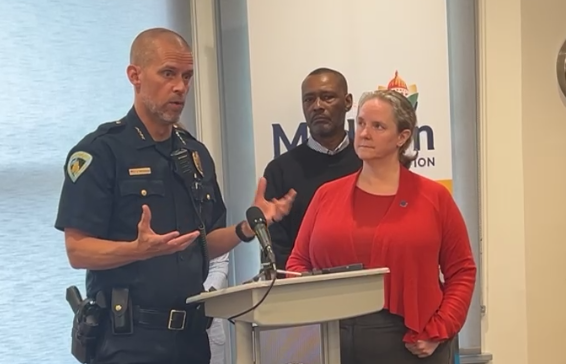
A $350,000 grant from the Madison Community Foundation will allow the Madison Police Department to equip all of its public-facing officers with body-worn cameras by the end of 2027, two years ahead of the city’s original timeline, Mayor Satya Rhodes-Conway announced Thursday.
The city had planned a three-year phased rollout that would have outfitted only officers in the North District by the end of 2027. Rhodes-Conway said the foundation reached out to the city with an offer to help close the funding gap.
Rhodes-Conway said a phased rollout would have been unfair to residents. “It is just simply not fair to have one police district have cameras and others not,” she said.
“Thanks to a generous grant from the Community Foundation, I’m very pleased to announce that every Madison police officer will be equipped with a body-worn camera, not in three years, but by the end of next year,” Rhodes-Conway said at a press conference at the foundation’s office.
Rhodes-Conway said Police Chief John Patterson requested a body-worn camera program early in this year’s budget process.
“He was persuasive in convincing me that we could no longer be an outlier on this subject, and that he was willing to make tough choices in his budget to make a body-worn camera program happen for the city of Madison,” she said.
The one-year grant will fund the hiring of two IT specialists and one forensic analyst and cover most of the program’s software costs, which Rhodes-Conway put at about $100,000 a year. The police department will absorb the remaining operating costs, which the mayor estimated at between $30,000 and $40,000, within its existing budget. The city plans to apply for a U.S. Department of Justice grant, which requires a 50-50 match, to help pay for the 220 cameras the program will need.
The program still requires several Common Council approvals. Rhodes-Conway said she will introduce a capital budget amendment at the Finance Committee to advance funding for the equipment. The operating funding will be included in her executive operating budget, and the grant agreement with the foundation will also go before the council.
“I do not anticipate it being a problem to pass any of those items through council. I think there is broad support for this on the council,” she said.
Foundation president and CEO Bob Sorge opened his remarks by offering condolences to the family and friends of Corey Ruiz, shot and killed by Madison police on July 22.
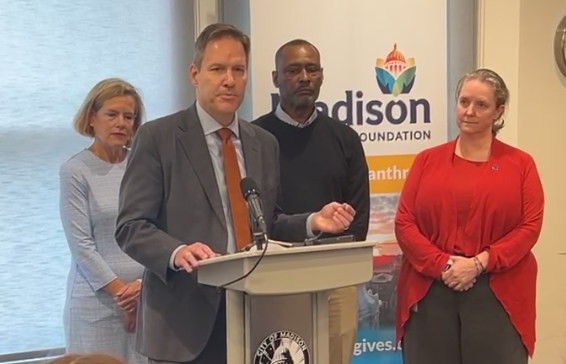
“The events of the past several months have brought renewed attention to questions of trust, transparency, and accountability in our community,” Sorge said. “They have also renewed a long-running conversation about body-worn cameras for our public-facing officers.”
Sorge said philanthropy can help but cannot answer those questions on its own.
“Nor do we believe philanthropy can solve our community’s challenges on its own. But philanthropy does have a role to play,” he said. “What stood in the way of moving more quickly was a financial barrier. Madison Community Foundation can remove that barrier … This is an unusual grant for the community foundation, but it is consistent with our mission to advance a more vibrant and equitable community.
He was joined by board chair Ann Lucke and board vice chair Noble Wray, a former Madison police chief. Sorge said the foundation contacted the city in mid-August.
“Funding body-worn cameras is not in itself a solution to all the issues surrounding policing accountability and community trust. That work belongs to the entire community,” Sorge said.
“While we know that body-worn cameras are not the tool that will fix every strained relationship, they absolutely can play an important role in rebuilding trust and improving transparency,” Patterson said.
The 220 cameras will be held in a shared pool available to uniformed officers assigned to direct contact with the public. “Patrol officers, community policing officers, neighborhood officers, traffic officers — they will all have cameras, and the expectation will be they’re wearing them when they’re on the street,” Patterson said.
Patterson said cameras will most likely be in use by early summer, after devices are distributed, staff are trained, and the new positions are hired.
Patterson said will be reviewed regularly by a new Service Excellence and Outreach section, which Patterson said is being formed as part of a department reorganization that eliminates the community outreach section’s current positions. Staff will use footage to review use-of-force incidents and evaluate procedural justice in officers’ encounters with the public.
“You can’t just have the footage and not review it, not audit it,” Patterson said.
Sorge said the foundation discussed with the city a desire for community involvement in shaping the program’s policy and operations.
Patterson said patrol officers criticized a 2024 pilot policy as difficult to follow. “There were a lot of ‘if this then that.’ I think we want to try to simplify it so there aren’t mistakes, either intended or unintended ones,” he said. He said the department will also draw on a 2023 national model policy from the Police Executive Research Forum.
The city’s Office of the Independent Police Monitor was not mentioned during the press conference. Independent Police Monitor Aeiramique Glass, reached after the press conference, said she welcomed the program but objected to how her office had been treated.
“I am encouraged that BWC is finally coming to pass, and I am also deeply concerned and disappointed because of the attempt to overstep and ignore the office of the independent police monitor, and to truly convey the level of commitment towards strong oversight and policy around the implementation and use of body-worn cameras,” Glass said.
“I hesitate to say that Madison feels unanimously about anything, but I do think that we are much closer to a consensus that this is a good tool for the police department to have,” she said. She said the price tag in the pilot program’s report “was much larger than the city could possibly absorb” before Patterson reworked it. “There was a path to make it happen over multiple years, but there is no way we could have made it happen in one year without the community foundation,” she said.
A condition of the grant requires the city to continue funding the program in its 2028 budget and beyond. Rhodes-Conway said the program’s long-term health depends on state budget limits, including the expenditure restraint program, levy limits and shared revenue. Without changes, she said, “it is going to be increasingly hard for every city, including Madison, to maintain programs like this, and frankly, every other service we provide.”
“I do think that very much depends on who is elected in November, and I won’t say anything more partisan than that,” she said.