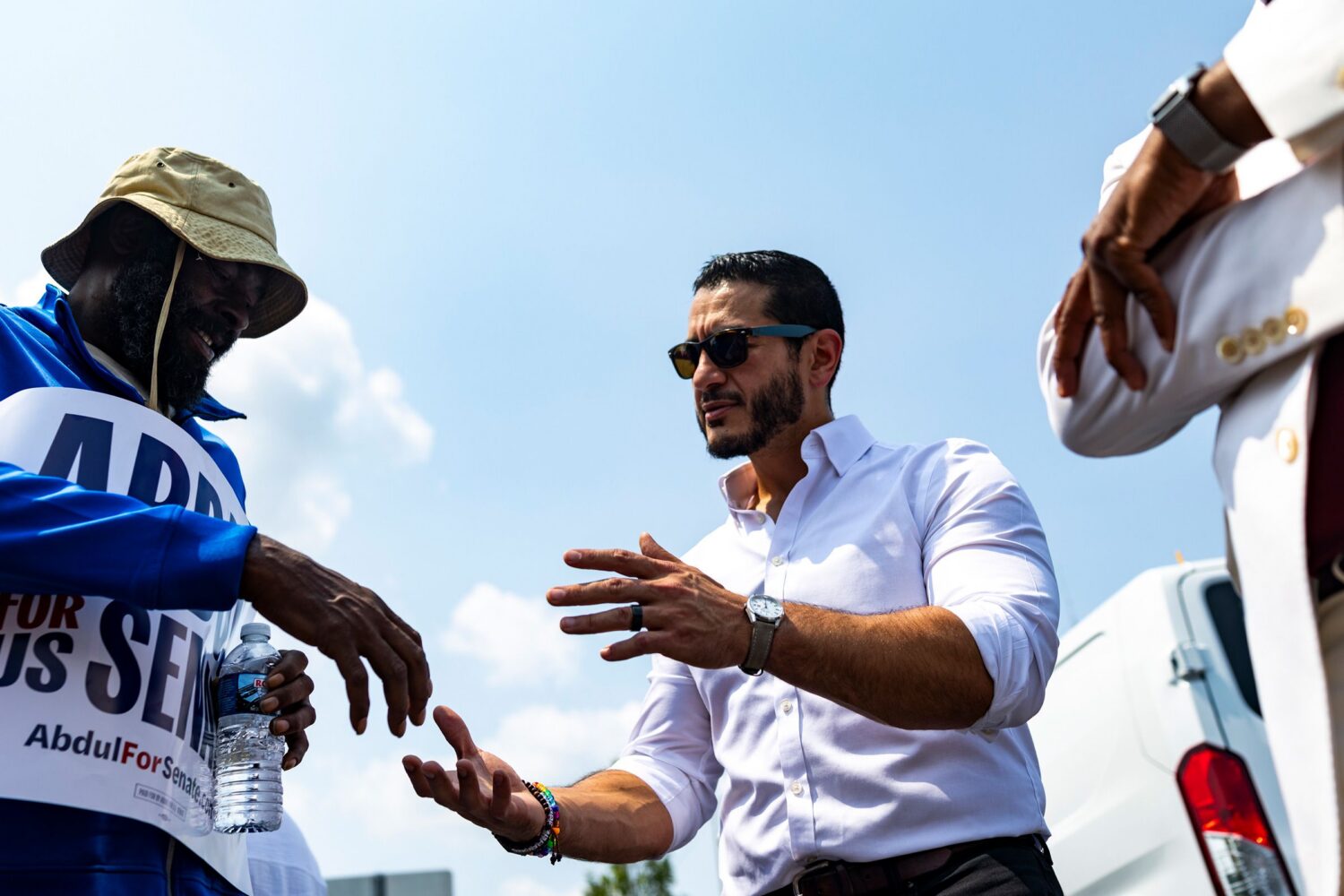
Pontiac, Michigan (CNN) — Larry Nix pulled into a cookout hosted by Abdul El-Sayed’s campaign on Sunday, rolled down his window and told the progressive Senate candidate he needed answers.
Nix, a 63-year-old Army veteran, shares some of El-Sayed’s concerns with the direction of the country. He’s furious at how high the war in Iran has driven up the price of gas for his Ford Expedition, and he thinks Democratic leaders in Washington are “getting a little soft” when it comes to taking on President Donald Trump.
But El-Sayed’s more moderate opponent in the August 4 primary, four-term Rep. Haley Stevens, has come to Nix’s house during previous congressional campaigns, spoken with him and put a sign in his yard. “That’s my girl,” he told CNN.
Nix had also seen the barrage of television advertisements portraying El-Sayed as disparaging toward women, highlighting his past criticism of former first lady Michelle Obama’s anti-obesity initiative. “I’m a big pro-Obama person and you’re dogging his wife,” Nix said of his concerns. He told El-Sayed he wanted to know “what the hell is going on.”
The battle over the direction of the Democratic Party is being waged in conversations like this one, in a parking lot in Pontiac where El-Sayed’s campaign was hosting a get-out-the-vote gathering after he visited Black churches in the area.
The 41-year-old son of Egyptian immigrants is seeking to deliver the party’s progressive insurgency its biggest win yet in the Michigan Senate primary. But he is running into resistance among Black voters, many of whom say the establishment he eschews has delivered for them in important ways.
El-Sayed, a former public health official, told Nix the same thing he’d told about 40 attendees at New Bethel Baptist Church minutes earlier: The ads were a distortion of previous comments he’d made about Michelle Obama, Michigan Gov. Gretchen Whitmer and more, and an example of why he was running to get big money — including that of the American Israel Public Affairs Committee, which has spent millions on ads opposing El-Sayed — out of politics.
“He opened my mind,” Nix said of El-Sayed. “I’m going to go home and do my research, and then I’m going to decide if he switched me over.”
But El-Sayed may still have an uphill battle ahead of him. Dozens of interviews across the Detroit metropolitan area over the first weekend of early voting revealed the skepticism he faces among Black voters like Nix.
The Senate primary has emerged as this year’s most important test of the party’s ideological gulf — with El-Sayed and Stevens, the favorite of the Democratic establishment in Washington and in Michigan, squaring off in a race that is both critical to Democrats’ hopes of claiming a Senate majority in November, and an early preview of the battles to come in the 2028 presidential primary.
Black voters make up about one-fifth of the state’s Democratic primary electorate, and they have a history of overwhelmingly backing the more moderate candidate in similar ideological battles in Michigan. Hillary Clinton bested Vermont Sen. Bernie Sanders by about 40 percentage points among Black voters in the state’s 2016 presidential primary, exit polls showed, and Joe Biden racked up a similar margin in 2020 against the progressive stalwart.
Sanders’ weakness with Black voters was the obstacle he never overcame, although he narrowly defeated Clinton in Michigan in 2016 while losing to Biden in 2020.
Now, those voters are once again a focal point in the primary’s closing stretch, as El-Sayed seeks to chip into Stevens’ advantage and Stevens looks to run up a big enough margin to overcome El-Sayed’s edge among White progressive voters.
Some of the skepticism El-Sayed faces is fueled by the negative advertisements like those Nix highlighted. But he’s also hampered by lingering resentment from prominent Black Democrats who view his initial support for the “uncommitted” movement in the state’s 2024 presidential primary as ultimately helping President Donald Trump win Michigan that November and who worry about his campaign’s focus on opposing US support for Israel.
Other voters said Stevens, a White woman, has been an extremely active presence in their communities since being elected to Congress in the Democratic wave of 2018. More pointed to her role working on President Barack Obama’s task force that rescued the automotive industry — the economic driver of southeastern Michigan.
At the Soul Day Festival at Northwestern High School in Detroit, which Stevens attended on Saturday, it was the portion of her biography that voters were most familiar with — and an example of the achievements of a Democratic establishment that El-Sayed has cast as a failure.
“She was on the team that helped save our state when Obama was president. She was right there on the forefront,” said Kathie House Vinson, a retired college administrator who lives in Detroit.
“I think in my heart of hearts that (El-Sayed) is a good candidate,” she said, “but Haley has the track record, and I know what she’s done for me.”
A proving ground for progressives
For the Democratic Party’s ascendant progressive insurgency, Michigan is a proving ground — a perennial presidential battleground where the stakes are much higher than the handful of House primaries in deep-blue districts where progressive challengers have ousted incumbents this year.
The winner of next’s month Senate primary will take on Republican former Rep. Mike Rogers in the race to replace retiring Democratic Sen. Gary Peters. For Democrats, retaining the seat is crucial to the party’s hopes of the net four-seat gain they’d need in November to win the Senate majority.
Leaders of the progressive movement, including Sanders and New York Rep. Alexandria Ocasio-Cortez, have lined up behind El-Sayed. The more moderate establishment, including Senate Minority Leader Chuck Schumer, a slew of top current and former elected officials in Michigan, the Congressional Black Caucus’ political action committee and influential South Carolina Rep. Jim Clyburn, are supporting Stevens.
Stevens, when asked about her Black support, pointed to her efforts to secure investments in infrastructure and Black-owned businesses, as well as support for Michigan’s manufacturing sector.
“My campaign approach is to campaign like I govern, and govern like I campaign. To show up, to be trusted, to listen, to hear from folks, and then to lead for them,” Stevens told reporters Saturday at the Soul Day Festival in Detroit.
El-Sayed, who boasts his own long list of Black supporters, told reporters Sunday that Stevens’ advantage among Black voters comes down to ad spending.
“It’s what $60 million in advertising does,” he said after a church visit. “There’s a reason they spend that money. … Sixty million dollars is what you need to move a message that does not really offer anything to anyone unless you’re a corporate PAC or AIPAC.”
Outside groups have committed about $51 million to running ads boosting Stevens or attacking El-Sayed, including $30 million from the United Democracy Project, the AIPAC-aligned super PAC, according to AdImpact data.
For some Black voters who to CNN, the ideological schism is a major factor.
Demetria Card, a 68-year-old Pontiac housewife, said she is “not progressive really at all,” and thinks Stevens is “the voice of the people.”
Most, though, downplayed the role ideology is playing in their primary votes.
Card’s daughter, 45-year-old Natasha Bartley, an information technology student in Novi, said she is backing Stevens because she’s consistently shown up for her community.
“This won’t be the first day she’s been somewhere that we’ve been,” she said. “You know, she seems approachable. I talked to her. She seems like she’s honest. You know, doesn’t look like she’s hiding anything, and I like that.”
Likewise, Rex Close, a 54-year-old HVAC technician in Pontiac, said he voted for El-Sayed because he’s “an honest guy.”
“I listen to everything he’s saying, what he’s going to do, and I believe him,” Close said.
Lingering resentment over ‘Uncommitted’ movement
But in conversations with prominent Black leaders from Michigan about the state’s Democratic Senate primary, a recurring complaint came up: El-Sayed’s support for “uncommitted” in 2024.
The pro-Palestinian protest movement was a critical factor in Michigan, with its large Arab immigrant community, as opponents of the war in Gaza voted “uncommitted” on Democratic presidential primary ballots to register their dissatisfaction with Biden’s steadfast support for Israel.
El-Sayed, a prominent Arab American then serving as director of the Wayne County Department of Health, publicly backed “uncommitted,” which garnered more than 100,000 votes in the state.
While Biden ultimately withdrew and the party attempted to rally around former Vice President Kamala Harris, Black leaders in Michigan who spoke to CNN in recent weeks remain convinced the effort did lasting damage to the Democratic presidential ticket’s chances that year.
“Many people believe that he was a part of that. And had Kamala Harris been elected, we would not be in the mess we’re in right now. Gaza would not be what Gaza is right now,” said Rev. Dr. Anthony Wendell of Fellowship Chapel, the president of the Detroit chapter of the NAACP and a Stevens supporter.
Though El-Sayed ultimately endorsed Harris, and encouraged his followers to vote for her, his critics argue it was too little, too late. As he runs for US Senate with an ongoing focus on US policy toward Israel, doubts also linger about El-Sayed’s priorities.
“The question is now: Are you going to be more concerned about the West Bank than the West Side of Detroit?” Anthony asked.
Remarks from a Farmington school board member Angie Smith also made waves over the weekend, when she told local reporter Sam Robinson that she was backing Stevens because she believed the congresswoman would represent all races.
“We need someone that can represent all of us. Not just one race, but all races,” she said in a clip that circulated online. “You have to know how to work the room. Don’t come out speaking only Arabic. Don’t come out with your Arabic music on. Represent everyone.”
Stevens’ camp denounced Smith’s comments.
“Haley disagrees with and disavows this comment. Her campaign is about bringing Michiganders together, not dividing them,” spokesperson Arik Wolk said in a statement.
El-Sayed’s campaign is working to address those critiques. His campaign launched a new TV ad, touting his role as “the first Muslim American leader to endorse Kamala Harris for president.”
Whether it’s enough to overcome enduring skepticism is an open question.
“The bottom line is, he’s been a little cute with that. He was with the ‘uncommitted’ during the primaries when it was convenient,” said Keith Williams, the chairman of the Michigan Democratic Party Black Caucus who is backing the congresswoman. “He was a part of the movement in the beginning. So to me, you can’t have your cake and eat it too.”
Darius Jones, the founder and president of the National Black Empowerment Action Fund, said El-Sayed is “going to continuously have work to do to repair that breach.”
“It definitely didn’t do anything to benefit people from my community in the Midwest,” he said. “And I think this was a situation where the political judgment of people who were in the leadership of that movement should be called into question, and Black folks have real questions around that strategy.”
Other Black Democratic leaders in Michigan said they don’t think the “uncommitted” movement will play a major role in the outcome on August 4.
Virgie Rollins, the Democratic National Committee’s Black Caucus chair and a Michigan power broker who has not endorsed in the Senate race, pointed to El-Sayed’s ultimate support for Harris.
“I had 50 Arab leaders in my house, and he came in to talk. He talked to them in order to support Kamala,” she said. “I don’t see a big issue with uncommitted with Abdul. I think it’s an issue, but it’s not a big issue.”
She added: “If he wins the nomination, everybody will be behind him, 100%. I can guarantee that.”
Wayne County Commissioner Martha Scott, who appeared in a pro-El Sayed ad, also downplayed the role any lingering resentments over the “uncommitted” movement will play but acknowledged the 2024 loss is “on all of our minds.”
“You know, we just keep working at it and hope things change for the better for people,” Scott said.
Stevens’ personal connections
Online, Stevens’ heavy Michigan accent — on display in a recent viral clip in which she told a crowd she was campaigning with “a little bit of stick it to ‘em” — often is the target of mockery. In person, though, it plays much differently.
The word Black voters most frequently used to describe Stevens in interviews with CNN was “fighter.” Those who had met her said she came across as more genuine than most politicians.
“I vibe with her,” said Kelly Garrett, the former mayor of Lathrup Village, just northwest of Detroit, shortly after a Stevens rally in Detroit Friday night attended by Whitmer and Clyburn.
Garrett said she got to know Stevens when the congresswoman called her after Garrett’s 21-year-old son died from sickle cell anemia in 2021. About a month later, she said she was surprised when she received a package from Stevens’ office containing a flag that flew over the US Capitol.
The two have become close since, and Garrett — who spoke to CNN minutes after electrifying the crowd at the rally — said they often talk when Stevens “needs to be pumped up.”
“The person you saw on stage is the person you see at home, and is the person you see out. That’s who Haley is. There is no different person,” Garrett said. “And if she sounds like she has a twang, I’m down with it.”
In Detroit and Pontiac, many people — including those who are not active in politics — said they’d met Stevens not just once, but several times.
At El-Sayed’s gathering Sunday in Pontiac, an elderly woman who asked not to be named said she appreciated that El-Sayed showed up, but said she’d met Stevens four times over nearly a decade, and that the congresswoman had been to her apartment complex.
At the Soul Day Festival, Anita Moncrease, a 70-year-old retired physician in Southfield, said she’d met Stevens in Washington during a group trip to discuss health care issues. She said she backed Stevens, even though both she and El-Sayed have “positive stands” on health care policy.
“I like the energy and I like the availability,” Moncrease said of Stevens. “It’s the little things that make the difference.”
Supporters of El-Sayed have also highlighted the impact of an on the ground presence in their community.
Keyon Green, a 52-year-old automotive factory manager in Pontiac, said he voted for El-Sayed because he felt he’d been a regular presence in the community — even though he doesn’t have any problems with Stevens.
“He’s always around. He shows up a lot,” Green said of El-Sayed. “People tend to vote for people that they that they see or you know have some type of connection to.”
But for Katanya Johnson, a 58-year-old retired postal worker from Redford who is backing Stevens, it comes down to experience.
“I’m not interested in anybody that’s flying by the seat of their pants and trying to run our country in any way,” Johnson said.
The-CNN-Wire
™ & © 2026 Cable News Network, Inc., a Warner Bros. Discovery Company. All rights reserved.