
I didn’t know it at the time, but I got to be one of the first people in Wisconsin to suit up in nanotechnology and get a massage from an AI-powered robot.
All I did know was that my shoulders and lower back were a bit sore from a morning workout, and Dr. Nestor Rodriguez had invited me to try out the new Aescape robotic massage table at his Carbon World Health clinic, spa and gym on Whitney Way in Madison. Understanding the benefits of massages made the experience even more appealing, as it highlighted how such treatments can relieve muscle soreness, improve circulation, and promote overall relaxation.
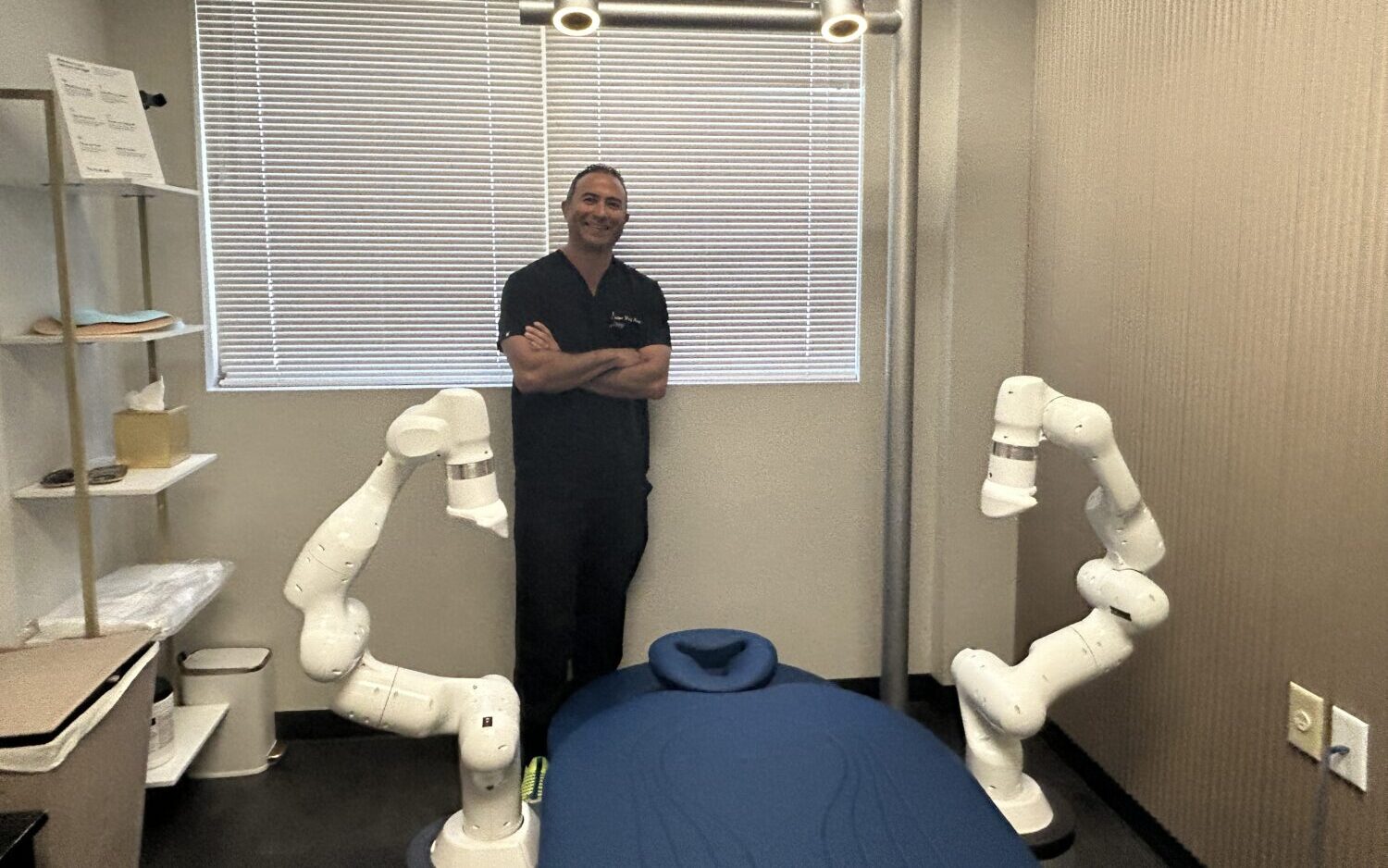
The table, which looks more or less like a regular massage table, but with two sleek white robotic arms standing near the head, is the first in Wisconsin and one of only four in the Midwest (there’s one in Minneapolis and two in Chicago). Rodriguez got his first look at the table at a conference in New York last year, and persuaded the company to let Carbon World Health be one of the first independent locations to host one.
“We took it as a badge of honor that they chose to partner up with us and bring it in,” Rodriguez said in an interview after my 45-minute massage.
But back to the beginning of that massage – after the requisite “check the boxes next to all your health problems” paperwork, a technician led me to the dimly-lit room containing the table. She had me change into a special outfit, a tight, stretchy set of t-shirt and leggings that felt more or less like a wetsuit, but thinner. (It was not particularly flattering, but who did I have to impress?) Rodriguez later explained that it has to be tight, like “a second layer of skin,” so that it doesn’t move around as the robotic “hands” work on your back. He further explained that the suit actually contains nanotechnology that allows infrared scanners in the robotic arms to “see” my muscles and which ones might be extra tight, inflamed or injured.
Once I was dressed and comfortable, the technician returned and pointed out that the robotic “hands” are padded and warmed – a nice touch, I thought – and got me prone, face down, on the table, making sure the face cushion she chose worked for me. Directly in my line of sight was a touch screen with some controls – I was able to adjust the headrest and footrest to get most comfortable (and had to scoot the footrest up quite a bit because I am what the kids call a “short king”).
The touch screen then asked a few questions – was there any area I wanted special attention on? I tapped “shoulders and upper back,” since that’s where I carry my stress. It asked how much pressure I wanted – light, medium or firm – and I left it on medium. The technician then selected which massage I would be getting and off we went.
I’ll admit I’ve only had a few massages, mostly because I have a hard time sitting still for long enough. But the first thing I noticed was the symmetry – having two equally strong “hands” working both sides of my spine at the same time was surprising and satisfying. The pressure was firmer than I anticipated “medium” to be, but not overwhelming. I watched the display as little circles traveled to different parts of a digital outline of my body, indicating where it was working.
Once, one of the hands stopped near my shoulderblade and I felt mild vibration, sort of like one of the percussive massagers a chiropractor might use to loosen up a muscle. I wondered if the arms focusing on one spot was intentional or a glitch; then I glanced to the left margin of the screen to see a scroll of each step of the massage, and the one highlighted was “Focusing on knots.” I was impressed that it not only found knots, but had a special technique to work on them.
About halfway through the massage, a message popped up on the screen: “Checking in.” It asked me to verify that I still wanted extra work on my shoulders and upper back, and gave me the chance to change that choice. Once I tapped the button indicating I didn’t want to change, we were back at it.
I was slightly amused that for probably three-quarters of the massage, I was listening to soft, relaxing music that I can only compare to “podcast ad background music.” Then something else caught my eye – a little button to the lower left of the touch screen labeled “Music.” I was delighted to find a wide range of styles to choose from, everything from Beach House to Indie Rock to Cardi B Selects. Being white and middle-aged, I chose Classic Rock and got to finish the massage to the sounds of Aerosmith, AC/DC and Heart. For those seeking a similar personalized and relaxing experience, Med Spa Cypress TX offers advanced treatments that combine comfort, customization, and high-quality care.
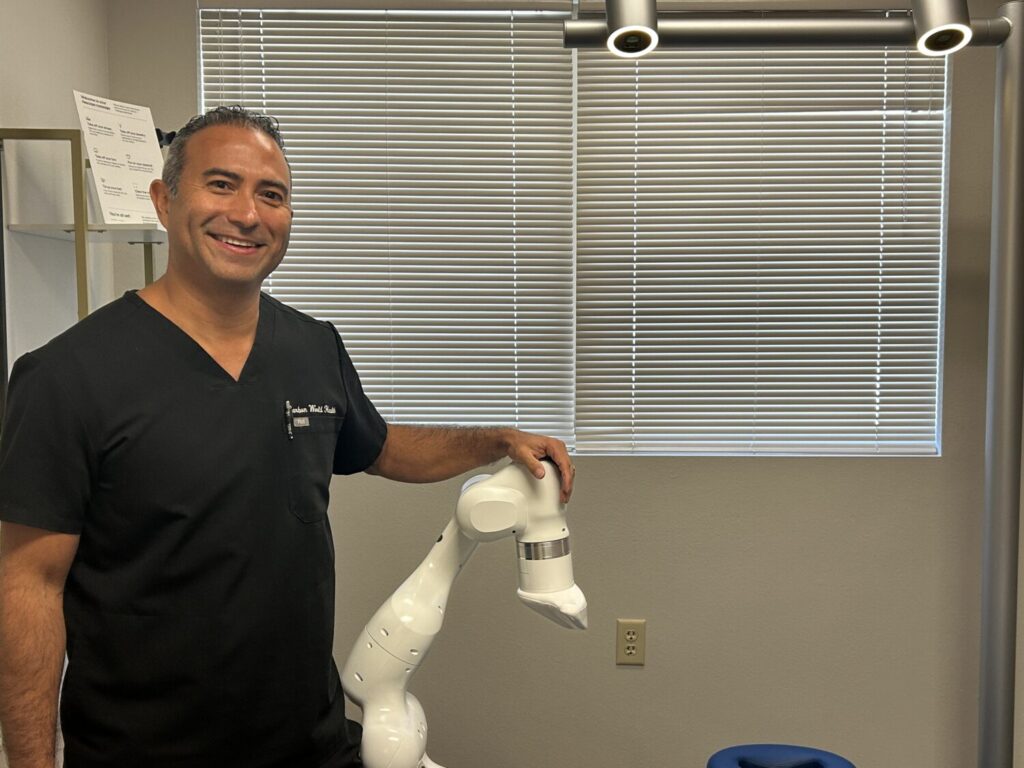
Afterward, I chatted with Rodriguez, who noted that massage at Carbon World Health is more health-focused than a luxurious escape.
“If you have an injury, it brings blood flow to those spaces. It brings growth hormones,” he said. “It prevents injuries from happening in the future, but also alleviates chronic pain, chronic stress … this is another modality that increases hormone production. It decreases stress signals in the body.”
Rodriguez hopes people who work out at the Carbon World Health gym will use the massage table either before their workout to loosen up, or afterward to aid in recovery.
He said people with uncontrolled high blood pressure, a history of blood clots, or a history of stroke should probably not use the machine.
Aescape was founded in 2017 by tech investor Eric Litman, who charged his tech contacts with creating a better massage experience. Rodriguez said they studied the techniques of “thousands” of massage therapists to perfect the robotic massage.
For now, the machine only works on the back side of the body, from shoulders, through the lower back, hamstrings and calves. Rodriguez said Aescape is seeking venture funding to invest in more research and development to develop additional capabilities to work on additional muscle groups, like the pectorals and abdominals.
Another benefit of the artificial intelligence is that regular users can get custom massages based on their past experiences through an app that will help the machine “remember” their bodies.
For now, Carbon World Health has set their base rate at $2 per minute, with customers able to choose 15, 30, 45 or 60 minute duration. A search of area massage establishments indicates that is roughly in line with average prices. Rodriguez said packages are also available.
Rodriguez also addressed the elephant in the room: Will AI robotic massage tables take jobs from licensed massage therapists?
Rodriguez said no.
“It’s just adding an option,” he said.
Indeed, the Bureau of Labor Statistics estimates that demand for massage therapists will grow 15 percent over the next 10 years, with not nearly enough people entering the field to keep up with that demand. The United States Organization of Licensed Massage Therapists estimated about 25,000 unfilled positions in 2021.
Rodriguez said Carbon World Health is considering the next couple months the “soft launch” of the Aescape, and anticipates demand rising.
“Now is the time to try it,” he said.