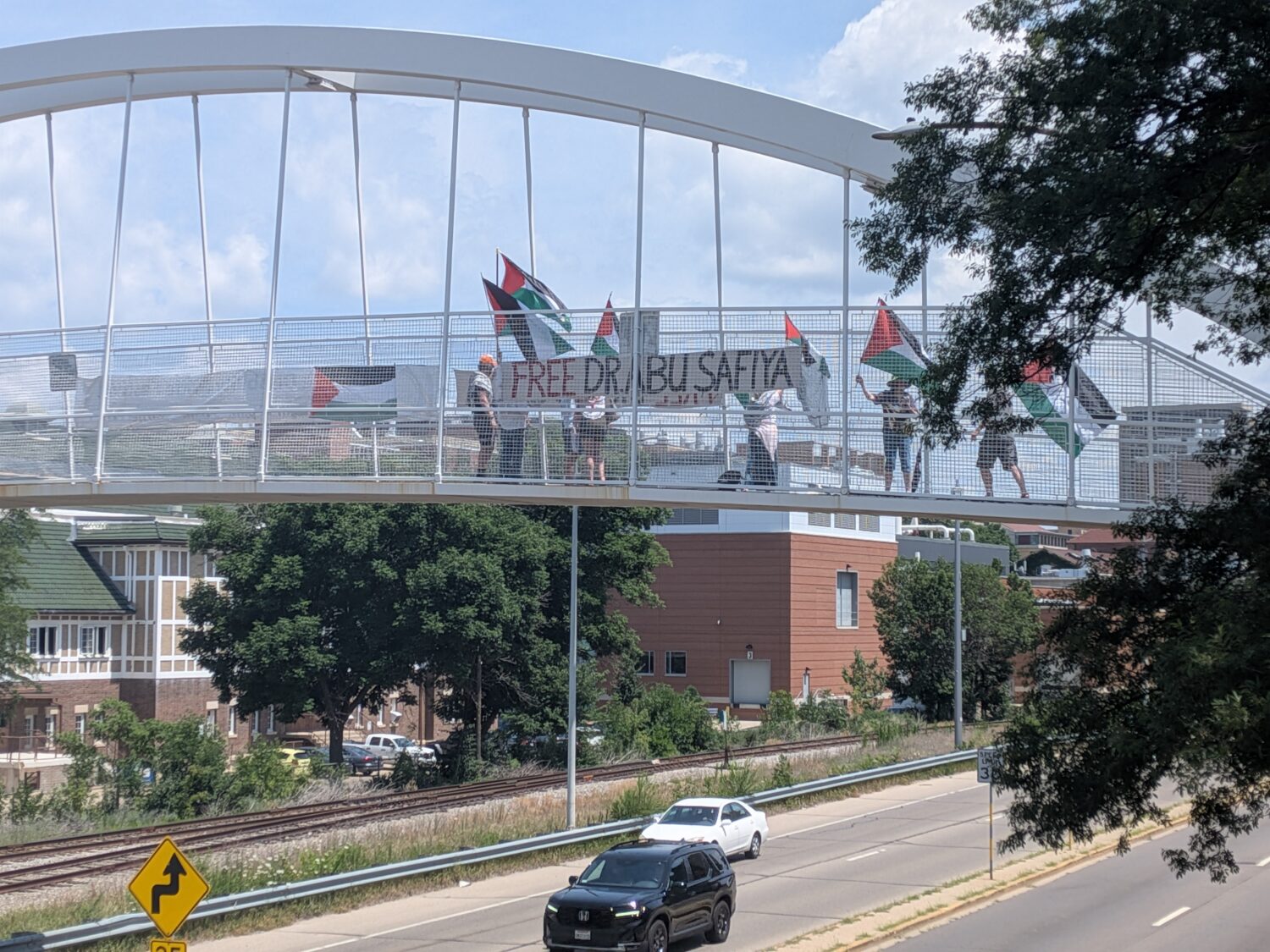
Honks were heard from cars passing under the Campus Dr bridge while Madison groups dropped a banner to bring attention to the imprisonment of Dr. Hussam Abu Safiya, the director of Gaza’s Kamal Adwan Hospital. The action was part of an international call for an hour of solidarity on July 15 by Doctors Against Genocide.
“I’m here because we need to free Dr. Abu Safiya,” said Mimi Hasan, a participant in the call to action. “He’s somebody who’s gone completely above and beyond the basic call of duty, completely exceeded the Hippocratic oath. I think it’s really important that we show up for him, and that he’s not forgotten. It’s really dire. I don’t have a lot of hope for him and I know he doesn’t have a lot of hope for himself.”
Abu Safiya was arrested in late December 2024, after Israel Defense Forces forced the evacuation of the Kamal Adwan Hospital. The final image of Dr. Abu Safiya before his detention held global attention as the director stood among the rubble of his hospital in his white lab coat while IDF tanks approached. He remains in custody without being charged.
“His case is front and center because of the fact that it has such strong humanitarianconnections as a pediatrician and health care provider,” said Mark Rosenthal, a member of Jewish Voice for Peace, also at the action. “It’s deeply symbolic of a system that is completely out of control”.
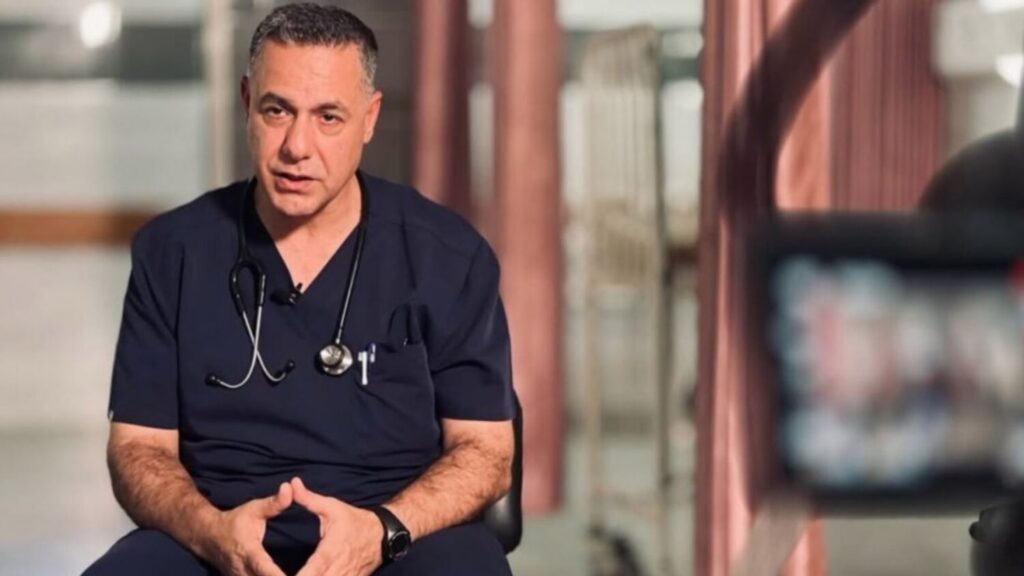
The doctor’s attorneys warned that 18 months in prison has caused Dr. Abu Safiya to be in “critical condition,” according to AP News.
Barb Olson, cofounder of Madison Rafah Sister City Project, said his decline in health is due to many forms of abuses, including sexual assaults by guards which are rampant in Israeli prisons.
“It’s calling attention to the whole thing but focusing on Dr. Abu Safiya, trying to save his life,” said Olson. “He played a very important role during the war, keeping the hospital running while dealing with losing his son in the bombings and exposing to the world what was going on. Which is why we think he was taken, he’s being punished.”
Members from Madison Rafah Sister City Project, Palestine Partners, and Jewish Voice for Peace, among others, cite personal reasons for showing up for the international call to action.
Rosenthal empathized with Dr. Abu Safiya as an ER nurse of 35 years and through his work in street medicine.
“He, as a pediatrician, exemplifies the attempt of people to live a life that sees basic things like water, health care, housing, and shelter as basic fundamental rights that we all have,” he said. “This is systematically denied to the Palestinian people. As a nurse, as somebody who sees and respects people who have dedicated their lives to providing care to the most vulnerable people within our societies, I’m horrified,”
Hasan also makes a connection to Dr. Abu Safiya; her father immigrated to America as a Palestinian refugee in 1948. Because of this, Hasan said she pays more attention to the Palestinian cause.“People are facing real consequences for their advocacy. I think our strength is in numbers and I want to do my small part,” she said.
Beyond personal connections to Dr. Abu Safiya’s case, participants point to systematic abuses of Palestinians as a major cause for Madison groups’ participation in the international protest.
“We’ve had an unofficial sister city relationship with the city of Rafah for 23 years,” said Olson, “All our humanitarian projects are destroyed, all the water filters, all the school work we did. They’ve squished the 2 million people into a small strip and taken about 60 percent. Anything infrastructure that was done is gone, so it was important to do this”.
Americans are connected to this issue because citizen tax dollars aren’t being invested in our cities, said Olson, but instead funding military actions.
Rosenthal said, “I am speaking out as an anti-zionist Jew against the complicity of my government in the genocide, the ethnic cleansing, and the simple system of a settler colonial apartheid state that exists largely due to its relationship to the United States and U.S imperialism”.
The participants said that the public support for Palestine has increased drastically over the past few years but there is still much work to be done. “There’s support, so now the question is: How do you translate the basic support and sympathy into moral action? That is the million dollar question,” said Oslon.
The banner crossing Campus Drive drew lots of positive attention in the form of honks from passing vehicles.
“I love the honking,” said Hasan. “It’s an affirmation that people are recognizing the truth due to the work that all the citizen journalists in Palestine have been doing. Honking is not the biggest deal, but it is a little act of solidarity to the people who are participating.”
Rosenthal shared similar sentiments about the supportive honks for Dr. Abu Safiya, reflecting on the labor organizers have put into the movement. “The honks represent many, many years of political work that have been difficult, but we are bearing the fruits today,” he said.
He suggests Madison support all efforts in BDS (Boycott, Divest, Sanction) by exploring the city’s investments in Israel and divesting in all forms as a powerful, nonviolent tool.