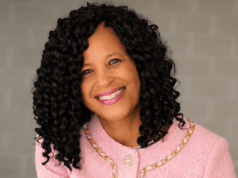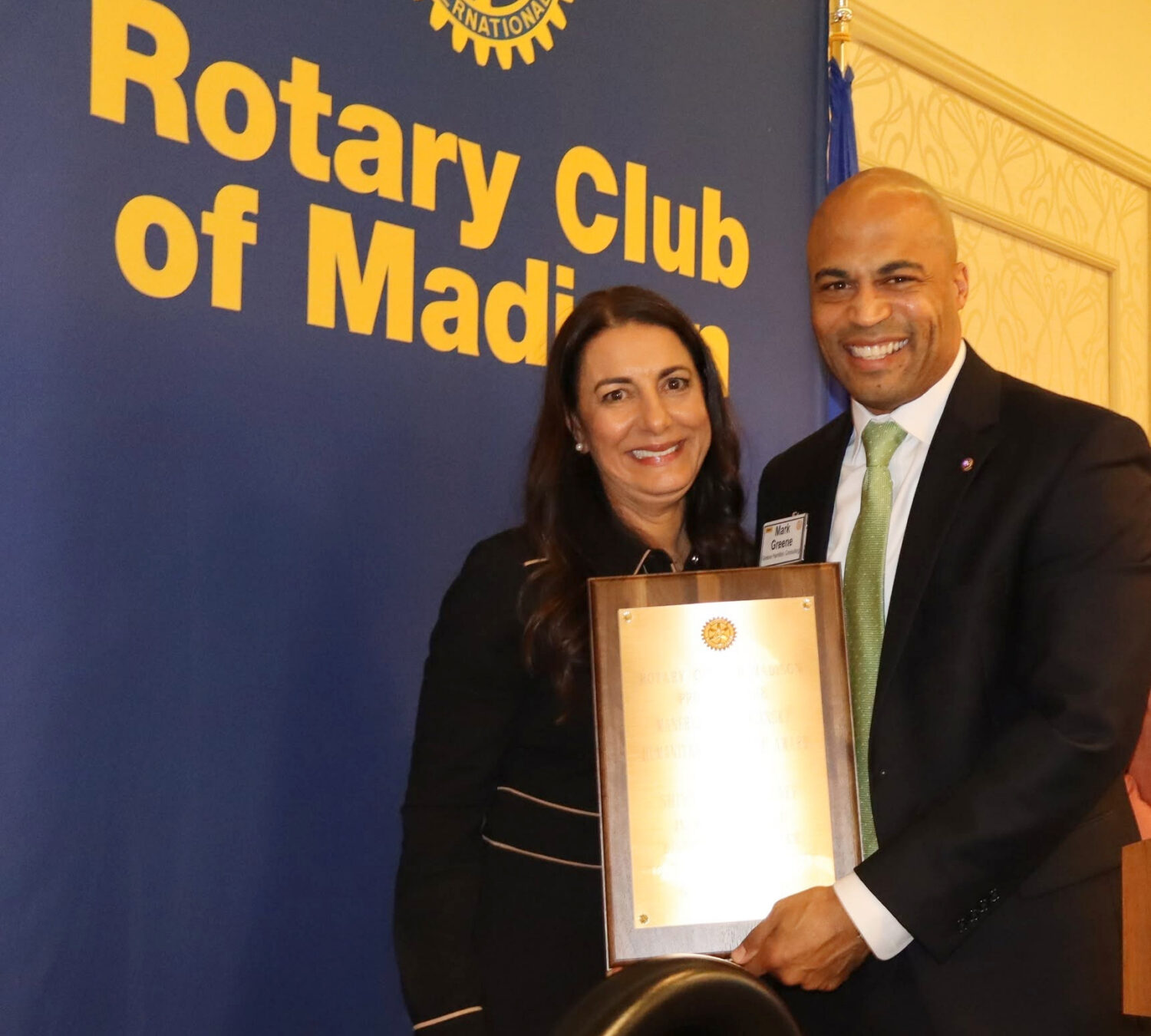
The Madison Downtown Rotary Club honored Shiva Bidar-Sielaff with its 2026 Manfred E. Swarsensky Humanitarian Service Award on Nov. 11, recognizing her decades of leadership, community service and work building connections across cultural and social differences.
The award, established in 1982, recognizes individuals whose volunteer efforts have made outstanding contributions to humanitarian service in the greater Madison community, following the example of Rabbi Manfred E. Swarsensky.
Bidar-Sielaff, the vice president and chief social impact officer at UW Health and associate dean for social impact and belonging at the UW School of Medicine and Public Health, was nominated by Juli Aulik.
Swarsensky, a Holocaust survivor who settled in Madison after fleeing Nazi persecution, founded Temple Beth El on the city’s near west side.
“Swarsensky dedicated his life to peacemaking and forgiveness,” Joe Loehnis, who chaired this year’s selection committee, told the crowd at the Rotary Club luncheon Nov. 11. “We give our prestigious award every year to those individuals who, like the rabbi, built bridges and seek reconciliation in our community.”
Loehnis said Bidar-Sielaff’s life and service reflect many of the same values, noting that she, like Swarsensky, experienced displacement at a young age. Born in Iran, she left the country with her mother and brothers during the Iranian Revolution, Loehnis explained, and her family arrived in Spain with only a few suitcases, separated from their father, extended family and the culture they had known.
“More than 25 years ago, Shiva became UW Hospital’s first medical interpreter. She helped establish UW Health’s medical interpreter program and became a national leader in developing professional standards for health care interpreters,” Loehnis said. “Today, she serves as vice president and chief social impact officer at UW Health and as associate dean for social impact and belonging at the UW School of Medicine and Public Health.”
Her community service also includes 16 years on the Madison Common Council, where she worked to bring opposing groups together and build consensus on complex issues, Loehnis said. She has also been a longtime leader in Madison’s Latino community, advocating for immigrants, helping families navigate challenges and mentoring young people.
In presenting the award, Loehnis cited her ability to connect diverse groups and bring stakeholders together, particularly in service of the community’s most vulnerable residents.
Along with the award, the Madison Rotary Foundation provides a $2,500 grant to an organization selected by the recipient. Bidar-Sielaff chose Centro to receive the grant.
In accepting the award, Bidar-Sielaff reflected on her family’s experience of displacement and how finding a welcoming community in Madison shaped her commitment to helping others find a sense of belonging.
“When you have experienced the loss of community, you really understand just how precious it is. And when you’re fortunate enough to find it again, you want to ensure others can find it too,” she said. “Madison has become that community for me … my home and my chosen family.”
She also reflected on Swarsensky’s legacy, saying his decision to respond to hatred and persecution with compassion and bridge-building remains especially meaningful.
“Building bridges certainly does not mean remaining silent in the face of injustice or compromising our values,” Bidar-Sielaff said. “It means having the courage to stand for what is right while refusing to give up on each other’s humanity.”
Bidar-Sielaff closed by challenging people to consider not only the kind of community they want to live in, but what they are willing to change within themselves to help create it.
“Rabbi Swarsensky’s legacy reminds us that humanity is not something to believe in. It is something we must choose again and again, especially when it is difficult,” she said.