In my last op-ed, I wrote about the little boy I held above the crowd. I wrote about the city we owe him and our responsibility to build something better than the conditions that brought Corey Ruiz to that intersection.
This op-ed begins with a harder question.
What happens when we finally reach the table, then spend all our time deciding who should be thrown out of the room?
Over the last several days, personal conflict has competed with the work that brought Madison together. Accusations became public. People chose sides. Old disagreements found new life. Attention shifted away from Corey, away from the people sleeping outside and away from the systems we were supposed to be challenging.
That should concern all of us.
Madison doesn’t have a shortage of Black leaders or Black organizations. We have plenty of both. What we lack is enough shared discipline to keep people-led work from being swallowed by personal conflict, organizational branding and political ambition.
When that discipline fails, the people with the least power usually pay the highest price.
What I won’t do
Let me be clear about what this op-ed won’t become.
I won’t litigate accusations I believe are false and defamatory in the town square. I won’t ask Madison365 to become the courtroom for a personal dispute, nor will I sully the image of this publication by dragging unnecessary conflict across its pages.
There are appropriate places to address false accusations. A movement’s public platform isn’t one of them.
Refusing to create a spectacle doesn’t mean refusing accountability. Accountability requires facts, standards, a fair process and an opportunity to respond. Most importantly, it should produce something more useful than another destroyed Black relationship.
I’ve said what I needed to say directly to the people involved. My concern now is what all this conflict is costing everyone else.
Division only has to be fed
A movement doesn’t always have to be crushed. Sometimes it only has to be distracted long enough for the people in power to finish what they were already doing.
The FBI understood this.
COINTELPRO worked to disrupt Black political organizations, discredit Black leaders and exploit divisions that already existed. The CIA’s Operation CHAOS belongs to the broader history of federal agencies surveilling domestic political movements and treating organized dissent like a threat.
I’m not suggesting that anyone involved in Madison’s current conflicts is a government agent. We don’t need a conspiracy theory to recognize a documented strategy.
The government didn’t invent every disagreement between Black leaders. It studied the disagreements that were already there. It learned where trust was thin, which personalities clashed and where ambition could be used like a crowbar.
Then it applied pressure.
Division doesn’t have to be invented. It only has to be fed.
A rumor becomes evidence. A disagreement becomes betrayal. A personal grievance becomes a community emergency. People who were once working toward the same goal begin spending all their energy proving somebody else should no longer be allowed in the room.
Eventually, there’s no room.
There’s only a collection of people standing outside it, each explaining why everybody else had to leave.
The people who benefit from our division don’t have to create it. They can simply wait. While we fight over who should speak, another budget passes. While we argue over who deserves visibility, appointments are made. While we divide into camps, the systems we were supposed to challenge remain exactly where they were.
We set fire to the table to prove somebody shouldn’t have a seat, then wonder why nothing gets built.
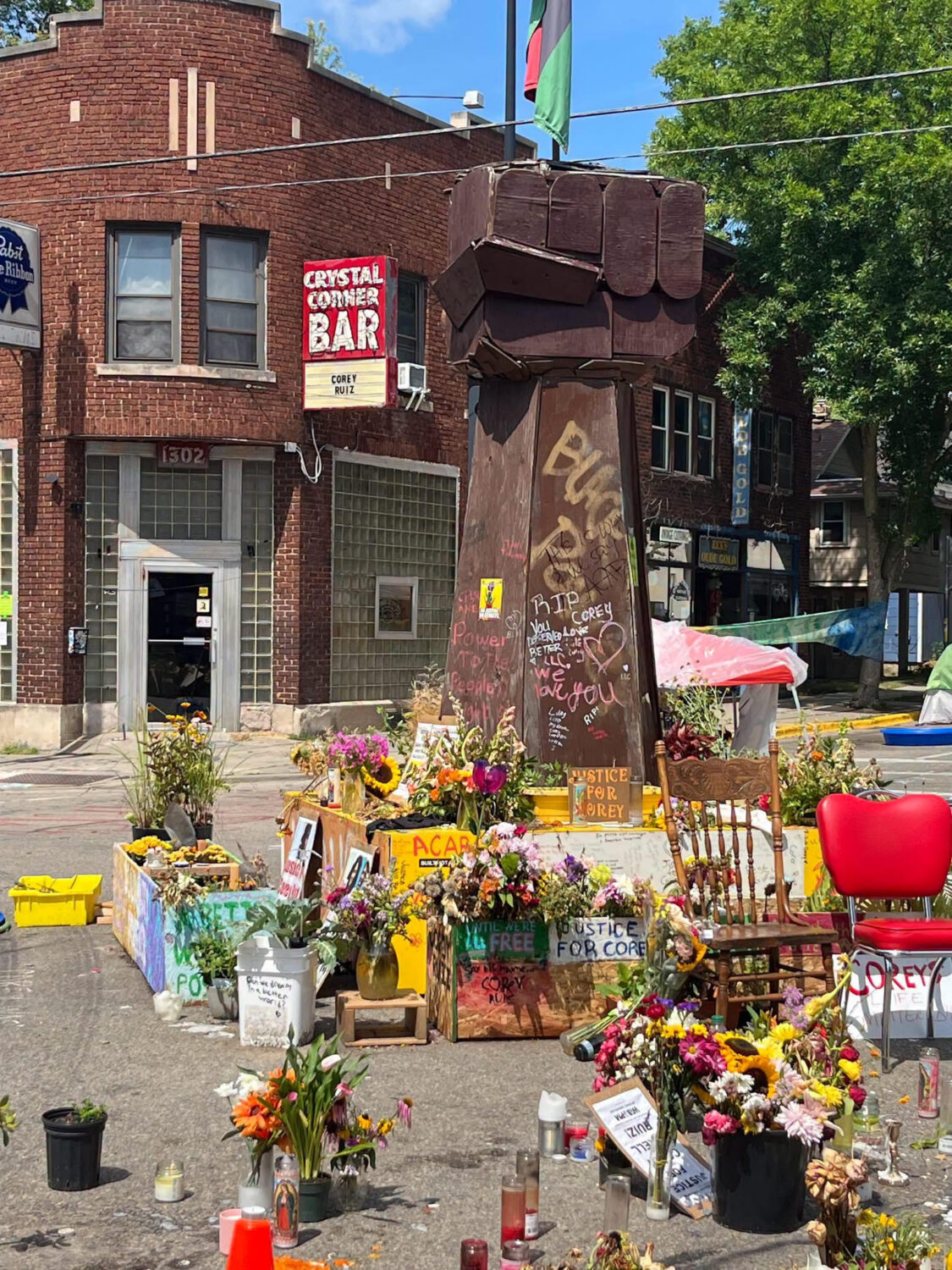
The memorial belongs to the people
Madison doesn’t lack Black institutions. The memorial simply doesn’t belong to any of them.
It was built by people. Sustained by people. Protected by people.
The work didn’t begin with a grant, a contract, a fiscal sponsor or an organizational mandate. Nobody waited for an executive director to approve food, water or supplies. People saw a need and responded.
Just people helping people.
That doesn’t mean nobody tried to turn the moment into a money grab or a power play. Some people absolutely did. It means those efforts didn’t create the memorial, and they don’t give anyone ownership of it.
At one point, an organization arrived during a training and put up a branded tent. I told them plainly, “You’re welcome. Your training is welcome. Your branded tent is not.”
They told me they would take it down when the training was finished. I told them they would take it down then, or we would take it down for them.
We took it down.
That wasn’t hostility toward Black organizations. Organizations are welcome to bring training, resources and people willing to work. They aren’t automatically entitled to leadership over a community response built because institutions, including some of our own, had already failed to respond.
The memorial wasn’t a trade show. Nobody was getting booth space.
The unhoused people were already unhoused. People who use drugs were already dying. The poverty was already visible. Corey was already struggling. The need didn’t suddenly appear when the cameras did.
Organizations are welcome to serve. They aren’t entitled to advertise, recruit, take ownership or place their logo over work people were already doing without institutional backing.
The memorial doesn’t need an owner.
It needs stewards.
Who carries the cost?
The cost of this conflict can’t be measured only in bruised feelings, damaged reputations or broken relationships between people with public profiles.
While we argue, people lose.
Unhoused residents lose the attention of a community that had finally begun seeing them as human beings instead of problems to be moved. They lose advocates, resources and the fragile sense of stability created when people showed up with food, water, shelter and a willingness to stand between them and systems that have repeatedly failed them.
An encampment can survive rain. It can survive criticism. It can survive hostility from people who want it gone.
What it can’t survive forever is everyone supporting it becoming consumed with one another.
People who use drugs lose too. They don’t get lost in the drama and social-media arguments. They lose actual access to lifesaving services.
They lose naloxone, safer-use supplies, treatment offered without judgment and trusted people willing to answer the phone when everyone else has decided they’re too difficult, too complicated or too far gone.
Harm reduction depends on trust. That trust is built quietly, long before cameras arrive. It grows through consistency, through showing up and through treating people like their lives have value even when the rest of the world has decided they don’t.
When that trust breaks, it isn’t the people with microphones who are most likely to die.
Corey’s family loses something too.
They lose the ability to grieve without being asked to referee a movement. They lose control over how Corey’s name is used. They’re forced to watch his life become a banner, a slogan, a campaign issue and sometimes a weapon people use against one another.
Corey’s family shouldn’t have to determine which organizer is credible, which accusation is true or which political ambition may be hiding behind someone’s grief. They should be allowed to mourn Corey, demand answers and remember him as a whole human being.
His name shouldn’t become a piece of territory for grown people to fight over like children.
The housed residents surrounding the memorial have been carrying this too. They have families, jobs, bills and responsibilities. Business owners have rent, inventory, payroll and employees depending on them. Those employees have households of their own.
Many of them witnessed Corey’s killing firsthand. They watched a man die outside their homes and workplaces. Before they had time to process what they had seen, the intersection became a memorial, a protest site and what some have experienced as an occupation.
We should be honest about the weight of that.
I’ve spoken with the president of the neighborhood business association. My understanding is that most business owners support the protest and understand why people gathered. They aren’t demanding that Corey be forgotten. They aren’t opposed to accountability.
They also know they have to reopen their doors.
Employees need to return to work. Customers need to come back. Rent has to be paid. Payroll doesn’t stop because the city is in crisis.
I understand that predicament.
Supporting the protest doesn’t make someone immune to its impact. A person can demand justice for Corey and still need access to their home. A business owner can support the memorial and still worry about whether the business will survive. An employee can believe in the cause and still struggle with returning to the place where they watched somebody die.
But disruption can’t be turned into a false story about violent protesters terrorizing the neighborhood.
The memorial itself hasn’t been the source of the most serious danger. People gathered there have fed one another, protected unhoused residents, de-escalated conflict and worked to keep the space peaceful.
The danger came looking for them.
Armed conservative influencers arrived to antagonize people at the memorial. A racist white man entered the space, assaulted multiple people and attempted to desecrate Corey’s memorial.
There have also been accusations that protesters harassed housed residents. To my knowledge, those reports haven’t been substantiated. We shouldn’t repeat allegations as fact simply because they’ve been repeated loudly or often.
That distinction matters.
The people living and working around that intersection didn’t create Madison’s housing crisis. They didn’t write state law. They didn’t design our system of policing or create the conditions that placed Corey in that street.
They shouldn’t have to carry the full weight of those failures forever simply because they were standing closest when everything finally broke open.
Community isn’t a scale where one group has to be pushed down for another to rise.
Unhoused residents need housing, sanitation and support. People who use drugs need harm reduction and care. Corey’s family needs dignity, answers and control over his memory. Housed residents need access to their homes. Employees need stable jobs. Business owners need the opportunity to reopen and survive.
All those things can be true at the same time.
A community isn’t a lifeboat with room for only one group. We don’t have to throw housed residents overboard to protect unhoused people. We don’t have to throw unhoused people into the water so businesses and neighbors can feel secure.
The entire community deserves recognition and protection.
The entire community deserves to be lifted up.
The site must change. The legacy can’t.
The memorial site can’t remain forever in its current condition. Saying that isn’t a betrayal of Corey. It’s an acknowledgment of reality.
A memorial isn’t preserved by trapping a crisis in amber. Streets must reopen. Sanitation must be addressed. Businesses, employees and residents need stability. People living outside need to be moved into housing and support, not simply pushed onto another sidewalk.
But changing the site can’t mean erasing what happened there.
The city can’t treat reopening the street like wiping a chalkboard clean. What happened there has already been written into Madison’s history.
People built a place where grief could be expressed publicly. They fed strangers. They protected one another. They placed unhoused residents at the center of a conversation that usually happens around them. They showed that ordinary people could de-escalate conflict and create safety without immediately reaching for guns, arrests or cages.
That legacy must remain.
The intersection should be permanently renamed Corey’s Corner, in consultation with Corey’s family. A permanent memorial should recognize Corey Ruiz, the life lost at that site and the community that rose up after his death.
The history of the memorial should be documented through photographs, writing, testimony and oral histories from the people who built and sustained it. There should also be a public record of the demands that were made, the commitments officials offered and the actions government ultimately took.
Otherwise, promises made during a crisis will disappear as soon as the cameras do.
The people living at the site can’t simply be pushed away without individualized housing plans and meaningful support. Moving tents without moving people into safety isn’t a solution.
It’s displacement wearing a clean shirt.
Harm-reduction services must continue after the physical site changes. Naloxone, safer-use supplies, treatment and trusted support can’t disappear because the tents are gone.
Businesses, employees and residents must also be included in the transition. They shouldn’t be treated as enemies for needing access, stability and the ability to survive. Their families and livelihoods matter too.
A transition plan must be built with the entire community, not imposed on one part of it for the benefit of another.
Protecting the work requires boundaries
A people-led movement can’t confuse openness with the absence of boundaries.
People should be welcomed when they come to serve. They should be corrected when they cause harm. When someone repeatedly damages the work, exploits the moment, spreads falsehoods or harms the people the movement exists to protect, removing them isn’t an attack on unity.
It’s protection.
Not every disagreement requires separation. Harm does.
Protecting the work sometimes means telling someone they can no longer participate in it. That decision shouldn’t be based on rumors, popularity or who has the largest audience. It should be based on documented conduct, a fair process and the safety of the people involved.
Accountability doesn’t require us to keep reopening the door for someone who has demonstrated that they’re willing to burn down the room.
We can’t demand due process from government while denying it to one another. We can’t demand evidence from police while treating rumor like evidence among ourselves. We can’t demand independent investigations while allowing popularity, friendships or political influence to determine who is believed.
Accountability should produce truth, fairness and protection. It should create repair where repair is possible and clear boundaries where it isn’t.
Most importantly, the work must continue even when relationships don’t.
People don’t have to like one another to keep unhoused residents fed. They don’t have to reconcile to make naloxone available. They don’t have to become friends to demand a complete investigation into Corey’s death.
Our personal relationships may break.
The infrastructure serving vulnerable people can’t be allowed to break with them.
Accountability must also face both directions. We’ve demanded it from the mayor, the Common Council, the Madison Police Department, the Office of the Independent Police Monitor, the Wisconsin Department of Justice, the district attorney and the State Legislature.
Those demands remain necessary.
We must also hold our own leadership accountable for the information it spreads, the promises it makes, the money it raises, the people it claims to represent and the damage created when personal conflict consumes public work.
No person owns this movement. No organization owns Corey’s grief. No elected official owns the community. No activist owns the microphone.
Accountability means protecting the work from the people doing it.
That includes me.
That includes all of us.
The standard can’t be lower for police
There’s another lesson from the memorial that Madison can’t ignore.
A racist white man entered the site, assaulted multiple people and attempted to desecrate Corey’s memorial. The people gathered there were already grieving, and they were being attacked in a place they had worked to keep peaceful.
They stopped him.
Unarmed community members restrained him, detained him and delivered him to police unharmed. They didn’t have badges, institutional authority or nearly $100 million in public funding behind them.
Still, they ended the threat without ending his life.
I’ve said this week that police use of force may be legally justifiable. That doesn’t automatically make every use of force necessary.
The investigation will determine whether the officer was legally permitted to shoot Corey. Madison must also ask whether every shot had to be fired. Whether another option remained. Whether Corey could’ve been restrained and detained with the same dignity and humanity grieving protesters extended to a violent racist who came to antagonize them.
The two encounters weren’t identical. Pretending they were would be disingenuous.
But the standard for trained police officers can’t be lower than the standard demonstrated by unarmed civilians in the street.
Police officers are given training, equipment, legal authority and enormous public resources because they’re supposed to make better decisions under pressure. We don’t spend nearly $100 million a year for officers to possess fewer tools than a grieving community improvising in real time.
A badge can’t become permission to stop looking for another option.
The investigation must determine whether the officer’s actions were lawful. The public must continue asking whether they were necessary.
When ordinary people can stop violence without taking a life, Madison has every right to demand that its police explain why they couldn’t do the same for Corey Ruiz.
What Madison must carry forward
The physical site will change.
The work must continue.
We must carry forward the community care created there, the demand for police accountability, the insistence that poverty isn’t a crime and the belief that unhoused people deserve more than displacement.
We must preserve Corey’s memory, the public commitments made in his name and the lessons of what people built without waiting for an organization to give them permission.
We must also remember what happened when personal conflict began consuming the work.
The little boy I held above that crowd will inherit more than Madison’s laws, budgets and institutions.
He’ll inherit our habits.
He’ll learn what Black leadership looks like by watching what we do when we disagree. He’ll learn whether accountability means truth and fairness, or whether it means gathering an audience and destroying whoever has become inconvenient.
He’ll learn whether our movements can continue feeding people after the cameras leave. Whether we can keep people who use drugs alive. Whether housed and unhoused residents can be protected at the same time. Whether businesses, workers and patrons can be included without becoming enemies of the movement.
He’ll learn whether Corey’s family was given space to grieve, or whether Corey’s name became another piece of territory for grown people to fight over like children.
We don’t need one organization to own this moment.
We need enough shared discipline to protect what the people created.
The memorial belongs to the people. The history belongs to the people. The responsibility belongs to all of us.
Nobody gets to own it.
Everybody has an obligation to protect it.