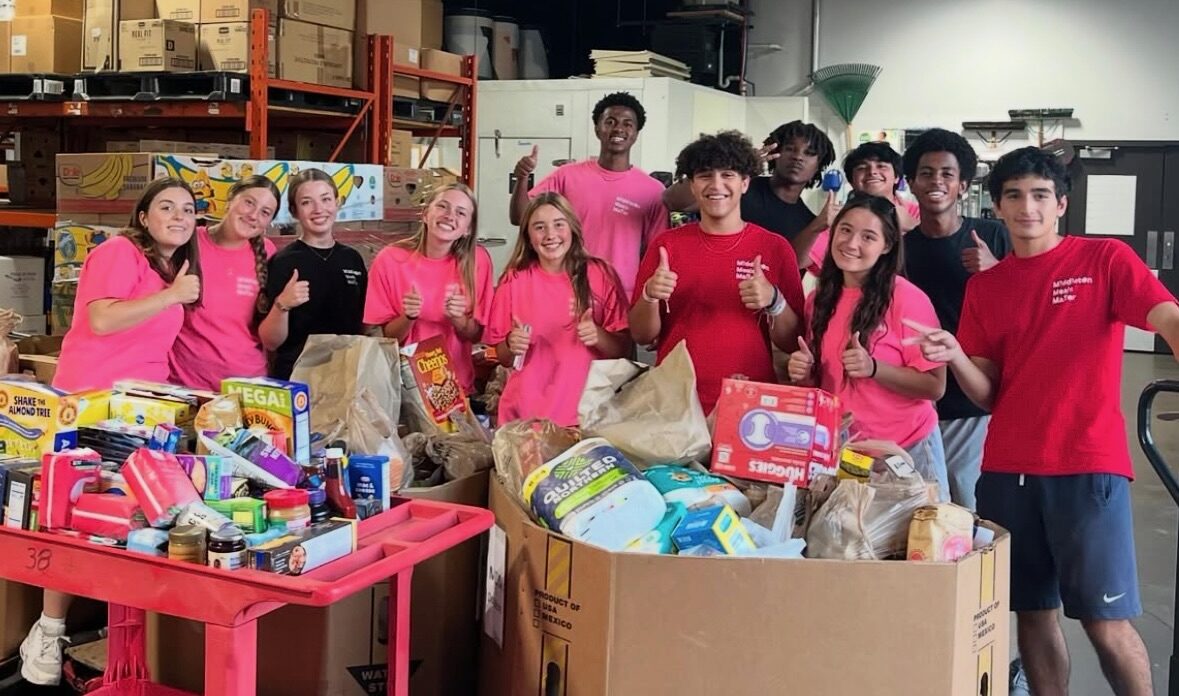
Two years ago, a group of students at Middleton High School decided to take on hunger – and were quite ambitious.
“At first, we had aspirations of fighting food insecurity at a global level right away,” said Rohan Dileep, co-president of Meals Matter. “We realized that food insecurity is happening in our own backyard. One in 10 people in the state of Wisconsin struggle with food insecurity, and one in eight adolescents struggle in just Dane County alone. So we realized it’s affecting our neighbors, our friends, our classmates, our peers, and we wanted to make an impact.”
To do that, they started holding food drives at local grocery stores, and exceeded their own expectations.
“Our first food drive, our goal was 200 pounds,” said co-president Beatrice Norman. They brought in closer to 3,000.
Now, two years later, Meals Matter has chapters in nearly 20 schools across the United States (and one in South Korea) which have collectively gathered nearly 100,000 pounds of food.
And next month, Dileep and Norman will travel to San Diego to receive the 2026 William R. Simms Award for Outstanding Youth in Philanthropy from the Association of Fundraising Professionals.

A sustainable, scalable model
Dileep said Meals Matter’s first partner was Metro Market, where they began holding daylong food drives two years ago. They’ve also worked with other groceries, like Pick ‘n Save in Middleton and Madison’s west side. Each food drive requires 10-15 volunteers to cover about 10 hours of presence collecting donations. Food donations then go to food pantries and distributors like Way Forward Food Pantry, Second Harvest Food Bank and Sunshine Place.
Early on, the group’s leaders knew they wanted to create something lasting.
“One thing that we realized, especially at the high school level, at the student level, a lot of (volunteering) is for patching up your resume, starting something for college,” Dileep said. “We realized that we’re here to stay, and we want to make a meaningful impact. So my goal right away on the board was making sure we’re sustainable and we’re lasting for years to come.”
One way to accomplish that is to bring on board members of different ages.
“We prioritize having freshman, sophomore, junior, senior (classes) represented across our board,” Norman said. “When we leave, if it’s only, say, juniors, the transition is going to be really hard. So we prioritize making a sustainable board, but also delegating tasks so that everybody is able to run it themselves once we graduate.”
Another way they’ve found to create sustainability – and increase impact – is to expand. It started within their circle of friends from other schools, who started Meals Matter chapters at Vel Phillips Memorial, Waunakee, Edgewood and other high schools around Dane County. Then, they divided a long list of high schools across the country, assigned every board member a region, and started cold calling. The result is chapters now up and running in Colorado, Texas, Maryland, Minnesota, the Chicagoland area and elsewhere. The founders in Middleton have put together a 20-page guide to starting a chapter and require monthly check-ins as well as consistency in branding. The advantage is that it’s a pretty simple model.
“Running monthly food drives, it’s not rocket science. All you need is student leadership — people who care about the community and want to make an impact,” Dileep said.
Every local chapter is tied to a school, which also acts as its fiscal sponsor for nonprofit status and financial purposes. The original organization has become the Middleton chapter of Meals Matter, which is now an umbrella organization helping coordinate and support local chapters’ activities. That umbrella organization has recently been granted 501(c)(3) nonprofit status.

The big picture
In addition to addressing immediate needs, Meals Matter hopes to tackle bigger, systemic issues through advocacy and awareness. Leaders have met with legislators and talked specifically about making it easier to get food to people in need.
“In specific states there’s so much red tape in donating food to food pantries just because of food waste and illness and liability,” Dileep said. “Our work is working with legislators and seeing, how do we cut that down while increasing the amount of food (donated).”
Advocacy isn’t just in the statehouse, though, Dileep said.
“It’s presenting to elementary schoolers, talking to them about what food insecurity looks like, and being cognizant and mindful that when we present to those groups, there are one in five students in that classroom that struggle with food insecurity, whether they know it or not,” Dileep said. “Our goal is to kind of end that stigma from a young age.”
Those talks to younger kids can inspire the next round of nonprofit leaders, too.
“We had the opportunity to present to a Verona middle school, and after that, one little girl went up to her teacher and said, ‘I have this really awesome idea to fight homelessness in our community, and I really want to start something in high school too,’” Dileep recalled. “Us hearing that — that is the most rewarding and impactful work, to know that we’re also building a community of leaders.”
Dileep and Norman said they’ve run into a few obstacles, not the least of which is establishing credibility.
“We pride ourselves on being fully student-led,” Dileep said. “From all those cold calls, emails or phone calls, to running food drives — we don’t really have that much adult supervision. At first there’s always that stigma of being younger, but we really established that the youth are serious about helping their communities, and we gained a lot of credibility.”
“It’s been harder being kids,” Norman said. “We now have respect, but at the start we didn’t know how to network, we didn’t know how to do all this stuff. But through the experiences we got — we went to Chamber of Commerce meetings, we were set up with interviews — we are so good at presenting ourselves now and public speaking now, and I think that’s also a really good benefit.”
Their work has led to local recognition by the Greater Madison chapter of AFP last year, which made Meals Matter and its leaders eligible to apply for national recognition, which they did in January. A month later, they learned they’d be headed to San Diego for their national award.
“The way Meals Matter empowers young leaders to create chapters, strengthen their own communities, and inspire others to join the movement is a powerful reminder that philanthropy scales one community at a time. AFP Global is proud to honor their extraordinary leadership and the far reaching ripple effects of their service,” AFP president and CEO Art Taylor said in a press release announcing the award.
For other young people looking to do some good in the world, with a Meals Matter chapter or any other endeavor, Norman said it’s important to find confidence.
“It’s scary at the start,” she said. “I think you don’t really understand the impact that you can make until you just go for it. Rejection is never an easy thing to deal with, but you also kind of have to think about the lives that you could be helping, and if you’re gonna let your fear of failure impact someone else’s quality of life, or their ability to get the nourishing food that they need. Once you hear the statistics about how many of your neighbors are struggling, you can’t just hear that and turn a blind eye to it. You feel compelled to help them.”
“Surround yourself with like-minded leaders. If I was surrounded with people that were so much more negative about it, I feel like that would have changed my mindset completely. It’s really that shift in mindset, and also to realize that small things matter as well. When we first started, we wanted to fight food insecurity in Sudan and in Africa and rural Asia, but to realize that food insecurity exists in our own backyard, and it’s making those small impacts that snowball into something bigger.”
More information, including how to start a Meals Matter chapter, is available at this link.