
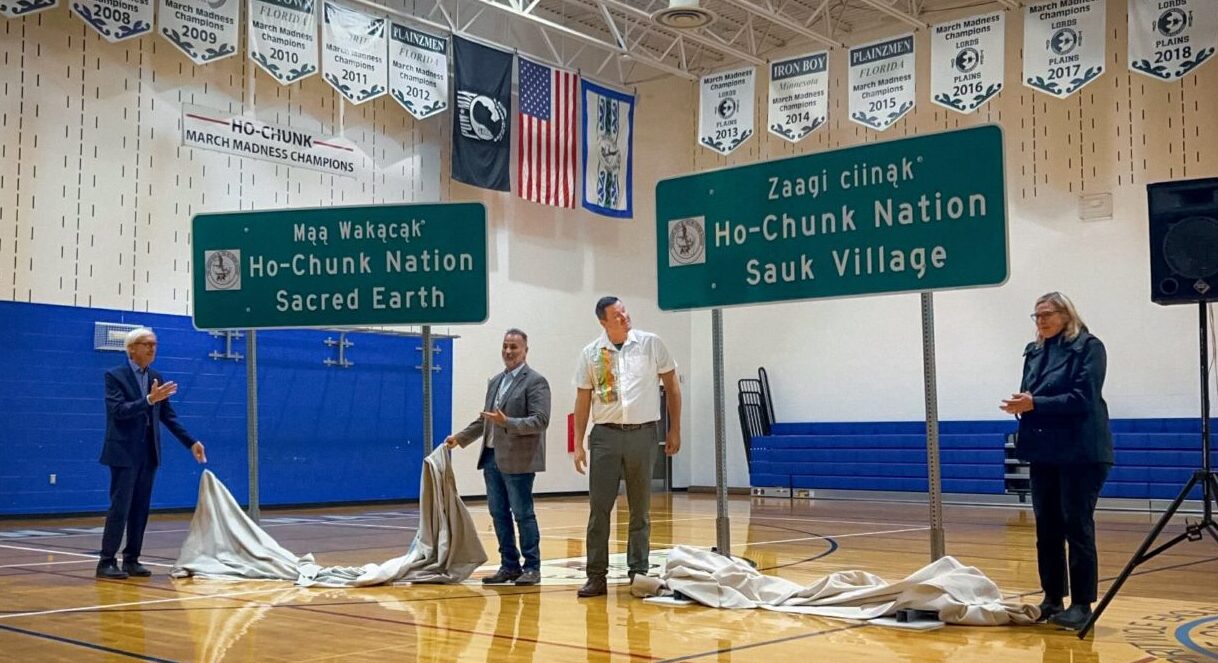
Gov. Tony Evers, together with Ho-Chunk Nation President Jon Greendeer and Wisconsin Department of Transportation (WisDOT) Secretary Kristina Boardman, celebrated the newest set of dual-language highway signs on Thursday, unveiled for placement on state highways as part of WisDOT’s Dual-Language Sign Program. The new signs identify Ho-Chunk Nation communities and the Mississippi River in both the Ho-Chunk and English languages.
“Today, we honor our ancestors and celebrate our enduring presence on this land. These dual-language signs are more than markers along the highway — they are a restoration of our Ho-Chunk identity, our language, and our responsibility to future generations,” said President Greendeer in a press release. “By placing our Ho-Chunk names back onto the landscape, we ensure that our story continues to be seen, spoken, and remembered throughout Wisconsin and along the Mississippi River. This is a proud moment for the Ho-Chunk Nation, and we look forward to sharing it with all of our communities.”
The sign unveiling took place at the Ho-Chunk House of Wellness in Baraboo and expands on a statewide dual-language sign initiative launched by WisDOT in 2021. Through WisDOT’s sign program, the department collaborates with Native Nations in Wisconsin to install road signs on Tribal lands in both English and Indigenous languages.
The Ho-Chunk Nation is the ninth Tribe in Wisconsin to install dual-language signs, according to a press release from the office of Gov. Evers, along with the Bad River Band of Lake Superior Chippewa, Forest County Potawatomi Community, Lac du Flambeau Band of Lake Superior Chippewa, Menominee Indian Tribe of Wisconsin, Oneida Nation, Red Cliff Band of Lake Superior Chippewa, St. Croix Chippewa Indians of Wisconsin, and the Sokaogon Chippewa Community, Mole Lake Band of Lake Superior Chippewa.
“Every dual-language sign we install is a shared decision, built through collaboration, consultation, and mutual respect,” said Gov. Evers. “Wisconsin is strongest when we recognize and respect the people and Nations who have shaped this land for generations, and these signs represent an important step in strengthening our government-to-government partnerships for decades to come while recognizing the incredible resilience and perseverance of Native nations to preserve their Indigenous languages, cultures, and homes.”