
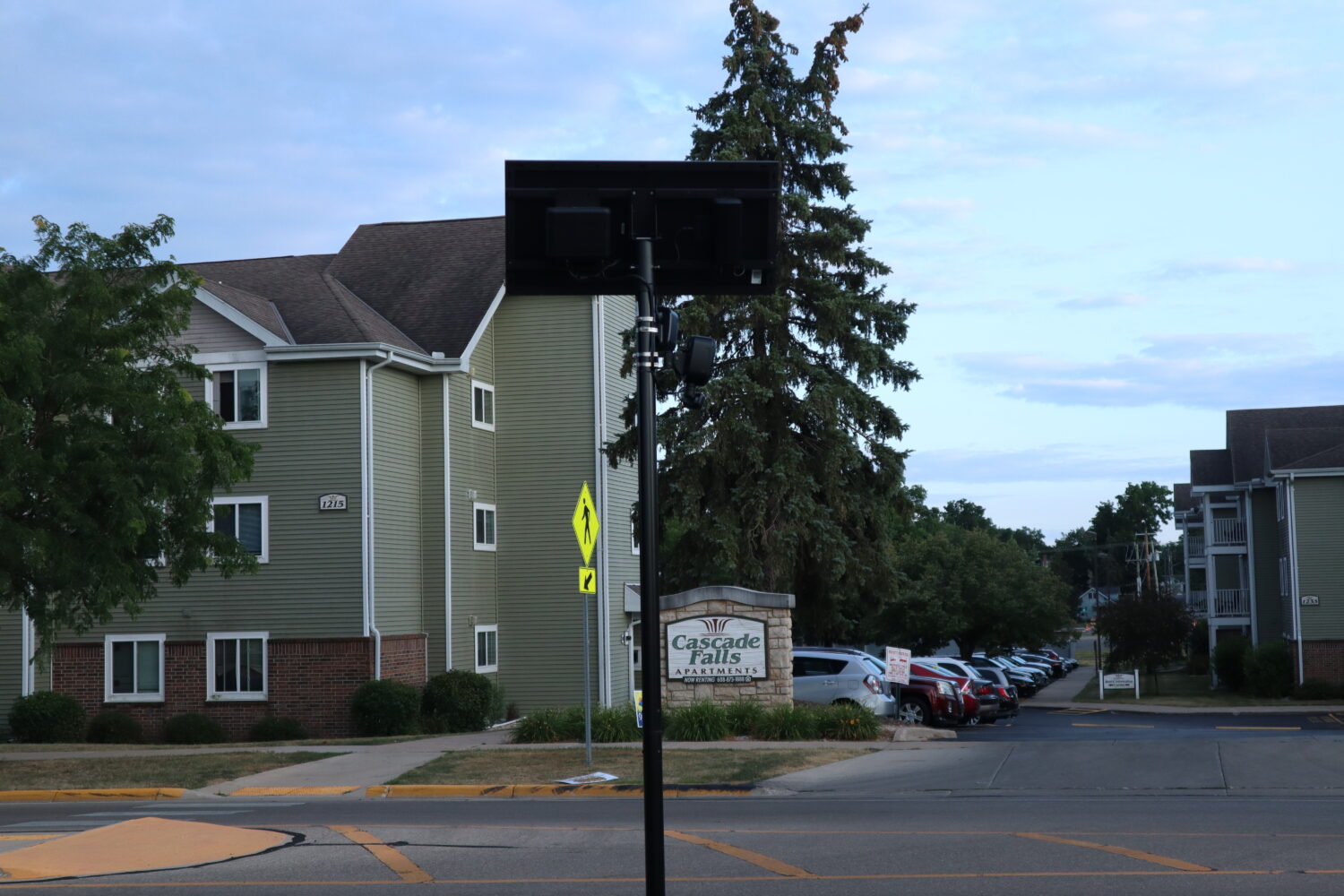
The City of Stoughton voted to terminate its contract with Flock July 28 after months of opposition to the surveillance cameras by the community.
Stoughton’s city council unamious decision comes after last week’s public safety meeting where it was recommended to vote on ending its contract with Flock. Residents have continuously voiced their concerns for Stoughton’s five Flock cameras — four automatic license plate readers (ALPR) and one live feed camera — with worries for privacy, attraction to the city and degradation of Stoughton’s police force becoming reliant on a private company. Stoughton’s contract was intended to span two years for a total cost of $25,000. With its contract terminated, it will still be required to pay the remaining half of the contract, in the amount of $12,500.
“I have been coming to these city council meetings … since literally two weeks after I moved to Stoughton this spring. I believe that how a government works, and how they spend their money, says a lot about the community,” said Brenda Carus, area resident and current citizen member of Stoughton’s finance committee. “There are things more important than sometimes money, and the people in this room are telling you and have been telling you that this is not a service that they want or need in this community.”
Key issues with the Flock contract have been the lack of community input behind the initial decision and where its one live feed camera is pointed.
The history behind the contract began in 2019 as a single line item in a capital improvement grant. The community was not able to get any input on the decision to form a contract with a surveillance company, which many have criticized over the past few months.
“I find it odd that we are in a situation right now where you guys are having to vote to decide whether to keep this going or not keep this going when it wasn’t voted for in the first place. The people didn’t decide this. You didn’t decide this, or well you approved it, but without much oversight from the community,” said Cy Davis.
For the one live feed camera, residents found it absurd that it is exclusively pointed at the area of Stoughton that has its highest concentration of people of color and right next to the high school. That camera is pointed directly at the Cascade Falls apartment complex, 1233 Jackson St., and records many children as they come and go to school.
One resident from Cascade Falls gave a comment on the positioning of the camera.
“I look at my neighbors and interact with my neighbors, my neighbors’ children. We have a sense of community, regardless of some people’s actions,” said Carla Hanson. “Are we being judged because of their income? Is this low-income housing? Why are you guys watching us?”
Hanson questioned if the cameras are truly effective to combat crime. She asked if the time recorded — nonstop 24/7 — has had any meaningful impact in reducing crime.
City council ultimately decided to terminate the contract after nearly an hour of public comment from residents. The resolution was passed, but stopped short of what the people advocated for. The City of Stoughton simply opted to end its contract with Flock, cease the use of its cameras through placing a bag over the five cameras and seek all data collected by the company to be deleted permanently.
Residents of Stoughton hoped for a more sweeping resolution to prevent ALRPs in the future without their direct input. The “People’s Resolution,” which was taken into advisory but not included in what was passed, noted the city’s “ethical and operational standards” in only doing business with “highly reputable companies” that reflect the city’s standards.
With the contract ended, Stoughton joins 55 other municipalities across the United States that have canceled their contract with Flock over concerns of the company’s ethics and data privacy. The People’s Resolution claimed that Flock “knowingly and frequently misleads customers and the public regarding its practices, privacy protections, data security, usage rights and relationships with other corporate and federal entities.”
In their version of the resolution, it pushed that the city would not replace the cameras with another similar technology because it would not “resolve the underlying concerns created by the continuous, suspicionless monitoring of the public.”
Additionally, it sets minimum conditions for if Stoughton wants to go into contract with another surveillance company.
Those conditions require the City of Stoughton to not seek another public monitoring system without a meaningful advance notice of at least 30 days to residents, independent information separate from the company and an opportunity to give input before it can acquire or deploy the tech. It does not allow the city or police department to replace the cameras and “does not invite replacement” until those conditions are met.
No city agency, department official or employee can enter any agreement, apply or receive a grant, start a pilot program, accept or borrow equipment, obtain access to an outside system or enter into a data sharing agreement with an ALRP or equivalent company without prior authorization from city council, the People’s Resolution stated.
Their resolution gave the city two weeks to comply with ending its Flock surveillance, but a previous resolution from the public safety commission said that contingent on the contract’s termination, bags will be placed over cameras the day after to immediately stop the cameras’ ability to record and take photos.
This story has been updated to clarify the difference between the mayor’s resolution that was adopted and a resolution proposed and preferred by community members.