
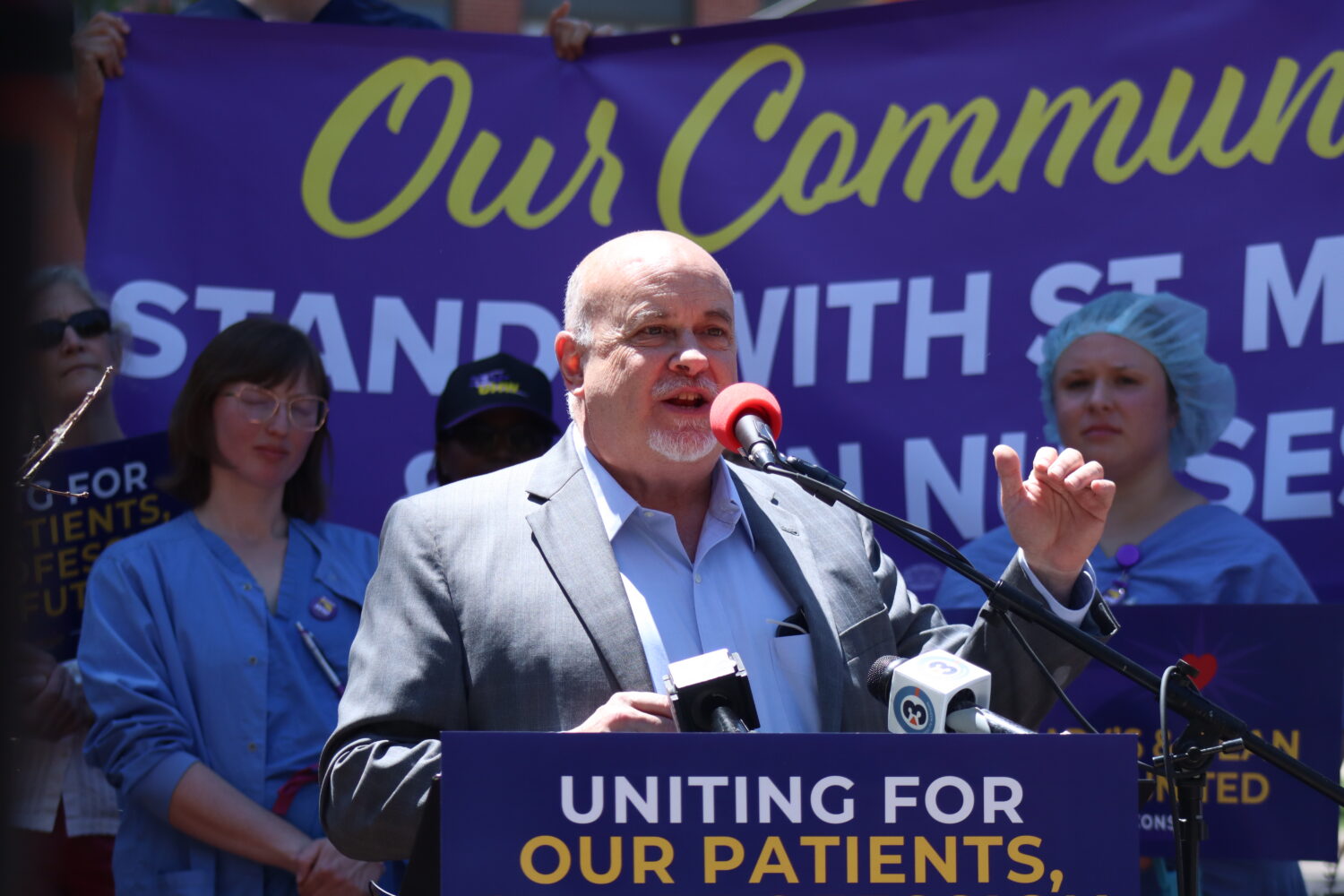
Nurses at St. Mary’s held a rally in front of the hospital as they called out St. Louis-based parent company SSM Health on its union-busting efforts on May 28.
Nurses have been working to unionize to address continuous issues that staff face at St. Mary’s. Issues include staffing shortages, poor retention of nurses, both new and experienced, lack of seniority from staff loss, increasing inability to fully care for patients, prioritization of billing over care, cut to incentive pay and mandatory overtime. The nurses intend to be represented by the Service Employees International Union (SEIU) Wisconsin, which also represents UW and Meriter staff.
“Ever since SSM acquired our hospital, policies have increasingly been handed down from the executive board room in St. Louis to us in Madison without any input from the people here on the ground,” said Emily Berceau, registered nurse at St. Mary’s. “That is unfair to our nurses, our patients and our community.”
Nurses have tried to raise concerns about policies that have impacted things like short staffing and high turnover. The response from SSM to nurses has frequently been, “We will escalate the issue,” Berceau said. Yet, no fixes come as issues “disappear into oblivion.”
Berceau drew attention to the hospital’s productivity grid that prioritizes billing over care to push profitability. As such, staffing has been based on that rather than on the necessary care to treat patients.
“The end result being that nurses are run ragged and have serious difficulty providing the level of care that our patients need and deserve,” Berceau said.

(Photo by Omar Waheed)
Other issues highlighted included the high turnover and burnout. The pool of veteran nurses continues to dwindle as pay incentives for longevity are no longer offered. Young nurses early in their career or with St. Mary’s as their first job are pushed into situations that they are not adequately prepared for as a result.
Many new nurses are burned out after only a few years and leave the hospital or the profession altogether due to the experience at St. Mary’s.
Nurses like Jeff Ness have been at St. Mary’s for 25 years — long before SSM acquired the hospital in 2013. It didn’t used to be like this.
Ness recalled when there was shared governance before St. Mary’s acquisition. He knew the president and chief nursing officer personally and would often talk to them. That’s not the case anymore.
Treatment is different. Recently, SSM threatened to send home Ness for wearing a button that said “St. Mary’s United.”
“I was marched down to HR and told that I had to take off my badge or be sent home,” Ness said. “That is not a way some should treat someone in our professions.”
Treatment like that, among the other myriad of issues, sends a clear sign to Ness from SSM: they do not appreciate nurses’ experience, he said.
“I’m going to retire at some point, but I want to leave St. Mary’s a better place for those who come after me, and someday, I or a loved one will need hospital care,” Ness said. “I want to make sure that they have the best possible care throughout this region.”
Congressman Mark Pocan joined the rally to voice his support. As the co-chair of the Labor Caucus, Pocan has seen what happens when companies work cooperatively with their employees and its unions, and those who don’t.
He notes that companies, and their employees, do better. For St. Mary’s, that means better care for patients.
Pocan also called out some of SSM’s union-busting tactics and likened it to the behavior of some of the worst perpetrators of union-busting.
“If a little purple button is scaring you that much, maybe you need to check into St. Mary’s and get that looked at,” Pocan said. “To do things like not allow people to wear buttons, tearing up literature, taking them from their work and making them have to talk to management are all tactics that I’ve seen from some of the worst companies in the country, and I don’t want to believe that St. Mary’s is one of those companies.”
From a legislative perspective to combat union busting, Pocan said that better funding the National Labor Review Board (NLRB) will help and the passing of the Protecting the Right to Organize (PRO) Act.
The act was passed in the House in both 2020 and 2021, but not the Senate. It would expand rights for employees to collectively bargain and organize and end “Right-to-Work” laws.
A vote for unionization is expected in the coming weeks, pending approval from the NLRB. St. Mary’s nurses expected it to pass as it has an estimated 73% of support from staff.