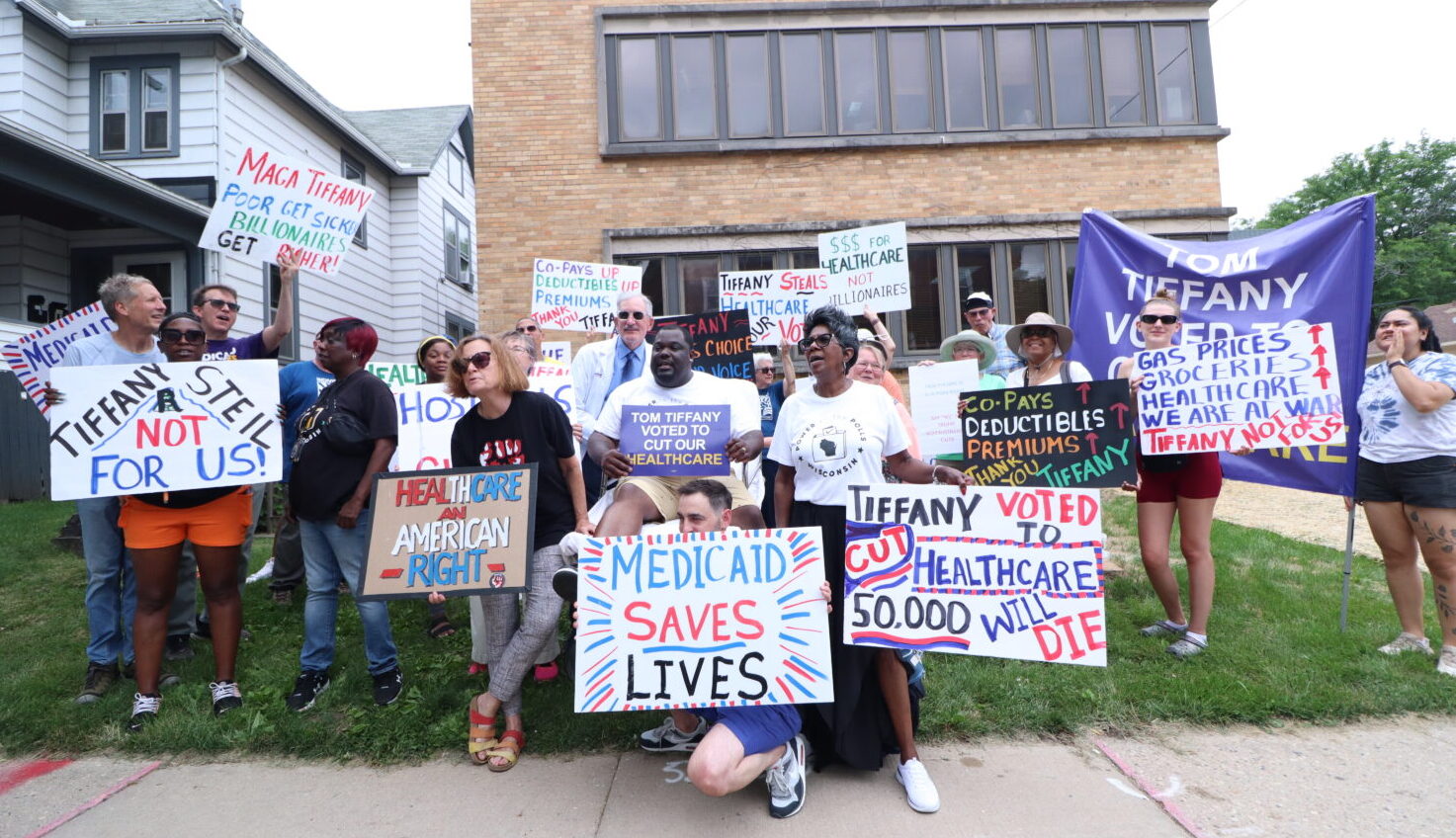
A state-wide tour in protest of gutting health care came to a close in Madison in front of the Wisconsin GOP headquarters as it drew attention to the effects of the “Big, Beautiful Bill” near its first anniversary.
On June 30, doctors and community leaders from around the state protested in front of GOP headquarters, 148 E. Johnson St., to end its tour. Seven other cities — Milwaukee, Racine, La Crosse, Eau Claire, Chippewa Falls, Wausau and Green Bay — were previously visited to call out elected officials who voted to gut health care. The tour featured a decommissioned ambulance that was posted near each of its stops.
“I’m the wife, soulmate and caregiver for my husband who’s been paralyzed for 37 years. He’s a Vietnam veteran,” said LuAnn Bird, activist and founder of political organizing group Birds on a Wire. “We get all of our care from the VA, but what really hurts are the caregivers that come in and help us; they don’t get that same benefit as we do. They end up on Medicaid.”
The “Big, Beautiful Bill” cut federal spending for Medicaid by nearly $1 trillion over 10 years. The provisions in the bill are expected to leave 10 million uninsured by 2034, according to the Congressional Budget Office.

(Photo by Omar Waheed.)
Protesters pointed to the very real circumstances of one Wisconsinite named Mark Steigerwald, who is battling colon cancer. Steigerwald intended to be at the protests, but his current condition made it difficult for him to attend.
Steigarwald’s insurance deductible was formerly $9,000. Following cuts, the amount has now jumped to $30,000 for him and his wife.
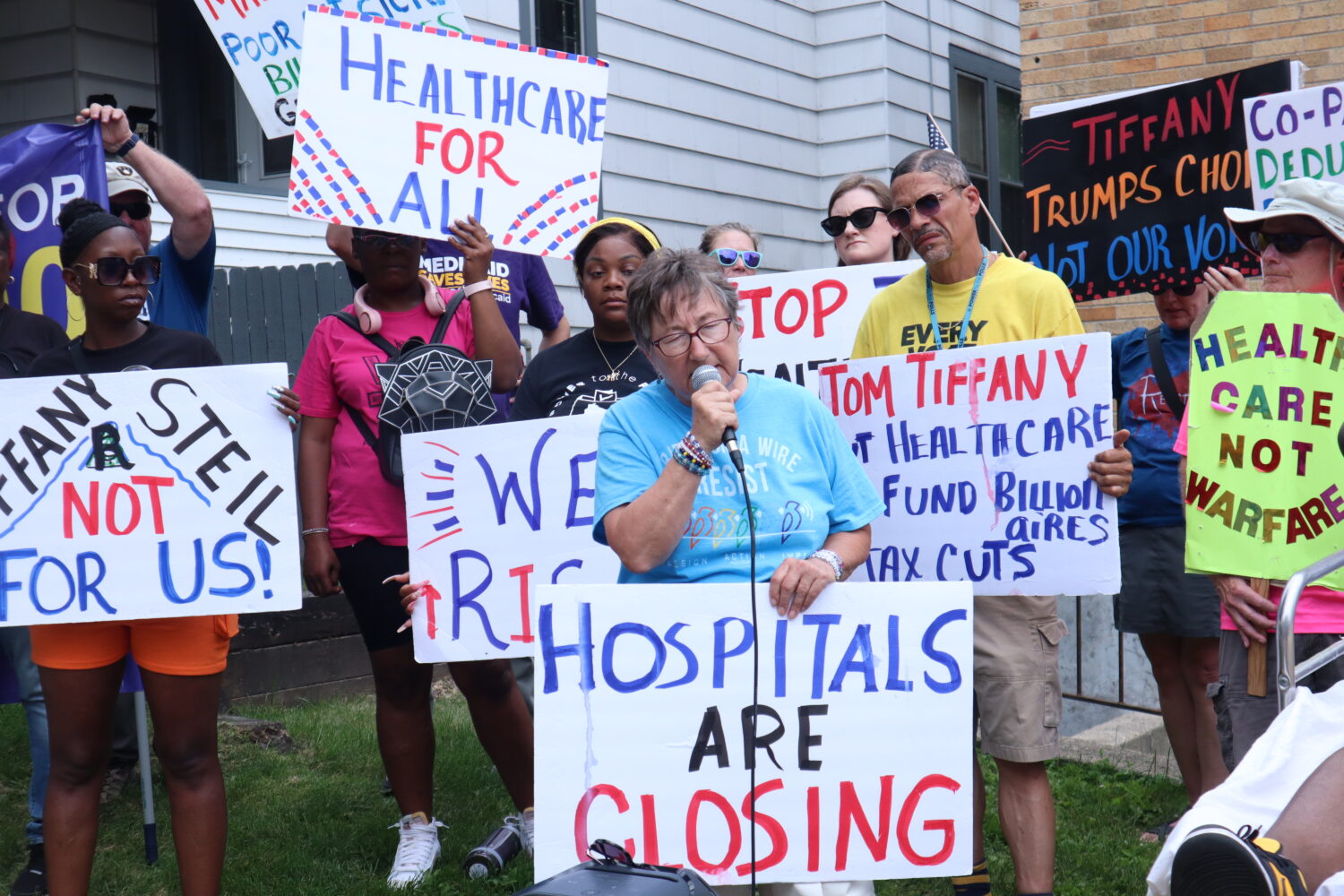
“You’ll hear our opponents say there are no cuts there, but what I say is when a hospital closes, that’s a cut. When two hospitals close, that’s cuts,” said Cyndi Greening, a member of Chippewa Falls Indivisible. “For people like Mark… it’s increasing their insurance costs double and triple. That’s a cut in their income. That’s a cut in their livelihood.”
Greening also drew attention to the status of rural health care options. In her area of Chippewa Falls, two hospitals have recently been closed. The loss of rural hospitals can be detrimental to those who need access to care.
Greening has faced shortfalls that come with hospital closures. The lack of immediate access to care forced her to be transported three hours away when she needed medical attention.
(Photo by Omar Waheed.)
“They told me they needed to get me into some places immediately, and there was nothing in Eau Claire at Mayo Hospital,” Greening said. “There was nothing there, and they didn’t know when I could get something, so they threw me in an ambulance and drove me three hours south to La Crosse.”
Circumstances are expected to get worse as another five hospitals in Wisconsin are at risk of closing, according to a study by Public Citizen.
While there have been some efforts proposed by gubernatorial candidates to better protect rural hospitals, Greening said it’s not remotely enough to ensure that at-risk hospitals will remain open.
In a recent gubernatorial forum hosted by Service Employees International Union (SEIU) Wisconsin, current Lt. Gov. Sara Rodriguez stated she would create a rural health stabilization fund to combat the closure of rural hospitals. She has not said how much would be allotted for this in her campaign yet.
The state has received $200 million from the federal Rural Health Transformation program. There is currently $40 million planned for grant funding in its initial period — but no portion of that money is specifically directed toward keeping rural hospitals open. Current funds are geared towards community health workers and dental efficiency in rural Wisconsin.
Wisconsin’s rural hospitals are projected to take a $10.5 billion loss in service reduction through 2034 from the “Big, Beautiful Bill,” according to the National Rural Health Association.
If all $200 million were to be directed towards keeping rural hospitals alive, there would still be a 98% loss.
“Who cares? They’re making a big deal of the $40 million they got us, and then they’re talking about getting us another $50 million,” Greening said. “Who cares when they’re talking rural health fund? They’re giving us peanuts.”