
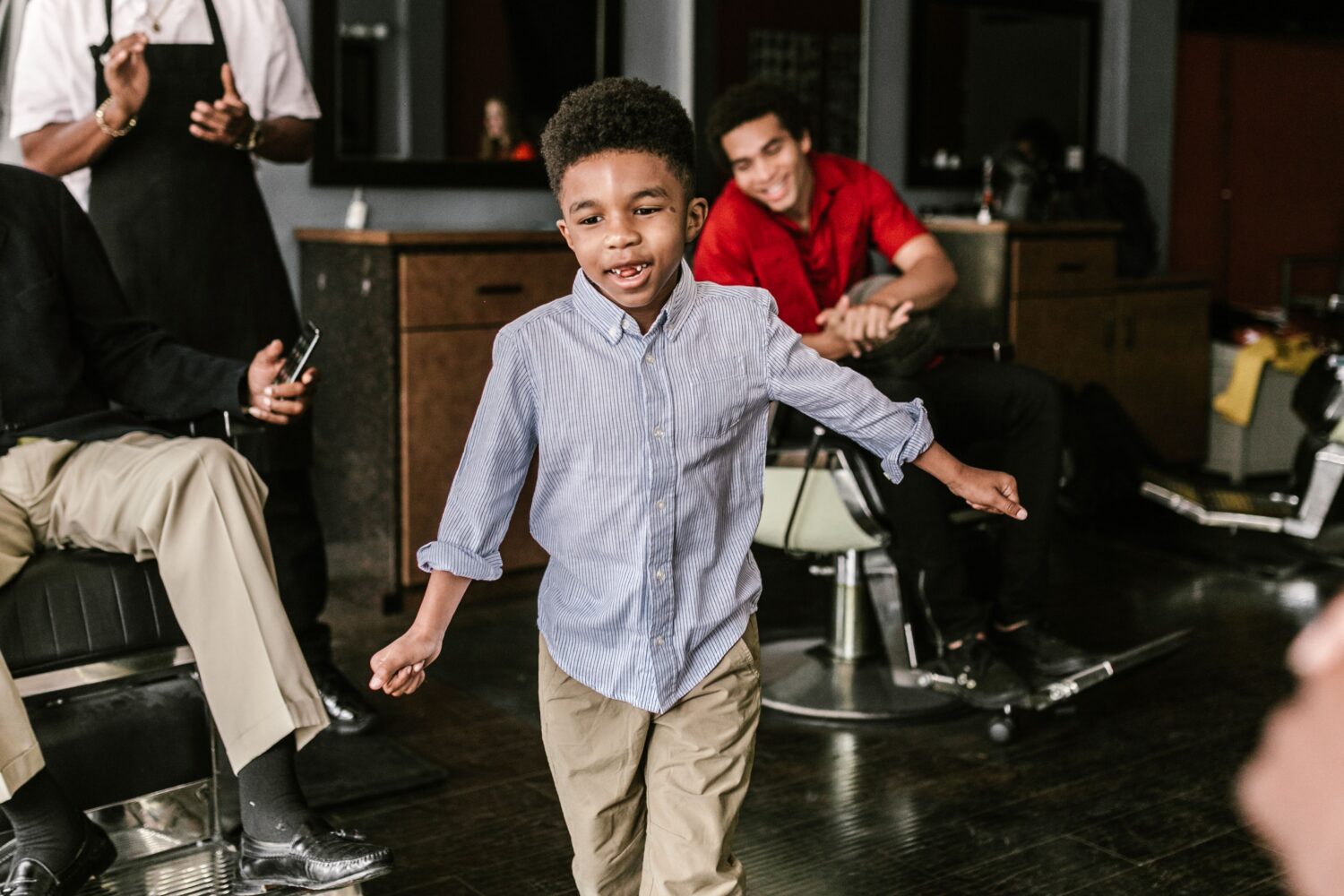
I was sitting in a neighborhood barbershop a few days ago when a young mother walked up to the door with three boys.
Two of them came inside. The youngest stayed outside with his mom. One of the barbers looked up and said, “He doesn’t have to stay out there. Bring him in.”
She smiled and stepped inside. Less than a minute later, the little boy began to cry. Not the kind of crying you can ignore. The kind that fills a room.
His mother tried to comfort him, but he only became more upset. Thinking she was disturbing everyone, she decided to take him back outside.
The little boy did not want to leave. She gently took the toy from his hands and began leading him toward the door while he cried even harder.
Then something happened that I will probably remember for a long time. Nobody complained. Nobody rolled their eyes. Nobody reached for their phone.
The barber walked outside, picked the little boy up, and carried him back into the shop. “It’s okay,” he told him. “You’re alright.”
Another customer smiled, rubbed the boy’s head, and started talking with him. A third joined the conversation. Within moments, the crying stopped. The little boy relaxed.
His mother stood in the doorway watching. You could almost see the weight come off her shoulders. She smiled. Not only because her son had stopped crying, but because she realized she was not carrying the moment alone.
Watching all of that reminded me of something we have almost forgotten. Communities are not built when everyone minds their own business. They are built when people decide someone else’s burden matters too.
We often hear people say, “It takes a village.” Maybe it does. But villages do not appear by accident. They are built one decision at a time. One conversation. One act of kindness. One stranger deciding to care.
We spend a lot of time worrying about the next generation. We wonder why young people struggle with anxiety, loneliness, belonging, or respect.
Those are important conversations. But perhaps we should ask ourselves another question. What kind of adults are today’s children surrounded by?
Because children are constantly watching us. They notice whether compassion is something we talk about or something we practice. They learn whether people move toward one another in hard moments or quietly look away. They learn whether community still exists, or whether everyone is expected to figure life out alone.
That lesson isn’t taught only in classrooms. It’s learned in barbershops, restaurants, churches, ballparks, neighborhoods, and living rooms.
The same principle applies long after childhood. Healthy organizations are filled with people who notice when a coworker is overwhelmed. Strong families recognize when someone needs a hand instead of pretending everything is fine. Good leaders understand they do not lose influence by accepting help. They gain it.
Somewhere along the way, we started believing strength means handling everything ourselves. Real strength is creating the kind of community where people know they do not have to.
The young mother walked into the barbershop that day carrying more than three boys. She was carrying responsibility. For a few minutes, a room full of strangers helped carry a little of it with her.
Maybe that is what a village really is. Not a place, but a decision. The decision to care about someone else’s child as if they mattered. Because they do.
Every healthy community begins the moment someone decides another person’s burden matters too.