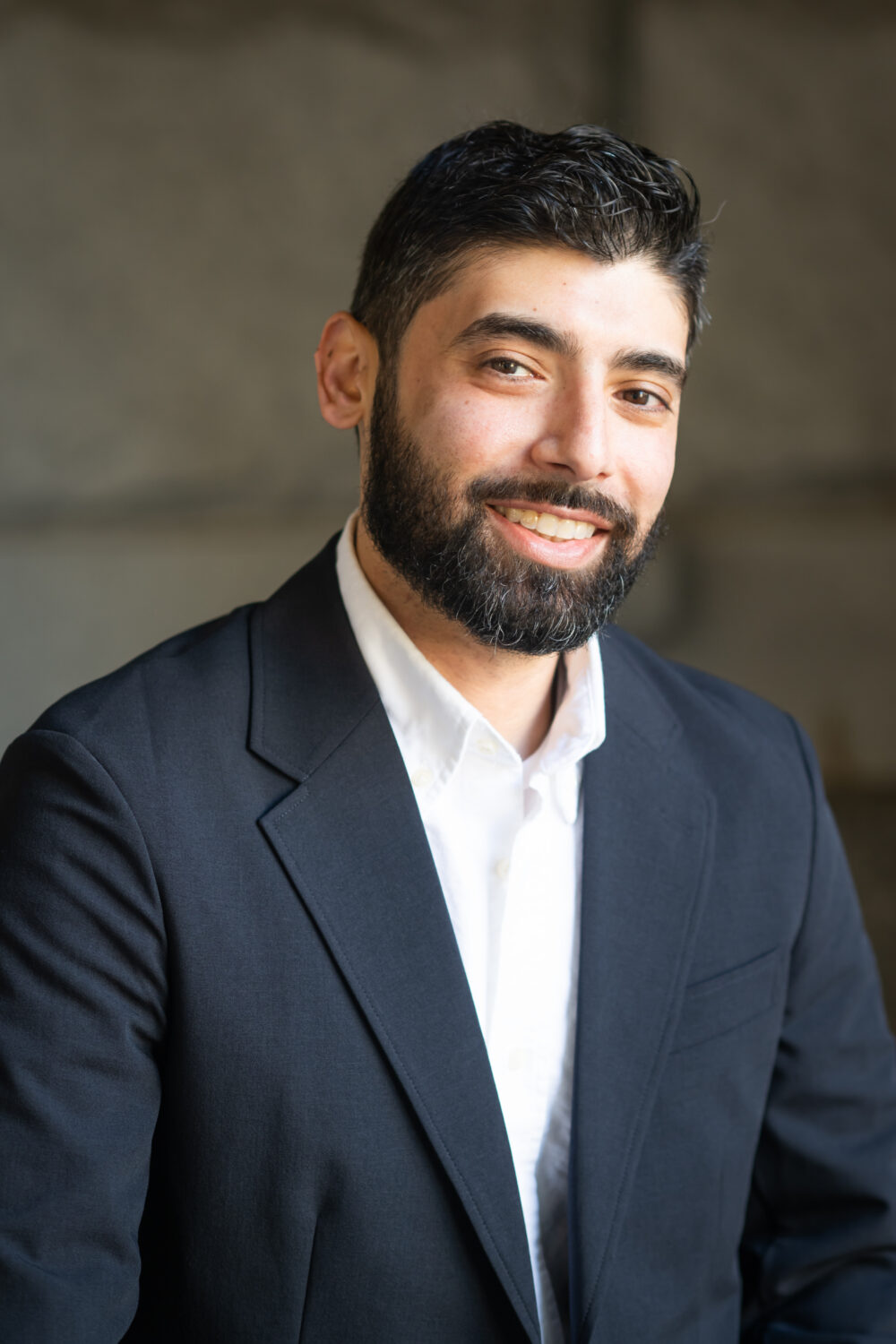
Monis Khan wears two hats. At least.
By day, he’s the editor-in-chief of Bucks+, the Milwaukee Bucks’ podcast network. By night he’s an Ozaukee County Board Supervisor, one of the newest and most unexpected voices in local Wisconsin politics. Somewhere in between, he’s a husband, a new father, and a proud member of Milwaukee’s Muslim community. For Khan, all of it is connected, even when it doesn’t look that way from the outside.
“Even some of my hats have hats on top of those hats,” he said with a laugh.
Khan produces and oversees all of Bucks+ programming, a portfolio that spans audio, social media and YouTube. Launched in February 2024 in partnership with Good Karma Brands, Bucks+ was the first network of its kind in professional sports: a full slate of shows built to deepen the connection between the Bucks and their fans. The network includes Here District, hosted by Bucks legend Marcus Johnson, which gives fans a game-by-game, insider’s look at the team, and Behind the Bucks, a documentary-style series that digs into team history through the people who lived it. Khan also hosts his own weekly show on WTMJ, called Bucks Speed, during the season.
He started as Bucks+’s first editor-in-chief in April 2024, two months after the network launched. Khan grew up in Germantown, moved away for a decade to build his career in Washington, D.C., and had only recently found his way back to Wisconsin when the opportunity opened up.
“I have loved the Bucks through thick and thin my whole entire life,” Khan said. He was born in California and moved to Wisconsin at age 5, and he says the team has shaped his identity as a sports fan ever since.
That identity runs deeper than wins and losses. Before Bucks+, Khan spent four years at ESPN helping launch The Undefeated, the network’s vertical exploring the intersection of race, culture and sports, during the years surrounding Colin Kaepernick’s protests and the “shut up and dribble” era. He was in Racine in the fall of 2019 when Bucks players, coaches and front office staff visited a prison to meet with incarcerated people.
“It just kind of shows how forward the Bucks have been, even before these issues were so mainstream, so headline-driven,” Khan said. “They’ve been doing the work and trying to make the change in the community.”
Khan also pointed to a Behind the Bucks series he worked on called Bucks vs. the World, about the 1987 exhibition game in which Milwaukee became the first NBA team to play the Soviet Union’s national team, a game he says helped set the stage for the Dream Team and the globalization of basketball. It’s the kind of story, he said, that reflects a franchise with a long history of leaning into moments bigger than basketball.
A few extraordinarily happenstance things
Khan’s path into journalism was, by his own telling, anything but planned. He grew up reading Time magazine because his parents subscribed to it, but it wasn’t until college, at Washington University in St. Louis, that news became something closer to a calling. The Arab Spring was unfolding in real time, and as a Muslim American whose family is from Pakistan, Khan found himself locked in on the coverage — and specifically on Al Jazeera, which he felt was capturing the uprisings in a way no other network was. He remembers watching the live feeds and, almost as a joke to himself, pulling up Al Jazeera’s job listings and thinking, “Whoa, what if I worked there?” It seemed impossible. He had no journalism background, no experience, nothing that looked like a path in.
Then a string of coincidences intervened. Khan had met a guy in college sitting on a couch watching the Brewers in the playoffs, and it turned out the guy was from Milwaukee. The summer after graduation, Khan ran into him again, this time at Bayshore mall back home, and learned he was about to leave for an internship at Al Jazeera. Around the same time, Khan discovered that a WashU classmate he didn’t even know well was Al Jazeera’s internship coordinator, who told him to stay in touch. Khan, meanwhile, had taken a public policy fellowship, and that fellowship came with an unusual perk: the chance to write an op-ed for the Washington Post. He submitted it and then waited six weeks, hearing nothing, assuming it would never run.
It did run — and two days after it was published, without Khan realizing anyone had noticed, he landed an interview to intern for The Stream, an Al Jazeera talk show. The interview went well. Khan talked about the political dynamics he understood intimately as someone with family touched by terrorism abroad: the dominant American narrative, that terrorism happens because “Muslims hate America” or “Muslims hate freedom,” gets it backwards, he said, because the people dying in bombings in cities like Islamabad are overwhelmingly Muslim themselves. He talked about traveling to Pakistan to work with communities that had gone without resources for generations. The conversation was going well, he said, until the interviewer asked the one question that actually mattered: Have you ever done journalism?
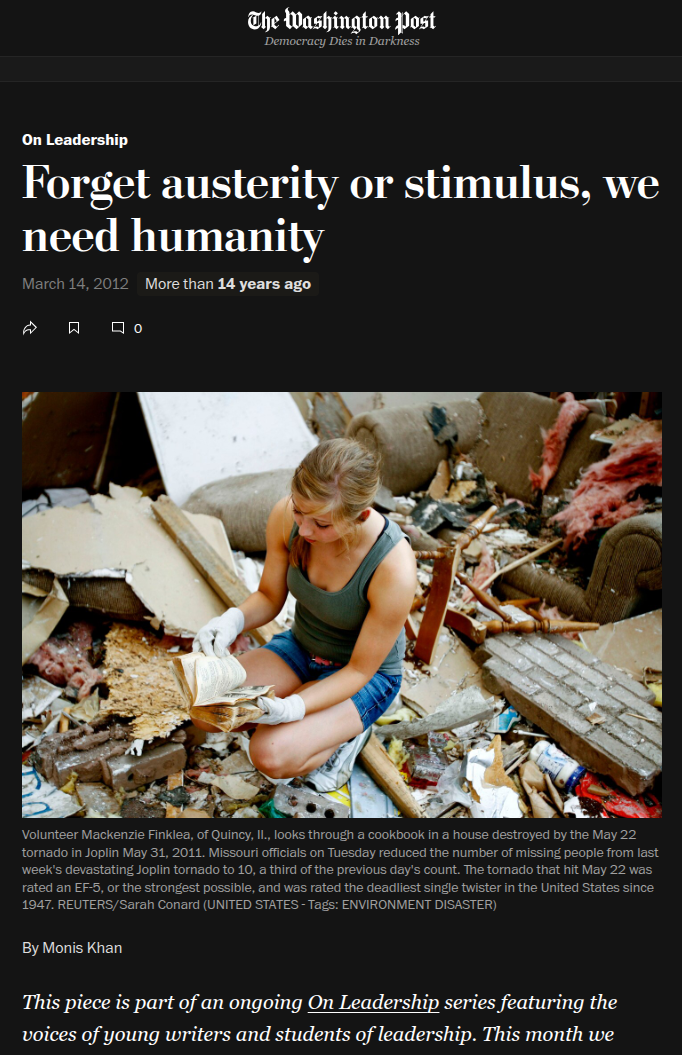
Khan said no — and then it hit him. Two days earlier, the Washington Post had published his op-ed, headlined “Forget austerity or stimulus, we need humanity.“
Written in 2012, the piece wrestled with John McCain’s presidential campaign trail, David Foster Wallace’s famous essay chronicling it, and the idea that authenticity and relatability — caring visibly about what people are going through — was the kind of politics that would ultimately break through. It was enough. He got the internship, and with it, a career.
“The timing of a few extraordinarily happenstance things and being in the right place at the right time launched my career that I’m still enjoying,” Khan said. “I would just encourage [young people]: continue not only believing in yourself, but doing the things that you want to do in your future.”
Khan is candid about the harder realities of building a career in sports media, too. It’s a sector, he says, that runs on a deep well of people willing to work for less than they’re worth. His advice to the next generation is to create value for its own sake, love the work for the work’s sake, and stay adaptable, because the industry itself is anything but stable.
“I’m only here to serve.”
It was a family moment, not a career plan, that pulled Khan into politics.
Two days after his son was born last year, Khan gave an off-the-cuff, emotional speech about brotherhood at his own brother’s wedding. The executive director of the Wisconsin Muslim Civic Alliance happened to be there, and asked him on the spot to help launch a Muslim caucus within the Democratic Party of Wisconsin. From there, things moved quickly: a neighbor and fellow Pakistani American, Dr. Ariba Khan (no relation), decided not to run for re-election for her seat on the Ozaukee County Board and encouraged him to run in her place. He was on the ballot by January 2026 and has served on the board since April.
Khan has been outspoken about issues affecting Milwaukee’s Muslim community, including the detention by ICE of the president of the Islamic Society of Milwaukee, a community institution where Khan says he has been involved since childhood. He’s watched national politics grow more volatile and more polarized even as, in his experience, county government has stayed refreshingly grounded and free of the polarization that characterizes so much of the discourse today.
“I am the only person of color out of the 26 people” on the county board, Khan said, “but dude, it’s almost impossible for me personally to decipher where people stand on the political spectrum. The way people are stewards of our county resources, and so committed, each and every one of them, to making life better for all of us — it totally turns my perception of politics in America upside down. This is what teamwork looks like. This is what neighbors working together looks like.”
He sees that local, practical common ground as inseparable from the bigger national fights he cares about — even if the connection isn’t obvious at first glance.
“It all actually starts at the local level,” he said. “I’m learning how we can make a material difference, even in a conservative county, for the people in our community… I don’t think these partisan media apparatuses want us to understand that.”
Khan is careful about how visible he is with his two worlds. He said he’s never put his county board seat or his role with the Muslim caucus on LinkedIn, in part out of concern about how those roles might be received in his professional circle. But when asked directly, he says, he won’t hold back.
“I only keep it real about everything,” Khan said. “When you ask me, I’m gonna tell you the truth.”
As for what’s next politically, Khan says he’s not thinking that far ahead. For now, his focus is on the job in front of him — both on the podcast side and the public service side — and on being present for a community, and a young family, that he says have already given him more than he expected.
“I’m only here to serve,” Khan said. “I’m only here to do what is in front of me to make my community better, to stand up for my community and to be an example for others on what is possible.”