
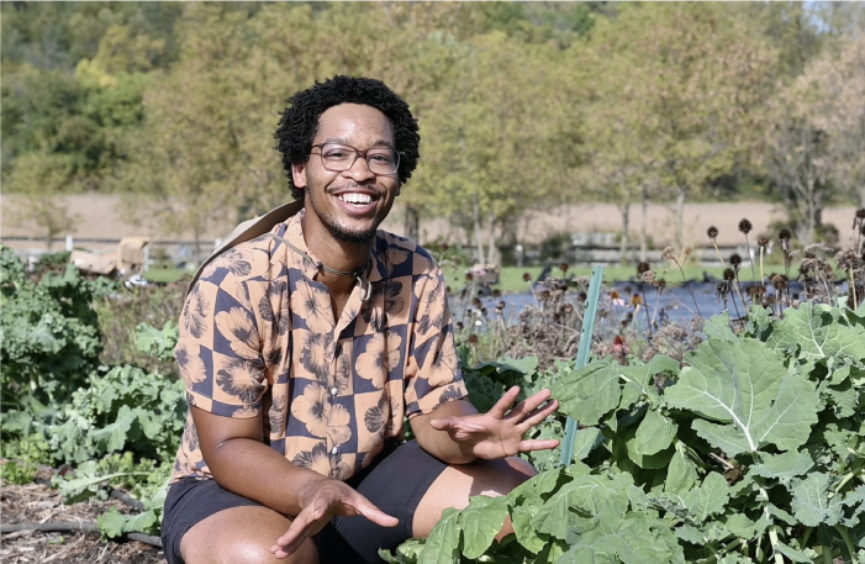
Alex Booker grew up in the dirt. He was first introduced to growing his own food during a gardening class at a pilot program at East Madison Community Center. His mom, realizing how much he loved it, started a garden at their house.
His love and care of agriculture has only grown. Now he works with Rev. Chacon and Andrea Richardson of Firm Footing Farms, located in Black Earth, which over the past decade has developed a space for BIPOC and queer people to have access to land for various projects.
Tuesday evening, at Olbrich Gardens summer series ‘Olbrich After Hours’ event, Firm Footing Farms will host the second Collard Fest from 6 to 9 pm. Food trucks serve dishes inspired by collard greens at the event. Music performances by Black Star Drum Line and Obi Original and the Black Atlantics will take place from 6:45-8:30 p.m.
Collard Fest started as a way for Firm Footing Farms to celebrate and share the importance of collard greens in the community, Booker said. Firm Footing Farms has been working on a project growing heirloom collards that can overwinter in Wisconsin, working to make collard growing more accessible.
“I’m really excited to touch base again with people, see if this has encouraged them to grow,” Booker said. “I am just excited to celebrate a plant that is used across the African diaspora. I’ve learned from different Brazilian people that I’m close to and Mexican people that I’m close to how they use collards in their community as well, and it’s something that bridges all of us together.”
Agriculture and growing brought him closer to his own family and culture, Booker said. In college, he started growing his own collard greens because he and his mom could not find good collards in Wisconsin. His family are farmers in Mississippi, so their connection to growing was different; “It’s not agriculture. It was dinner,” he said.
Booker sees growing and harvesting as something for Black people to be proud of, something for Black people to reclaim.
“It is nothing for us to be ashamed about what we went through as a people,” Booker said. “I would talk to other people about gardening and farming, they’re like, ‘I’m not about to go out there slaving.’ I’m like, ‘What are you talking about? That’s why we had to incorporate some education in there too. Of course, we’ve been doing this before and after that. You can’t let someone else’s negative impact onto our community shape the way we view the land itself because the land did not do it to us.”
With Firm Footing Farms, Booker not only grows food but grows knowledge and spaces for Black people. Finding outdoor spaces that are welcoming and safe for Black people can be very difficult, but it is important to take a leap, try it out and even create your own, Booker said.
Firm Footing Farms can serve as a sanctuary for Black people, allowing them to unplug, Booker said. As it is outside Madison, being at the farm gets people out of the city, off their phones and present, said Booker.
Recently, Madison’s Chapter of Jack and Jill of America brought 30 Black families to Firm Footing Farms, Booker said. There was no Wi-Fi, so it took the older kids a bit to adjust, he said.
“It took them like 10 minutes to adjust, and now they’re playing with the younger kids, playing with my dog, and just being present. It’s really cool to have it out there [in Black Earth] because you get to just be in the sun, be in the fresh air, be present. The flowers, just all of those things that we rush past in our day-to-day because we have to do so much.”
Seeing food as medicine, Booker teaches classes on how to use different herbs in teas and dishes to give more preventive medicinal effects. He boils down his expertise so it is understood by people with no prior knowledge of gardening and agriculture–even working with students at Badger Rock Middle School for farm education class.
“I believe it was Toni Morrison that said that racism is a distraction. It is meant to keep us distracted from reaching our full potential. And so, yes, it is hard, it is difficult, and it’s annoying. And I won’t allow those things to keep me from knowledge that I want to bring back to my community,” said Booker.
Many organizations and farms across Wisconsin and the county work to create spaces for Black people. Troy Farms, part of Rooted, a Wisconsin-based non-profit, grows produce for low-income communities on the Northside. Color in the Outdoors holds events and educates. The Black Urban Growers and Farmers Conference connects hundreds of Black farmers across the county to teach and share knowledge.
“Now, every time they won’t look like you, but they, for the most part, have the best intentions. And then once you get in there, you can find people that look like you,” said Booker.
Booker invites everyone to start small and grow something you will eat. Not only will you have grown something you can eat, but you will also have grown joy.